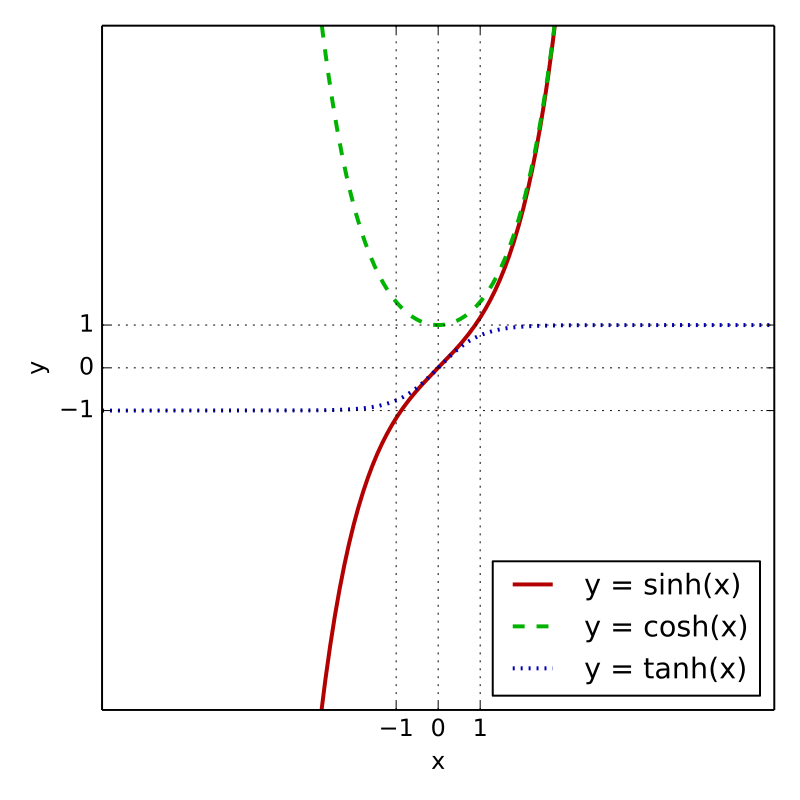
File:Sinh_cosh_tanh.svg · Wikimedia Commons · See Wikimedia Commons
hyperbolic function
Sign in to savemathematical function related with trigonometric functions
Hyperbolic functions are mathematical tools that work similarly to the trigonometric functions you might know from geometry, but they apply to hyperbolas instead of circles. They're useful in engineering and physics for describing things like the shape of hanging cables and the behavior of certain physical systems.
AI-generated from the Wikipedia summary — may contain errors.
Described at
6.4 Hyperbolic functions | Functions | Siyavula
Siyavula's open Mathematics Grade 10 textbook, chapter 6 on Functions covering 6.4 Hyperbolic functions
siyavula.com →We use this information to present the correct curriculum and to personalise content to better meet the needs of our users. Functions of the general form (y= dfrac{a}{x}+q ) are called hyperbolic functions.
Excerpt from a page describing this subject · 24,393 chars · not written by Vinony
Wikidata facts
- Image
- Mplwp hyperbolic functions.svg
Show 3 more facts
- Stack Exchange tag
- math.stackexchange.com/tags/hyperbolic-functions
- Commons category
- Hyperbolic functions
via Wikidata · CC0
~28 min read
Article
In mathematics, hyperbolic functions are analogues of the ordinary trigonometric functions, but defined using the hyperbola rather than the circle. Just as the points (cos t, sin t) form a circle with a unit radius, the points (cosh t, sinh t) form the right half of the unit hyperbola. Also, similarly to how the derivatives of sin(t) and cos(t) are cos(t) and –sin(t) respectively, the derivatives of sinh(t) and cosh(t) are cosh(t) and sinh(t) respectively.
Hyperbolic functions are used to express the angle of parallelism in hyperbolic geometry. They are used to express Lorentz boosts as hyperbolic rotations in special relativity. They also occur in the solutions of many linear differential equations (such as the equation defining a catenary), cubic equations, and Laplace's equation in Cartesian coordinates. Laplace's equations are important in many areas of physics, including electromagnetic theory, heat transfer, and fluid dynamics.
Gallery (12)
Available in 61 languages
- Español
- Français
- Deutsch
- 中文
- 日本語
- Русский
- Português
- Italiano
- العربية
- हिन्दी
- Albanian
- Armenian
- Asturian
- Azerbaijani
- Bahasa Indonesia
- Bashkir
- Basque
- Bosnian
Show 42 more
- Bulgarian
- Catalan
- Chuvash
- Croatian
- Czech
- Danish
- Esperanto
- Filipino
- Finnish
- Galician
- Greek
- Hebrew
- Hungarian
- Icelandic
- Irish
- Khmer
- Latin
- Latvian
- Macedonian
- Malay
- Nederlands
- Norwegian
- Norwegian Nynorsk
- Polski
- Romanian
- Serbian
- Serbian (Latin)
- simple
- Sinhala
- Slovak
- Slovenian
- Svenska
- Tamil
- Tiếng Việt
- Türkçe
- Ukrainian
- Uzbek
- Wu Chinese
- zh_min_nan
- zh_yue
- فارسی
- 한국어
via Wikidata sitelinks · CC0