Schmidt, C. A.;Shattuck, S. O.
Hypoponera
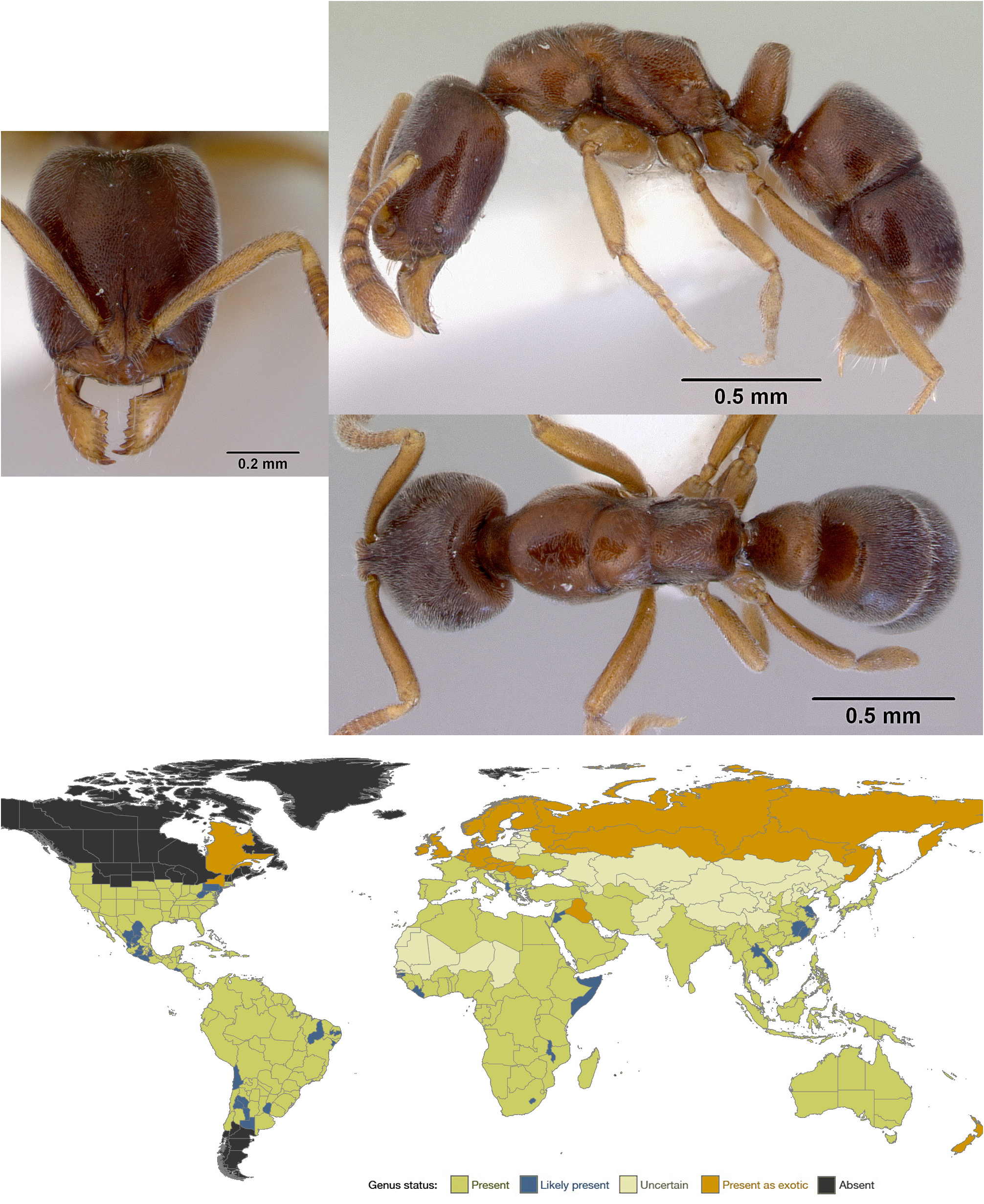
Sign in to saveHypoponera is a genus of ants in the subfamily Ponerinae. The genus has a worldwide distribution and is found in all continents except Antarctica, as well as lacking a presence in taiga or tundra biomes, New Zealand and central Asia.
Species
GENUS
- KingdomAnimalia
- PhylumArthropoda
- ClassInsecta
- OrderHymenoptera
- FamilyFormicidae
This is a cosmopolitan genus of small predacious ants, nesting in soil and rotten wood. Four species are known from California, of which one ( Hypoponera sp. CA-01) is apparently undescribed and not included in the keys cited below. It is similar to Hypoponera opacior (Forel) from which it can be distinguished by the orange-brown body color (usually dark brown in California H. opacior ), narrower head (CI 0.77-0.83, as opposed to 0.83-0.87 in H. opacior ), and conspicuous standing pilosity on the venter of the head (such pilosity sparse in California populations of H. opacior ). Species identification: keys in Creighton (1950a), Wheeler and Wheeler (1986g) and Mackay and Mackay (2002). Additional references: Delabie and Blard (2002), Duffield et al. (1976), Foitzik et al. (2002), Taylor (1967a).
via GBIF
Museum specimens
- Specimen records
- 1,722
- With media
- 137
- Family
- Formicidae
- Collections
- UQROO, INECOL
- Recorded in
- Mexico
Wikidata facts
Show 5 more facts
- taxon rank
- genus
- taxon name
- Hypoponera
- Commons category
- Hypoponera
- topic's main category
- Category:Hypoponera
- taxon common name
- klatežka
Sources (1)
via Wikidata · CC0
~7 min read
Encyclopedic overview
4 sectionsContents
- Description
- Species
- References
- External links
Hypoponera is a genus of ants in the subfamily Ponerinae. The genus has a worldwide distribution and is found in all continents except Antarctica, as well as lacking a presence in taiga or tundra biomes, New Zealand and central Asia.
== Description == The genus has stout, triangular mandibles and 12 segmented anntennae. Species in this genus typically do not have eyes, and when present are always very small; however, queen's typically have large eyes, with setae between the ommatidia. When viewed in profile, the petiole is usually more slender and often more tapered dorsally than in workers. Males typically have large eyes, with setae protruding between the ommatidia and 13 segmented antennae. Ergatoid males are extremely worker-like, with male genitalia present. Antennae are either 12 or 13 segmented and eyes can be either present or absent.
Excerpted from Wikipedia’s “Hypoponera” article, available under the CC BY-SA 4.0 licence.