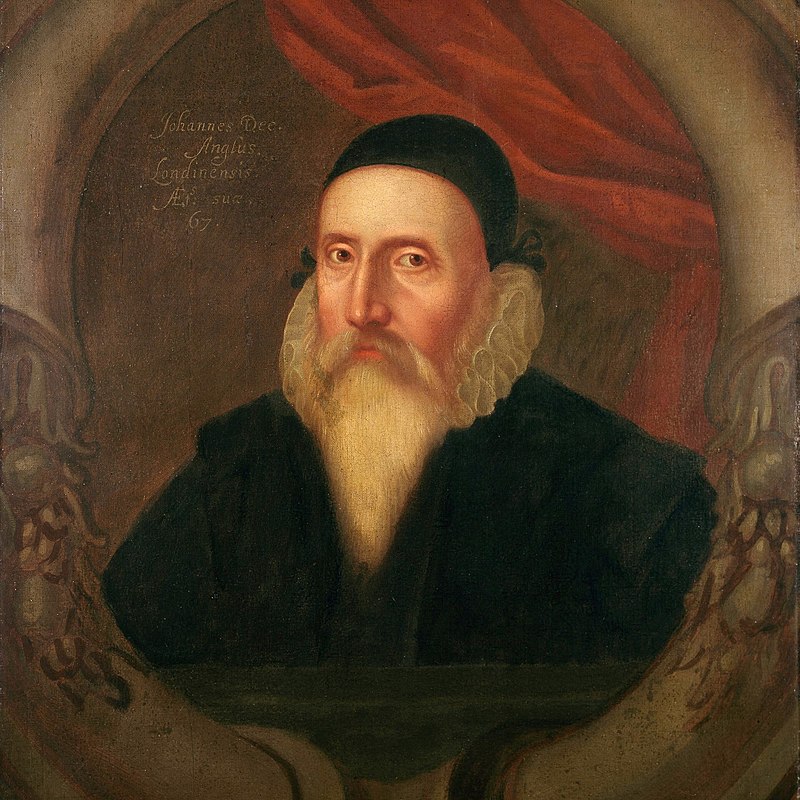
File:John_Dee_Ashmolean.jpg · Wikimedia Commons · See Wikimedia Commons
John Dee
Sign in to saveİngiliz filozof ve siymacı (1527-1608)
John Dee was a 16th-century English scholar who practiced mathematics, astrology, and alchemy—fields that blended scientific inquiry with mystical and magical traditions during the Renaissance. He matters as a historical figure because his work reflects how educated people of his era pursued knowledge across what we now see as separate disciplines, and his extensive writings and activities influenced intellectual circles in England.
AI-generated from the Wikipedia summary — may contain errors.
Person · Open Library
- Born
- 1527
- Died
- 1608
- Works
- 65
Top works
- Epistola fratris Rogerii Baconis, De secretis operibus artis et naturae, et de nullitate magiae
- Elements of geometry
- Libro del modo di dividere le svperficie
- Parallaticae commentationis praxeosq
- A triple almanacke for the yeere of our Lorde God 1591, being the thirde from the leape yeare
via Open Library + Wikidata
Music · MusicBrainz
- Type
- Person
- Gender
- Female
- Origin
- United States
- Active from
- 1950-05-27
Discography
- Dee Dee Bridgewater
- Afro Blue1974
- Dee Dee Bridgewater1976
- Just Family1978
- Bad for Me1979
- Dee Dee Bridgewater1980
- Precious Thing1989
- Victim of Love1989
- All of Me1992
- Keeping Tradition1993
via MusicBrainz · CC0
Listeners · Last.fm
- Listeners
- 9,994
- Total plays
- 55,997
Tags
Bandung, Indonesia. <a href="https://www.last.fm/music/John+Dee">Read more on Last.fm</a>
Recent publications · Crossref
5 total works indexed
- Generalized Gradient Approximation Made Simple
· 1996 · cited 204,552x
- Highly accurate protein structure prediction with AlphaFold
· 2021 · cited 43,600x
- Gene Ontology: tool for the unification of biology
· 2000 · cited 36,901x
- Matplotlib: A 2D Graphics Environment
· 2007 · cited 35,568x
- The MOS 36-ltem Short-Form Health Survey (SF-36)
· 1992 · cited 29,128x
via Crossref · CC0
Quotes
- “Cut that in Three, which Nature hath made One,Then strengthen hyt, even by it self alone,Wherewith then Cutte the poudred Sonne in twayne,By length of tyme, and heale the woonde againe.The self same Sunne twys yet more, ye must wounde,Still with new Knives, of the same kinde, and grounde;Our Monas trewe thus use by natures Law,Both binde and lewse, only with rype and rawe,And ay thanke God who only is our Guyde,All is ynugh, no more then at this Tyde.”
- “It is by the straight line and the circle that the first and most simple example and representation of all things may be demonstrated, whether such things be either non-existent or merely hidden under Nature's veils.”
- “Neither the circle without the line, nor the line without the point, can be artificially produced. It is, therefore, by virtue of the point and the Monad that all things commence to emerge in principle. That which is affected at the periphery, however large it may be, cannot in any way lack the support of the central point.”
- “Therefore, the central point which we see in the centre of the hieroglyphic Monad produces the Earth, round which the Sun, the Moon, and the other planets follow their respective paths. The Sun has the supreme dignity, and we represent him by a circle having a visible centre.”
- “Although the semicircle of the Moon is placed above the circle of the Sun and would appear to be superior, nevertheless we know that the Sun is ruler and King. We see that the Moon in her shape and her proximity rivals the Sun with her grandeur, which is apparent to ordinary men, yet the face, or a semi-sphere of the Moon, always reflects the light of the Sun.”
- “We finish the brief hieroglyphic consideration of our Monad, which we would sum up in one only hieroglyphic context: The Sun and the Moon of this Monad desire that the Elements in which the tenth proportion will flower, shall be separated, and this is done by the application of Fire.”
via Wikiquote · CC BY-SA