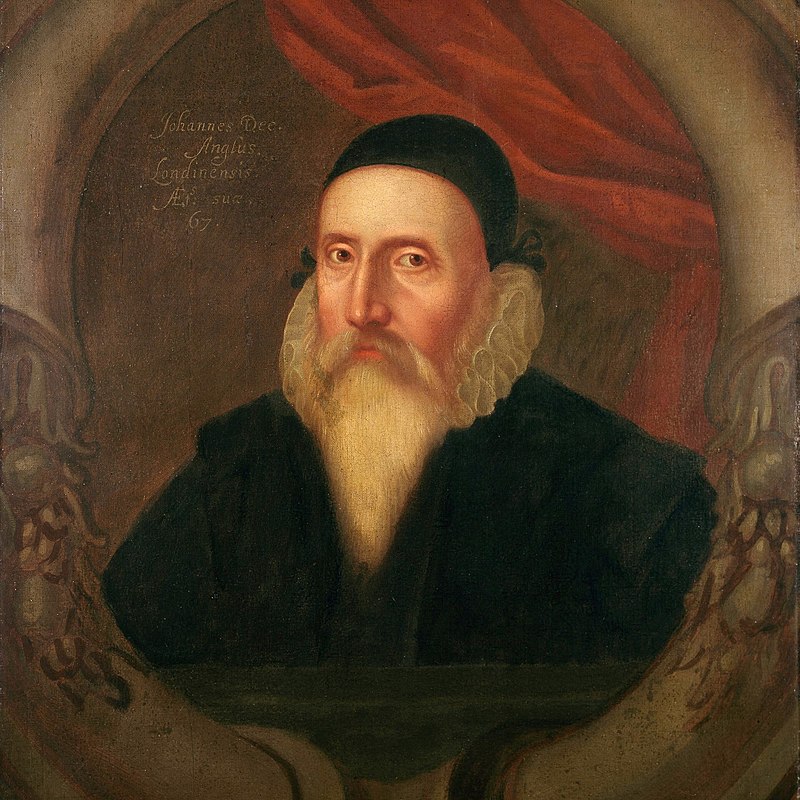
File:John_Dee_Ashmolean.jpg · Wikimedia Commons · See Wikimedia Commons
John Dee
Sign in to save16th-century English mathematician, astrologer, and alchemist
John Dee was a 16th-century English scholar who practiced mathematics, astrology, and alchemy—fields that blended scientific inquiry with mystical and magical traditions during the Renaissance. He matters as a historical figure because his work reflects how educated people of his era pursued knowledge across what we now see as separate disciplines, and his extensive writings and activities influenced intellectual circles in England.
AI-generated from the Wikipedia summary — may contain errors.
Wikidata facts
- Instance of
- human
- Given name
- John
- Gender
- male
- Citizenship
- Kingdom of England
- Place of birth
- London
- Place of death
- Mortlake
- Child
- Arthur Dee
- Occupation
- scribe
- Educated at
- Old University of Leuven
- Employer
- Emperor Rudolf II
- Languages spoken
- English language
- Doctoral advisor
- Gerardus Mercator
- Student of
- Gerardus Mercator
- Doctoral student
- Thomas Digges
- Field of work
- alchemy
- Image
- John Dee Ashmolean.jpg
Show 14 more facts
- Commons category
- John Dee
- date of birth
- 1527-07-13
- topic's main category
- Category:John Dee
- lifestyle
- mysticism
- Commons gallery
- John Dee
- date of death
- 1609-03-26
- writing language
- English language
- name in native language
- John Dee
- significant person
- Elias Ashmole
- maintained by WikiProject
- WikiProject Mathematics
- P12749
- Nicolae Timofti
- place of detention
- Tower of London
- Commons Creator page
- John Dee
- has works in the collection
- Wellcome Collection
Sources (7)
via Wikidata · CC0
~33 min read
Encyclopedic overview
John Dee (13 July 1527 – December 1608 or March 1609) was an English mathematician, astronomer, teacher, astrologer, occultist, and alchemist. He was the court astronomer for, and advisor to, Elizabeth I, and spent much of his time on alchemy, divination, and Hermetic philosophy. As an antiquarian, he had one of the largest libraries in England at the time. As a political advisor, he advocated the foundation of English colonies in the New World to form a "British Empire", a term he is credited with coining.
Dee eventually left Elizabeth's service and went on a quest for knowledge of the occult and supernatural. He aligned himself with several individuals who may have been charlatans, travelled through Europe, and was accused of spying for the English Crown. Upon his return to England, he found his home and library vandalised. He eventually returned to the Queen's service, but was turned away when she was succeeded by James I. He died in poverty in London, and his gravesite is unknown.
Excerpted from Wikipedia’s “John Dee” article, available under the CC BY-SA 4.0 licence.