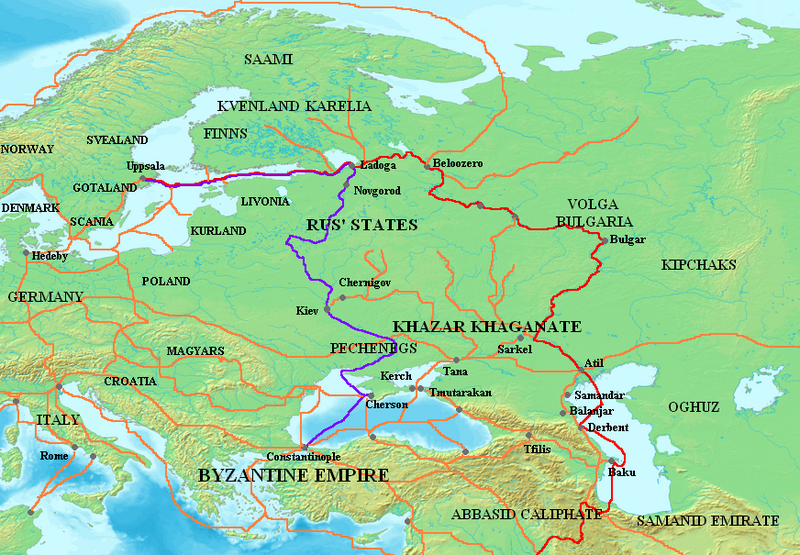
File:Varangian_routes.png · Wikimedia Commons · See Wikimedia Commons
The Khazars were a Turkic people who built a powerful trading empire from the late 6th century onward across what is now southern Russia, Ukraine, and Kazakhstan. They became one of the medieval world's most important commercial powers by controlling key trade routes between China, the Middle East, and Eastern Europe along the Silk Road.
AI-generated from the Wikipedia summary — may contain errors.
Key facts
- Country.conventional_long_name
- Khazar Khaganate
- Country.common_name
- Khazaria
- Country.era
- Middle Ages
- Country.status
- Khaganate
- Country.year_start
- 650
- Country.year_end
- 969
- Country.p1
- Western Turkic Khaganate
- Country.p2
- Old Great Bulgaria
- Country.s1
- Cumania
- Country.s2
- Pechenegs
- Country.s3
- Kievan Rus'
- Country.s4
- Durdzuks
- Country.s5
- Volga Bulgaria
- Country.s6
- Alania
- Country.event_end
- Sviatoslav's sacking and razing of Atil
- Country.image_map
- Chasaren.jpg
- Country.image_map_caption
- Khazar Khaganate, 650–850
- Country.currency
- Yarmaq
via Wikipedia infobox
Wikidata facts
- Part of
- Turkic peoples
- Native language
- Khazar language
- Religion
- Tengrism
- Country
- Khazar Khaganate
- Capital
- Balanjar
- Currency
- yarmaq
Show 8 more facts
- described by source
- Brockhaus and Efron Encyclopedic Dictionary
- Commons category
- Khazars
- topic's main category
- Category:Khazars
- inception
- 0618-00-00
- dissolved, abolished or demolished date
- 1048-01-01
- Commons gallery
- Khazars
- different from
- Hazaras
- on focus list of Wikimedia project
- Wikipedia:Vital articles/Level/4
via Wikidata · CC0
Article · Italiano
I Cazari (o anche K(h)azari o più raramente Khazary) (ebraico sing. Kuzar כוזרי plur. Kuzarim כוזרים; turco sing. Hazar plur. Hazarlar; russo sing. Chazarin Хазарин plur. Chazary Хазары; tataro sing Xäzär plur. Xäzärlär; persiano خزر Khazar) sono una confederazione di popolazioni turche seminomadi originarie delle steppe dell'Asia centrale in cui confluirono elementi slavi, iranici e i resti dei Goti di Crimea. Nel VII secolo fondano il Khanato di Khazaria nelle regioni più sud-orientali dell'Europa, vicino al Mar Caspio ed al Caucaso. Oltre alla regione oggi chiamata Kazakistan il khanato comprendeva anche parti dell'Ucraina, l'Azerbaigian, il sud della Russia e la penisola di Crimea. Intorno al periodo di fondazione del khanato molti Cazari si convertirono al giudaismo. Il nome 'Cazari' che essi stessi si sono dati proviene da un verbo in lingua turca che significa "vagabondare". Baḥr Khazar (mar Cazaro) è il termine in lingua persiana (e nelle lingue di culture persianizzate, come la maggior parte delle lingue turciche) usato per chiamare il mar Caspio.
Abstract from DBpedia / Wikipedia · CC BY-SA
Gallery (29)
Available in 88 languages
- Español
- Français
- Deutsch
- 中文
- 日本語
- Русский
- Português
- Italiano
- العربية
- हिन्दी
- Afrikaans
- Albanian
- Amharic
- Aragonese
- Armenian
- Asturian
- Avaric
- azb
Show 69 more
- Azerbaijani
- Bahasa Indonesia
- Bashkir
- Basque
- be_x_old
- Belarusian
- Bulgarian
- Catalan
- Central Kurdish
- Chechen
- Chuvash
- Croatian
- Danish
- Egyptian Arabic
- Esperanto
- Estonian
- Finnish
- Galician
- Georgian
- Greek
- Hebrew
- Hungarian
- Icelandic
- Ido
- Kannada
- Kazakh
- Kurdish
- Kyrgyz
- Latin
- Latvian
- lbe
- Lezghian
- Lingua Franca Nova
- Lithuanian
- Macedonian
- Malagasy
- Malay
- Mazanderani
- Minangkabau
- Mingrelian
- Nederlands
- Norwegian
- Norwegian Nynorsk
- Occitan
- Polski
- Punjabi
- Romanian
- Serbian
- Serbian (Latin)
- simple
- Slovak
- Slovenian
- Svenska
- Swahili
- Tatar
- Telugu
- Tiếng Việt
- Türkçe
- Ukrainian
- Urdu
- Uzbek
- Welsh
- Western Panjabi
- Wu Chinese
- Yakut
- Yiddish
- zh_yue
- فارسی
- 한국어
via Wikidata sitelinks · CC0