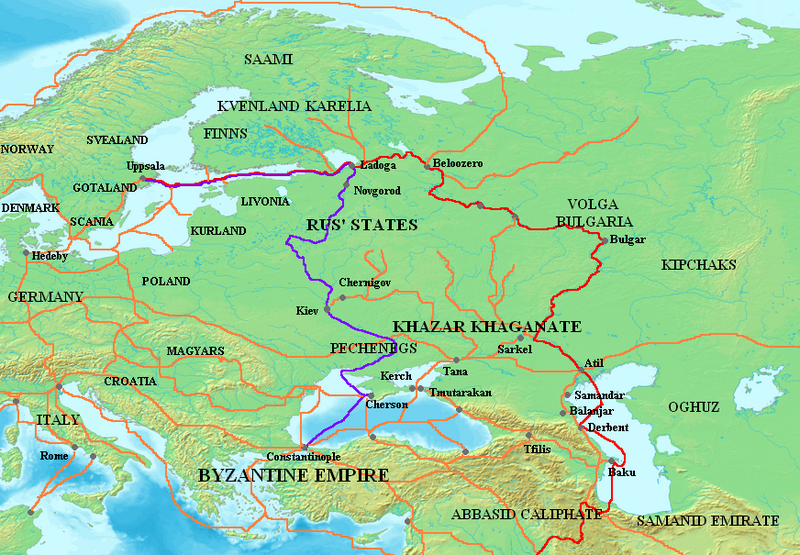
File:Varangian_routes.png · Wikimedia Commons · See Wikimedia Commons
The Khazars were a Turkic people who built a powerful trading empire from the late 6th century onward across what is now southern Russia, Ukraine, and Kazakhstan. They became one of the medieval world's most important commercial powers by controlling key trade routes between China, the Middle East, and Eastern Europe along the Silk Road.
AI-generated from the Wikipedia summary — may contain errors.
In the Vinony graph
Vinony's link graph records 1,361 inbound references to jázaros, and connects out to Dnieper, Kyrgyz people and Zaporozhian Cossacks.
It sits within the topics Ancient peoples of Russia, Ashina tribe and Groups who converted to Judaism.
Vinony links it to 88 Wikipedia language editions.
Key facts
- Country.conventional_long_name
- Khazar Khaganate
- Country.common_name
- Khazaria
- Country.era
- Middle Ages
- Country.status
- Khaganate
- Country.year_start
- 650
- Country.year_end
- 969
- Country.p1
- Western Turkic Khaganate
- Country.p2
- Old Great Bulgaria
- Country.s1
- Cumania
- Country.s2
- Pechenegs
- Country.s3
- Kievan Rus'
- Country.s4
- Durdzuks
- Country.s5
- Volga Bulgaria
- Country.s6
- Alania
- Country.event_end
- Sviatoslav's sacking and razing of Atil
- Country.image_map
- Chasaren.jpg
- Country.image_map_caption
- Khazar Khaganate, 650–850
- Country.currency
- Yarmaq
via Wikipedia infobox
Wikidata facts
- Part of
- Turkic peoples
- Native language
- Khazar language
- Religion
- Tengrism
- Country
- Khazar Khaganate
- Capital
- Balanjar
- Currency
- yarmaq
Show 8 more facts
- described by source
- Brockhaus and Efron Encyclopedic Dictionary
- Commons category
- Khazars
- topic's main category
- Category:Khazars
- inception
- 0618-00-00
- dissolved, abolished or demolished date
- 1048-01-01
- Commons gallery
- Khazars
- different from
- Hazaras
- on focus list of Wikimedia project
- Wikipedia:Vital articles/Level/4
via Wikidata · CC0
Article · Español
Los jázaros o jazares (en hebreo, singular «kuzarí» כוזרי, plural «kuzarim» כוזרים; en árabe, singular خزري, jazari; plural, خزر, jazar; en turco, hazarlar, en singular, «hazar»; en griego, χαζαροι; en ruso, xазары; en tártaro, singular Xäzär, plural Xäzärlär; en persa, singular «xazar» خزر, plural «xazarhâ» خزرها; en latín, gazari o cosri) fueron un pueblo túrquico procedente de Asia central. Su nombre parece estar vinculado a un verbo túrquico que significa «errante» ('gezer' en turco moderno). En el siglo VII, los jázaros fundaron un kanato independiente, el Kaganato de Jazaria o Kaganato jázaro, en el Cáucaso Norte a orillas del mar Caspio, donde con el paso del tiempo el judaísmo se convertiría en religión oficial. En su momento de máximo esplendor, ellos y sus tributarios controlaron buena parte de lo que hoy es el sur de Rusia, Kazajistán occidental, este de Ucrania, una parte importante del Cáucaso (Daguestán, Azerbaiyán, Georgia...) y Crimea. Los jázaros fueron importantes aliados del Imperio romano de Oriente contra el Imperio sasánida, además de constituir una significativa potencia regional en su momento de máximo esplendor. Emprendieron una serie de guerras, todas victoriosas, contra los califatos árabes, evitando así posiblemente la invasión de la Europa oriental. A finales del siglo X, su poder declinaría frente al de la Rus de Kiev, siendo su imperio absorbido por los emergentes estados eslavos, posteriormente emigraron hacia Europa donde formaron comunidades judías. Pequeños núcleos jázaros sobrevivieron en la estepa póntica hasta que en el siglo XIV las epidemias de peste y las invasiones mongolas los disiparon.
Abstract from DBpedia / Wikipedia · CC BY-SA
Gallery (29)
Available in 88 languages
- Español
- Français
- Deutsch
- 中文
- 日本語
- Русский
- Português
- Italiano
- العربية
- हिन्दी
- Afrikaans
- Albanian
- Amharic
- Aragonese
- Armenian
- Asturian
- Avaric
- azb
Show 69 more
- Azerbaijani
- Bahasa Indonesia
- Bashkir
- Basque
- be_x_old
- Belarusian
- Bulgarian
- Catalan
- Central Kurdish
- Chechen
- Chuvash
- Croatian
- Danish
- Egyptian Arabic
- Esperanto
- Estonian
- Finnish
- Galician
- Georgian
- Greek
- Hebrew
- Hungarian
- Icelandic
- Ido
- Kannada
- Kazakh
- Kurdish
- Kyrgyz
- Latin
- Latvian
- lbe
- Lezghian
- Lingua Franca Nova
- Lithuanian
- Macedonian
- Malagasy
- Malay
- Mazanderani
- Minangkabau
- Mingrelian
- Nederlands
- Norwegian
- Norwegian Nynorsk
- Occitan
- Polski
- Punjabi
- Romanian
- Serbian
- Serbian (Latin)
- simple
- Slovak
- Slovenian
- Svenska
- Swahili
- Tatar
- Telugu
- Tiếng Việt
- Türkçe
- Ukrainian
- Urdu
- Uzbek
- Welsh
- Western Panjabi
- Wu Chinese
- Yakut
- Yiddish
- zh_yue
- فارسی
- 한국어
via Wikidata sitelinks · CC0