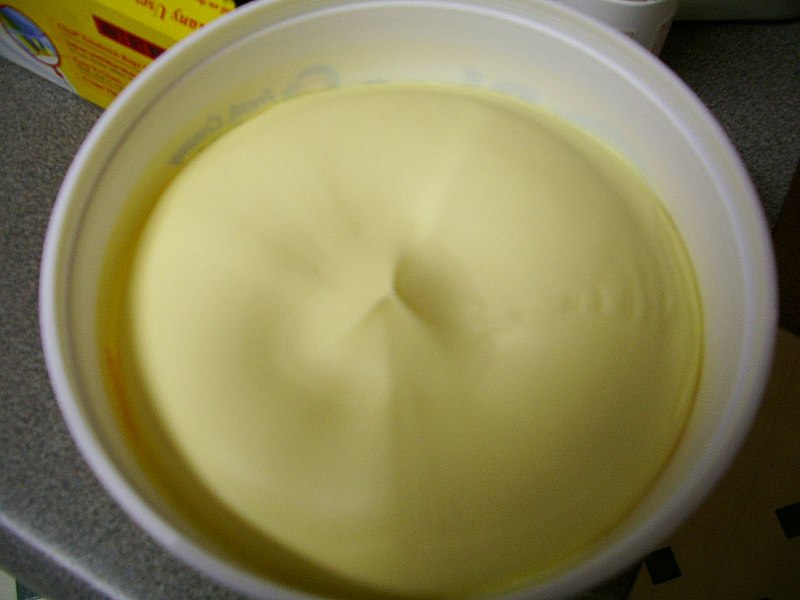
File:Margarine.jpg · Wikimedia Commons · See Wikimedia Commons
margarine
Sign in to saveAlso known as oleo, marge, oleomargarine
Margarine (, also , ) is a spread used for flavoring, baking, and cooking. It is most often used as a substitute for butter. Although originally made from animal fats, most margarine consumed today is made from vegetable oil. The spread was originally named oleomargarine from Latin for oleum (olive oil) and Greek margarite ("pearl", indicating luster). The name was later shortened to margarine, or sometimes oleo (particularly in the Deep South region of the United States).
OverviewAI-generated
Margarine is a food product categorized under the general term “margarines.” It has been the subject of 2,134 publications indexed in PubMed. In the Openfoodfacts database, 84 products are listed in this category.
Nutritional data for margarine indicates an energy value of 575 kcal. The product contains 64.3 units of fat, including 21.4 units of saturated fat. Carbohydrate content is 0.5 units, with 0.3 units of sugars and 0.1 units of fiber. Protein levels are 0.3 units, and salt content is 0.63 units. The product carries a nutriscore of d and a nova classification of 4. Margarine is referenced by 555 other encyclopedia articles.
Synthesized by Vinony from 16 facts across 4 sources: Wikidata, PubMed, Openfoodfacts, Vinony graph. Generated from structured data (not the Wikipedia text) and checked against those facts — may still contain errors.
Key facts
- Food.name
- Margarine
- Food.image
- Margarine.jpg
- Food.image_size
- 250px
- Food.caption
- Margarine in a tub
- Food.alternate_name
- Marge, oleo, oleomargarine, buttery spread
- Food.country
- France
- Food.creator
- Hippolyte Mège-Mouriès
- Food.type
- Spread
- Food.main_ingredient
- Vegetable oils
via Wikipedia infobox
Nutrition · Open Food Facts
Typical values per 100 g · averaged across 84 products
- Energy
- 575 kcal
- Fat
- 64.3 g
- — of which saturates
- 21.4 g
- Carbohydrates
- 0.5 g
- — of which sugars
- 0.3 g
- Fibre
- 0.1 g
- Protein
- 0.3 g
- Salt
- 0.63 g
via Open Food Facts · ODbL
Research
2,134 papers- Margarine--facts and myths.The Medical journal of Australia · 1994Nestel PJ
- Butter, margarine and serum lipoproteins.ReviewAtherosclerosis · 1997Zock PL, Katan MBDOI: 10.1016/s0021-9150(96)06063-7
- Margarine vs. butter. Let's put the facts (fats) on the table.ReviewJournal of general orthodontics · 1995Loudon ME
- Technological innovations in margarine production: Current trends and future perspectives on trans-fat removal and saturated fat replacement.ReviewComprehensive reviews in food science and food safety · 2025Bihola A, Chaudhary MB, Bumbadiya MR et al.DOI: 10.1111/1541-4337.70088
- Margarine.South African medical journal = Suid-Afrikaanse tydskrif vir geneeskunde · 1969
- Quality of margarine: fats selection and processing parameters.ReviewAsia Pacific journal of clinical nutrition · 2005Miskandar MS, Man YC, Yusoff MS et al.
- [Butter versus margarine?].Sozial- und Praventivmedizin · 1990Jacob S, Gutzwiller FDOI: 10.1007/BF01359483
- [Margarine's trans-fatty acid composition: modifications during the last decades and new trends].ReviewArchivos latinoamericanos de nutricion · 2005Griguol Chulich VI, León-Camacho M, Vicario Romero IM
via PubMed
Wikidata facts
- Subclass of
- vegetable fat
- Country of origin
- France
- Material used
- vegetable oil
- Image
- Margaryn 022.jpg
- Has use
- food ingredient
Show 5 more facts
- Commons category
- Margarine
- topic's main category
- Category:Margarine
- discoverer or inventor
- Hippolyte Mège-Mouriès
- on focus list of Wikimedia project
- Wikipedia:Vital articles/Level/4
- simulates
- butter
Sources (2)
via Wikidata · CC0
~28 min read
Encyclopedic overview
27 sectionsContents
- History
- Invention and early distribution
- Color debate
- Coal butter
- Post-WWII
- Spread products
- Manufacturing process
- Hydrogenation
- Nutrition
- Amount of fat
- Saturated fat
- Unsaturated fat
- Trans fat
- Plant sterol esters and stanol esters
- Market acceptance
- National standards
- Australia
- Canada
- European Union
- United Kingdom
- United States
- Legal issues
- Canada
- New Zealand
- United States
- See also
- References
Margarine (, also , ) is a spread used for flavoring, baking, and cooking. It is most often used as a substitute for butter. Although originally made from animal fats, most margarine consumed today is made from vegetable oil. The spread was originally named oleomargarine from Latin for oleum (olive oil) and Greek margarite ("pearl", indicating luster). The name was later shortened to margarine, or sometimes oleo (particularly in the Deep South region of the United States).
Margarine consists of a water-in-fat emulsion, with tiny droplets of water dispersed uniformly throughout a fat phase in a stable solid form. While butter is made by concentrating the butterfat of milk through centrifugation, modern margarine is made through a more intensive processing of refined vegetable oil and water.
Excerpted from Wikipedia’s “margarine” article, available under the CC BY-SA 4.0 licence.
Gallery (18)
Available in 73 languages
- Español
- Français
- Deutsch
- 中文
- 日本語
- Русский
- Português
- Italiano
- العربية
- हिन्दी
- Afrikaans
- Albanian
- Armenian
- Asturian
- Bahasa Indonesia
- Banjar
- Basque
- be_x_old
Show 54 more
- Belarusian
- Bulgarian
- Catalan
- Croatian
- Czech
- Danish
- Egyptian Arabic
- Esperanto
- Estonian
- Filipino
- Finnish
- Galician
- Georgian
- Greek
- Gujarati
- Hebrew
- Hungarian
- Icelandic
- Ido
- Irish
- Javanese
- Kannada
- Kazakh
- Latvian
- Lithuanian
- Macedonian
- Malay
- Nederlands
- Norwegian
- Norwegian Nynorsk
- Polski
- Romanian
- Rusyn
- Serbian
- Serbian (Latin)
- simple
- Sinhala
- Slovak
- Slovenian
- Svenska
- Swahili
- Tajik
- Tiếng Việt
- Türkçe
- Ukrainian
- Uzbek
- Waray
- Welsh
- Western Frisian
- Wu Chinese
- zh_yue
- فارسی
- ไทย
- 한국어
via Wikidata sitelinks · CC0