
File:Charles_Townes_and_first_maser.jpg · Wikimedia Commons · See Wikimedia Commons
激微波
Also known as microwave amplification by stimulated emission of radiation
300px|thumb|upright=1.7 |The first prototype ammonia maser in front of its inventor [[Charles H. Townes. The ammonia nozzle is at left in the box, the four brass rods at center are the quadrupole state selector, and the resonant cavity is at right. The 24 GHz microwaves exit through the vertical waveguide Townes is adjusting. At bottom are the vacuum pumps.]] thumb|right|260px|A hydrogen radio frequency discharge, the first element inside a #Hydrogen maser|hydrogen maser (see description below)
Described at
LED-pumped room-temperature solid-state maser | Communications Engineering
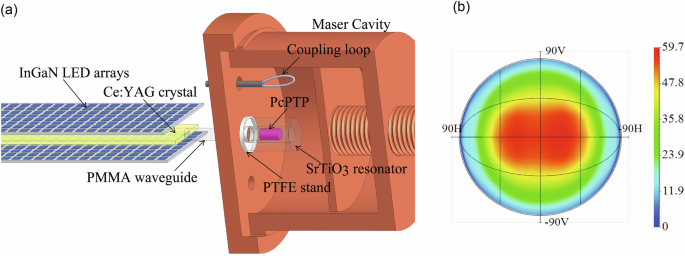
Room-temperature MASERs (Microwave Amplification by Stimulated Emission of Radiation) amplify electromagnetic waves at microwave frequencies with minimal noise. We demonstrate a cost-effective LED-pumped maser using pentacene-doped para-terphenyl as the gain medium. Here, we show that LED light, which is brightness-enhanced and guided via a cerium-doped yttrium aluminium garnet luminescent concentrator, achieves persistent maser emission at 1.45 GHz with a duration of 200 µs and a microwave output power of 0.014 mW, surpassing previous non-laser pumped systems. Operating at low voltage, the LED-pumped maser ensures safety, reduced costs, and simple integration. Potential applications include sensitive magnetic resonance imaging, portable atomic clocks, quantum technologies, and enhanced deep-space radio astronomy. Juna Sathian and colleagues demonstrate a room-temperature LED-pumped solid-state maser achieving persistent microwave emission. This advance opens opportunities for low-cost quantum technologies, deep-space communication, and sensing applications.
nature.com →Advertising and content can be personalised based on your profile. Your activity on this service can be used to build or improve a profile about you for personalised advertising and content. Advertising and content performance can be measured. Reports can be generated based on your activity and those of others. Your activity on this service can help develop and improve products and services. Thank you for visiting nature.com. You are using a browser version with limited support for CSS. To obtain the best experience, we recommend you use a more up to date browser (or turn off compatibility mode in Internet Explorer). In the meantime, to ensure continued support, we are displaying the site without styles and JavaScript. Room-temperature MASERs (Microwave Amplification by Stimulated Emission of Radiation) amplify electromagnetic waves at microwave frequencies with minimal noise. We demonstrate a cost-effective LED-pumped maser using pentacene-doped para-terphenyl as the gain medium. Here, we show that LED light, which is brightness-enhanced and guided via a cerium-doped yttrium aluminium garnet luminescent concentrator, achieves persistent maser emission at 1.45 GHz with a duration of 200 µs and a microwave output power of 0.014 mW, surpassing previous non-laser pumped systems. Operating at low voltage, the LED-pumped maser ensures safety, reduced costs, and simple integration. Potential applications include sensitive magnetic resonance imaging, portable atomic clocks, quantum technologies, and enhanced deep-space radio astronomy. Masers can detect and amplify weak microwave signals while introducing minimal noise1 (Deep Space Communication and Navigation Series, Jet Propulsion Laboratory, Caltech, 2008).") . Although they have many potential applications, their usage has been limited to only a few specialised areas due to the requirement for vacuum, high magnetic fields, and extremely low temperatures2.") ,3.") . The essential components of a maser include a gain medium, an excitation source (pump), and a resonant cavity. Recent advances have enabled room-temperature masers using organic crystalline materials, such as pentacene-doped para-terphenyl (PcPTP), coupled with cylindrical resonators and laser or lamp pumping4.") ,5.") ,6.") . Additionally, progress in miniaturised laser technology has facilitated the creation of compact laser-pumped masers7.") . Here, we report an alternative pumping system based on light-emitting diodes (LEDs), which offers several distinct advantages over traditional laser or lamp-based excitation sources. By directly coupling the LED output to the gain medium via a cerium-doped yttrium aluminium garnet (Ce:YAG) luminescent concentrator (LC), the design eliminates the need for complex optical alignment, enhancing simplicity and reproducibility. Moreover, the LED-based approach is safer, operating at low voltage and intensity, and is more cost-effective, utilising widely available components. Specifically, LED pumping offers an energy-efficient approach, minimises thermal loads in the gain medium compared to laser pumping, and ensures sufficient spectral overlap and photon density to drive quantum transitions in the pentacene-doped gain medium. By eliminating the need for high-power lasers and flashlamps, LED-pumped masers simplify both design and operation, broadening the practical applications of room-temperature maser technology. These features make LED-pumped masers particularly attractive for applications requiring scalability and cost-effectiveness. We address issues related to efficiency, thermal management, quantum mechanical considerations, and limitations of the existing pump systems. Driven by the lighting market, visible LEDs have been making steady progress for 25 years. Now, LEDs feature an even longer operating lifetime than laser diodes ( 50,000 hrs) and a drastically lower cost. Considering LED costs are below 0.5 $/W and continuously decreasing13.") , LED pumping of masers appea
Article · 中文
激微波(英語:MASER),音譯為邁射,意譯為激微波或微波激射器,是受激放大微波辐射(英語:Microwave Amplification by Stimulated Emission of Radiation)的头字母。它指通过受激辐射放大和必要的反馈,产生同一波寬、准直、相干的微波的过程及仪器。 利用激微波原理的「」,可製作「比精確十倍,每三百萬年還差不到一秒」的原子鐘。
Abstract from DBpedia / Wikipedia · CC BY-SA