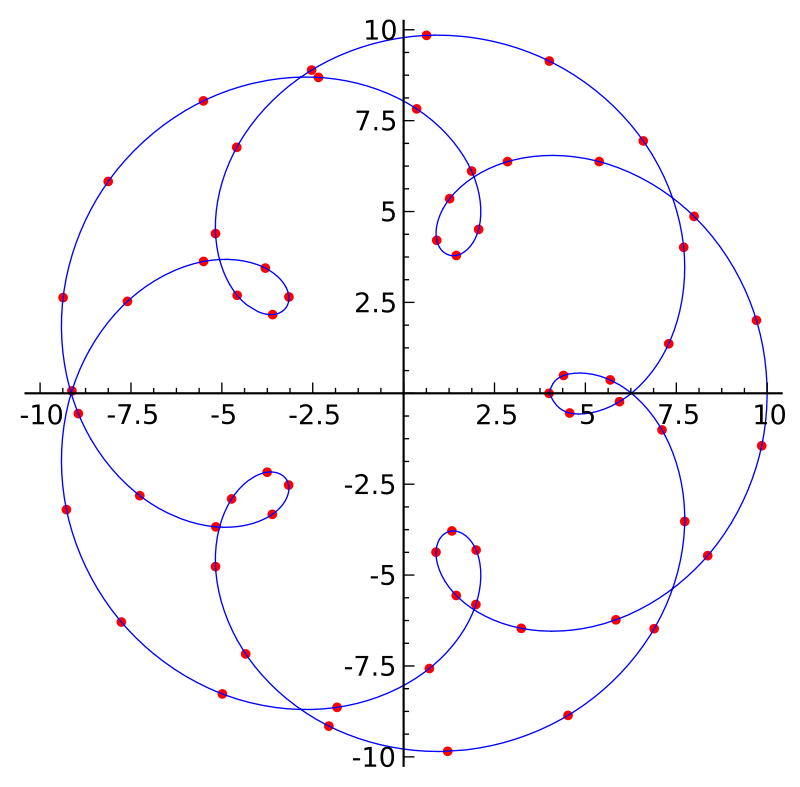
File:Splined_epitrochoid.svg · Wikimedia Commons · See Wikimedia Commons
mathematical interpolation
Sign in to saveAlso known as interpolation, numerical interpolation
In the mathematical field of numerical analysis, interpolation is a type of estimation, a method of constructing (finding) new data points based on the range of a discrete set of known data points.
Interpolation is a mathematical technique for filling in missing values between known data points — imagine you have measurements at certain times or locations, and you want to estimate what the values would be at points in between. It matters because it allows scientists, engineers, and analysts to make educated guesses about unmeasured data and create smooth curves or surfaces from scattered information.
AI-generated from the Wikipedia summary — may contain errors.
Wikidata facts
- Instance of
- mathematical model
- Subclass of
- algorithm
Show 7 more facts
- described by source
- Encyclopædia Britannica 11th edition
- different from
- approximation
- Commons category
- Interpolation
- topic's main category
- Category:Interpolation
- Stack Exchange tag
- stackoverflow.com/tags/interpolation
- opposite of
- mathematical extrapolation
- maintained by WikiProject
- WikiProject Mathematics
Sources (2)
via Wikidata · CC0
~16 min read
Encyclopedic overview
18 sectionsContents
- Example
- Piecewise constant interpolation
- Linear interpolation
- Polynomial interpolation
- Spline interpolation
- Mimetic interpolation
- Functional interpolation
- Function approximation
- Via Gaussian processes
- Inverse Distance Weighting
- Other forms
- In higher dimensions
- In digital signal processing
- Related concepts
- Generalization
- See also
- References
- External links
In the mathematical field of numerical analysis, interpolation is a type of estimation, a method of constructing (finding) new data points based on the range of a discrete set of known data points.
In engineering and science, one often has a number of data points, obtained by sampling or experimentation, which represent the values of a function for a limited number of values of the independent variable. It is often required to interpolate; that is, estimate the value of that function for an intermediate value of the independent variable.
Excerpted from Wikipedia’s “mathematical interpolation” article, available under the CC BY-SA 4.0 licence.