File:FoodMeat.jpg · Wikimedia Commons · See Wikimedia Commons
meat
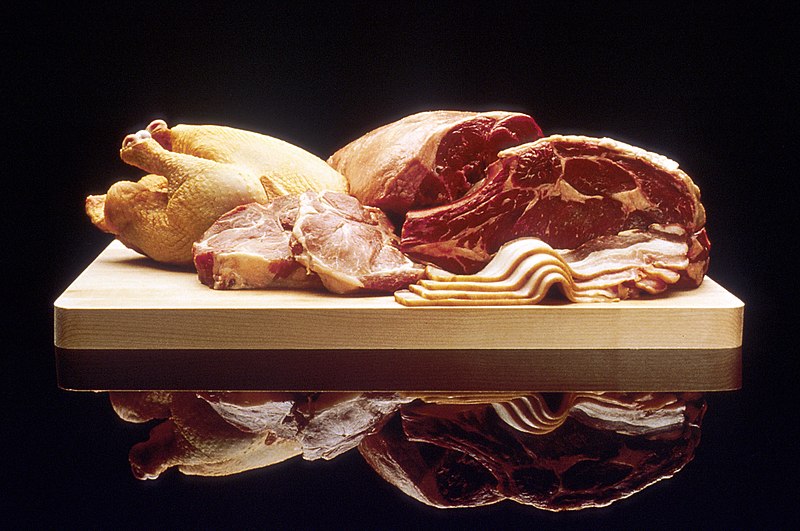
Sign in to savethumb|upright=1.5|Raw meat (clockwise from left): chicken as food|chicken, [[beef, bacon, pork chops]] Meat is animal tissue, mostly muscle, that is eaten as food. Humans have hunted and farmed other animals for meat since prehistory. The Neolithic Revolution allowed the domestication of vertebrates, including chickens, sheep, goats, pigs, horses, and cattle, starting around 11,000 years ago. Since then, selective breeding has enabled farmers to produce meat with the qualities desired by producers and consumers. Meat is important to economies and cultures around the world.
OverviewAI-generated
Meat is a food and food ingredient classified as flesh and an intermediate good. It consists of muscle, adipose tissue, and liquid water. These materials are natural products of mammals, amphibians, reptiles, and birds. The substance is produced through animal slaughter. It serves as a component in dishes such as Hochepot.
Nutritional data indicates that meat contains 233 kcal of energy, 15.4 grams of fat, and 18.8 grams of protein. It also includes 5.5 grams of saturated fat, 4.3 grams of carbohydrates, 2 grams of sugars, 0.4 grams of fiber, and 2.56 grams of salt. It holds a Nutri-Score of E and a NOVA classification of 4. The subject appears in 20,046 Openfoodfacts products. It is referenced by 2,007 other encyclopedia articles.
Synthesized by Vinony from 28 facts across 4 sources: Wikidata, PubMed, Openfoodfacts, Vinony graph. Generated from structured data (not the Wikipedia text) and checked against those facts — may still contain errors.
Nutrition · Open Food Facts
Typical values per 100 g · averaged across 20,046 products
- Energy
- 233 kcal
- Fat
- 15.4 g
- — of which saturates
- 5.5 g
- Carbohydrates
- 4.3 g
- — of which sugars
- 2 g
- Fibre
- 0.4 g
- Protein
- 18.8 g
- Salt
- 2.56 g
via Open Food Facts · ODbL
Research
144,791 papers- Health Risks Associated with Meat Consumption: A Review of Epidemiological Studies.ReviewInternational journal for vitamin and nutrition research. Internationale Zeitschrift fur Vitamin- und Ernahrungsforschung. Journal international de vitaminologie et de nutrition · 2015Battaglia Richi E, Baumer B, Conrad B et al.DOI: 10.1024/0300-9831/a000224
- Masculinity, Meat, and Veg*nism: A Scoping Review.American journal of men's health · 2024Velzeboer R, Li E, Gao N et al.DOI: 10.1177/15579883241247173
- Meat consumption and consumer attitudes in Japan: An overview.ReviewMeat science · 2022Sasaki K, Motoyama M, Watanabe G et al.DOI: 10.1016/j.meatsci.2022.108879
- Culture, meat, and cultured meat.ReviewJournal of animal science · 2020Bryant CJDOI: 10.1093/jas/skaa172
- Meat products in human nutrition and health - About hazards and risks.ReviewMeat science · 2024De Smet S, Van Hecke TDOI: 10.1016/j.meatsci.2024.109628
- Meat analogues, the Canadian Meat Industry and the Canadian consumer.ReviewMeat science · 2022Ngapo TMDOI: 10.1016/j.meatsci.2022.108846
- Functional fermented meat products with probiotics-A review.ReviewJournal of applied microbiology · 2022Munekata PES, Pateiro M, Tomasevic I et al.DOI: 10.1111/jam.15337
- Red Meat Amino Acids for Beginners: A Narrative Review.ReviewNutrients · 2025Barr B, Levitt DE, Gollahon LDOI: 10.3390/nu17060939
via PubMed
~41 min read
Encyclopedic overview
48 sectionsContents
- Etymology
- History
- Domestication
- Intensive animal farming
- Selective breeding
- Animal growth and development
- Genetics
- Environment
- Animal nutrition
- Animal welfare
- Human intervention
- Composition
- Biochemical
- Nutritional
- Production
- Transport
- Slaughter
- Dressing and cutting
- Conditioning
- Additives
- Consumption
- Historical
- Trends
- Methods of preparation
- Red vs white meat
- Health effects
- Contamination
- Cancer
- Bacterial contamination
- Diabetes
- Infectious diseases
- Changes in consumer behavior
- Cardiovascular disease
- Environmental impact
- Land use
- Climate change
- Biodiversity loss
- Reducing environmental impact
- Reducing meat consumption
- Cultural aspects
- Ethical issues
- Religious traditions
- Psychology
- Gender
- See also
- References
- Sources
- External links
thumb|upright=1.5|Raw meat (clockwise from left): chicken as food|chicken, [[beef, bacon, pork chops]] Meat is animal tissue, mostly muscle, that is eaten as food. Humans have hunted and farmed other animals for meat since prehistory. The Neolithic Revolution allowed the domestication of vertebrates, including chickens, sheep, goats, pigs, horses, and cattle, starting around 11,000 years ago. Since then, selective breeding has enabled farmers to produce meat with the qualities desired by producers and consumers. Meat is important to economies and cultures around the world.
Meat is mainly composed of water, protein, and fat. Its quality is affected by many factors, including the genetics, health, and nutritional status of the animal involved. Without preservation, bacteria and fungi decompose and spoil unprocessed meat within hours or days. Meat is edible raw, but it is mostly eaten cooked, such as by stewing or roasting, or processed, such as by smoking or salting.
Excerpted from Wikipedia’s “meat” article, available under the CC BY-SA 4.0 licence.
Gallery (28)
Available in 180 languages
- Español
- Français
- Deutsch
- 中文
- 日本語
- Русский
- Português
- Italiano
- العربية
- हिन्दी
- Abkhazian
- abstract
- Afrikaans
- Albanian
- Albanian
- Amharic
- Aragonese
- Aramaic
Show 161 more
- Armenian
- Assamese
- Asturian
- Atikamekw
- Aymara
- azb
- Azerbaijani
- Bahasa Indonesia
- Balinese
- Bangla
- Bashkir
- Basque
- bat_smg
- Bavarian
- be_x_old
- Belarusian
- Bikol
- Bosnian
- Breton
- btm
- Bulgarian
- Buriat
- Burmese
- Catalan
- cdo
- Cebuano
- Central Kurdish
- Chechen
- Church Slavic
- Chuvash
- Cornish
- Croatian
- Czech
- dag
- Danish
- Egyptian Arabic
- eml
- Erzya
- Esperanto
- Estonian
- Extremaduran
- Faroese
- Fiji Hindi
- Fijian
- Filipino
- Finnish
- fiu_vro
- Galician
- Gan Chinese
- gcr
- Georgian
- Greek
- Guarani
- guw
- Haitian Creole
- Hausa
- Hebrew
- Hungarian
- hyw
- Icelandic
- Ido
- Iloko
- Interlingua
- Inupiaq
- Irish
- Jamaican Creole English
- Javanese
- Jju
- Kabyle
- Kannada
- Kanuri
- Kashmiri
- Kazakh
- kge
- Kinyarwanda
- Kurdish
- kus
- Kyrgyz
- Latin
- Latvian
- Limburgish
- Lithuanian
- Lombard
- Low German
- Luxembourgish
- Macedonian
- Madurese
- Malagasy
- Malay
- Malayalam
- Manx
- Māori
- Mari
- Minangkabau
- Mongolian
- Navajo
- Neapolitan
- Nederlands
- Nepali
- Nias
- Northern Frisian
- Norwegian
- Norwegian Nynorsk
- nrm
- Occitan
- olo
- Pampanga
- Pashto
- Piedmontese
- Polski
- Punjabi
- Quechua
- roa_rup
- Romanian
- Rundi
- Santali
- Scottish Gaelic
- Serbian
- Serbian (Latin)
- Shona
- Sicilian
- simple
- Sindhi
- Slovak
- Slovenian
- Somali
- Standard Moroccan Tamazight
- Sundanese
- Svenska
- Swahili
- Swati
- Tajik
- Tamil
- Tatar
- Telugu
- Tiếng Việt
- Tswana
- Tumbuka
- Türkçe
- Tyap
- Ukrainian
- Urdu
- Uzbek
- Venetian
- Veps
- Volapük
- Walloon
- Waray
- Welsh
- West Flemish
- Western Panjabi
- Wu Chinese
- Yakut
- Yiddish
- Zaza
- zh_min_nan
- zh_yue
- Zulu
- فارسی
- ไทย
- 한국어
via Wikidata sitelinks · CC0