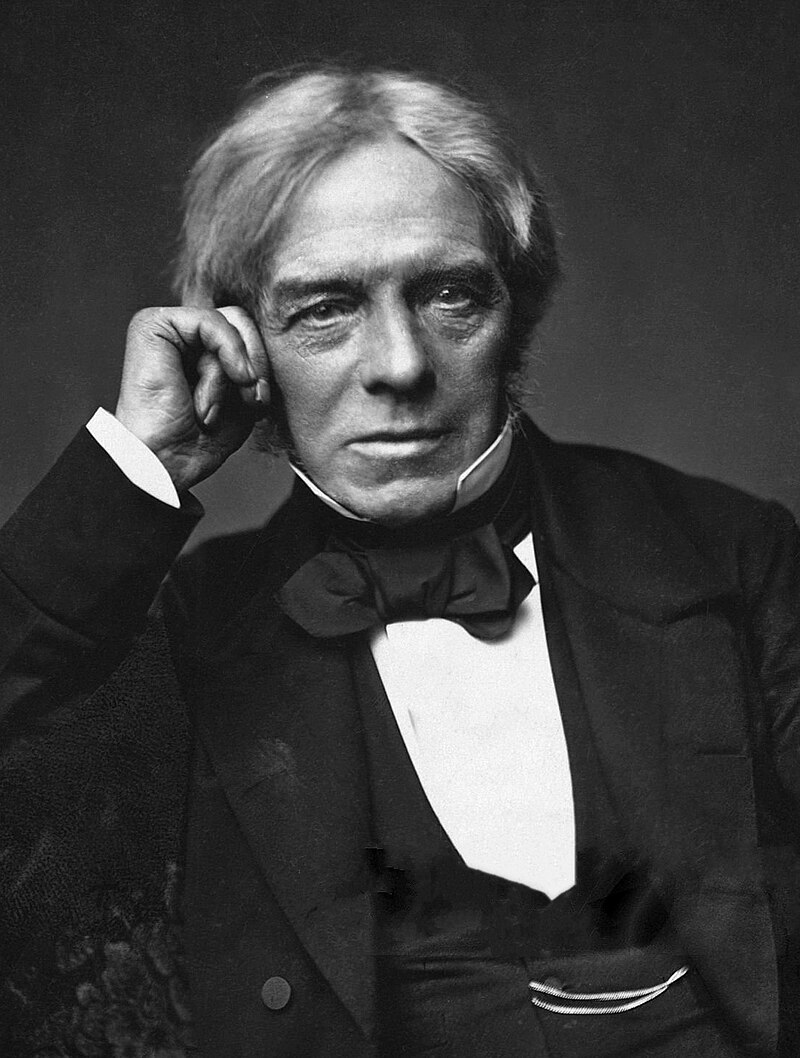
File:Michael_Faraday_sitting_crop.jpg · Wikimedia Commons · See Wikimedia Commons
Michael Faraday
Sign in to saveBritish scientist (1791–1867)
Michael Faraday was a British scientist who lived from 1791 to 1867 and made groundbreaking discoveries in electricity and magnetism that laid the foundation for modern electrical technology. His work revealed fundamental connections between these forces and enabled the development of electric motors, generators, and transformers that power much of our modern world.
AI-generated from the Wikipedia summary — may contain errors.
Wikidata facts
- Instance of
- human
- Given name
- Michael
- Gender
- male
- Citizenship
- Kingdom of Great Britain
- Place of birth
- London
- Place of death
- London
- Occupation
- writer
- Languages spoken
- English language
- Native language
- English language
- Religion
- Glasite
- Academic degree
- honorary degree
- Student of
- Humphry Davy
- Doctoral student
- John Tyndall
- Image
- Michael Faraday. Photograph by Henry Dixon & Son Ltd. Wellcome V0026347.jpg
- Work location
- England
Show 16 more facts
- place of burial
- Highgate Cemetery
- Commons category
- Michael Faraday
- date of birth
- 1791-00-00
- date of death
- 1867-00-00
- topic's main category
- Category:Michael Faraday
- Commons gallery
- Michael Faraday
- influenced by
- Jane Marcet
- name in native language
- Michael Faraday
- on focus list of Wikimedia project
- Wikipedia:Vital articles/Level/4
- student
- Charles Joseph Hullmandel
- writing language
- English language
- Commons Creator page
- Michael Faraday
- topic has template
- Template:Michael Faraday
- P8168
- Bobby Bare
Sources (6)
via Wikidata · CC0
Works in European collections
21 objects attributed to Michael Faraday, held across European museums, libraries & archives · via Europeana
![Chemische Manipulation oder das eigentlich Practische der sichern Ausführung chemischer Arbeiten und Experimente, [1]. [Grundwerk]](https://api.europeana.eu/thumbnail/v2/url.json?uri=https%3A%2F%2Fapi.digitale-sammlungen.de%2Fiiif%2Fimage%2Fv2%2Fbsb11020524_00005%2Ffull%2Ffull%2F0%2Fdefault.jpg&type=IMAGE)
Chemische Manipulation oder das eigentlich Practische der sichern Ausführung chemischer Arbeiten und Experimente, [1]. [Grundwerk]

Experimental researches in electricity, 1851,1

Experimental researches in electricity, Vol. 3

Naturgeschichte einer Kerze : sechs Vorlesungen für die Jugend

The life and letters of Faraday : in two volumes, 1

Experimental Relations of Gold (and other Metals) to Light : (Separatabdruck aus?

Die verschiedenen Kräfte der Materie und ihre Beziehungen zu einander : 6 Vorlesungen für die Jugend

Experimental Researches in chemistry and physics
![Chemische Manipulation oder das eigentlich Practische der sichern Ausführung chemischer Arbeiten und Experimente, [2]. Nachträge zur ersten Ausgabe von Faraday's chemischer Manipulation](https://api.europeana.eu/thumbnail/v2/url.json?uri=https%3A%2F%2Fapi.digitale-sammlungen.de%2Fiiif%2Fimage%2Fv2%2Fbsb10072543_00003%2Ffull%2Ffull%2F0%2Fdefault.jpg&type=IMAGE)
Chemische Manipulation oder das eigentlich Practische der sichern Ausführung chemischer Arbeiten und Experimente, [2]. Nachträge zur ersten Ausgabe von Faraday's chemischer Manipulation

On the Physical Character of the Lines of Magnetic Force : with a plate

Experimental researches in electricity, 1852,1

Chemical manipulation : Being instructions to students in chemistry, on the methods of performing experiments of demonstration or of research, with accuracy and success
![Chemische Manipulation oder das eigentlich Practische der sichern Ausführung chemischer Arbeiten und Experimente, [2]. Nachträge zur ersten Ausgabe von Faraday's chemischer Manipulation](https://api.europeana.eu/thumbnail/v2/url.json?uri=https%3A%2F%2Fapi.digitale-sammlungen.de%2Fiiif%2Fimage%2Fv2%2Fbsb10707830_00005%2Ffull%2Ffull%2F0%2Fdefault.jpg&type=IMAGE)
Chemische Manipulation oder das eigentlich Practische der sichern Ausführung chemischer Arbeiten und Experimente, [2]. Nachträge zur ersten Ausgabe von Faraday's chemischer Manipulation

The chemical History of a Candle: A Course of Lectures delivered before a juvenile Audience at the royal Institution : a course of lectures delivered before a juvenile audience at the royal institution
![Chemische Manipulation oder das eigentlich Practische der sichern Ausführung chemischer Arbeiten und Experimente, [1]. [Grundwerk]](https://api.europeana.eu/thumbnail/v2/url.json?uri=https%3A%2F%2Fapi.digitale-sammlungen.de%2Fiiif%2Fimage%2Fv2%2Fbsb10072542_00007%2Ffull%2Ffull%2F0%2Fdefault.jpg&type=IMAGE)
Chemische Manipulation oder das eigentlich Practische der sichern Ausführung chemischer Arbeiten und Experimente, [1]. [Grundwerk]

The life and letters of Faraday : in two volumes, 2
Untitled

Untitled
Untitled
Untitled
Untitled
~37 min read
Encyclopedic overview
Michael Faraday (22 September 1791 – 25 August 1867) was an English chemist and physicist who contributed vastly to the study of electrochemistry and electromagnetism. His main discoveries include the principles underlying electromagnetic induction, diamagnetism, and electrolysis. Although Faraday received little formal education, as a self-made man, he was one of the most influential scientists in history. It was by his research on the magnetic field around a conductor carrying a direct current that Faraday established the concept of the electromagnetic field in physics. Faraday also established that magnetism could affect rays of light and that there was an underlying relationship between the two phenomena. He similarly discovered the principles of electromagnetic induction, diamagnetism, and the laws of electrolysis. His inventions of electromagnetic rotary devices formed the foundation of electric motor technology, and it was largely due to his efforts that electricity became practical for use in technology. The SI unit of capacitance, the farad, is named after him.
As a chemist, Faraday discovered benzene and carbon tetrachloride, investigated the clathrate hydrate of chlorine, invented an early form of the Bunsen burner and the system of oxidation numbers, and popularised terminology such as "anode", "cathode", "electrode" and "ion". Faraday ultimately became the first and foremost Fullerian Professor of Chemistry at the Royal Institution, a lifetime position.
Excerpted from Wikipedia’s “Michael Faraday” article, available under the CC BY-SA 4.0 licence.
Gallery (12)
Available in 153 languages
- Español
- Français
- Deutsch
- 中文
- 日本語
- Русский
- Português
- Italiano
- العربية
- हिन्दी
- Afrikaans
- Albanian
- Albanian
- Amharic
- Aragonese
- Armenian
- Assamese
- Asturian
Show 134 more
- azb
- Azerbaijani
- Bahasa Indonesia
- Bangla
- Bashkir
- Basque
- bat_smg
- be_x_old
- Belarusian
- Bosnian
- Breton
- btm
- Bulgarian
- Buriat
- Burmese
- Catalan
- Central Kurdish
- Chechen
- Chuvash
- Cornish
- Croatian
- Czech
- Danish
- dty
- Egyptian Arabic
- Esperanto
- Estonian
- Fiji Hindi
- Filipino
- Finnish
- Galician
- gcr
- Georgian
- Goan Konkani
- Greek
- Guarani
- Haitian Creole
- Hebrew
- Hungarian
- hyw
- Icelandic
- Ido
- Iloko
- Interlingua
- Irish
- Javanese
- Kannada
- Kanuri
- Kara-Kalpak
- Kazakh
- Khmer
- Kikuyu
- Kurdish
- Kyrgyz
- Latin
- Latvian
- Ligurian
- Limburgish
- Lithuanian
- Lombard
- Low German
- Luxembourgish
- Macedonian
- Madurese
- Maithili
- Malagasy
- Malay
- Malayalam
- Marathi
- Mazanderani
- Mingrelian
- Mongolian
- Moroccan Arabic
- nah
- Nederlands
- Nepali
- Newari
- Northern Frisian
- Norwegian
- Norwegian Nynorsk
- Obolo
- Occitan
- Odia
- olo
- Oromo
- Pampanga
- Pashto
- Piedmontese
- Polski
- Punjabi
- Quechua
- rki
- Romanian
- Rusyn
- Santali
- Scottish Gaelic
- Serbian
- Serbian (Latin)
- Sicilian
- simple
- Sindhi
- Sinhala
- Slovak
- Slovenian
- Somali
- Sundanese
- Svenska
- Swahili
- szy
- Tajik
- Tamil
- Tatar
- Telugu
- Tiếng Việt
- Türkçe
- Ukrainian
- Urdu
- Uzbek
- Veps
- Volapük
- Waray
- Welsh
- Western Frisian
- Western Panjabi
- Wu Chinese
- Yakut
- Yiddish
- Yoruba
- Zeelandic
- zh_min_nan
- zh_yue
- فارسی
- ไทย
- 한국어
via Wikidata sitelinks · CC0