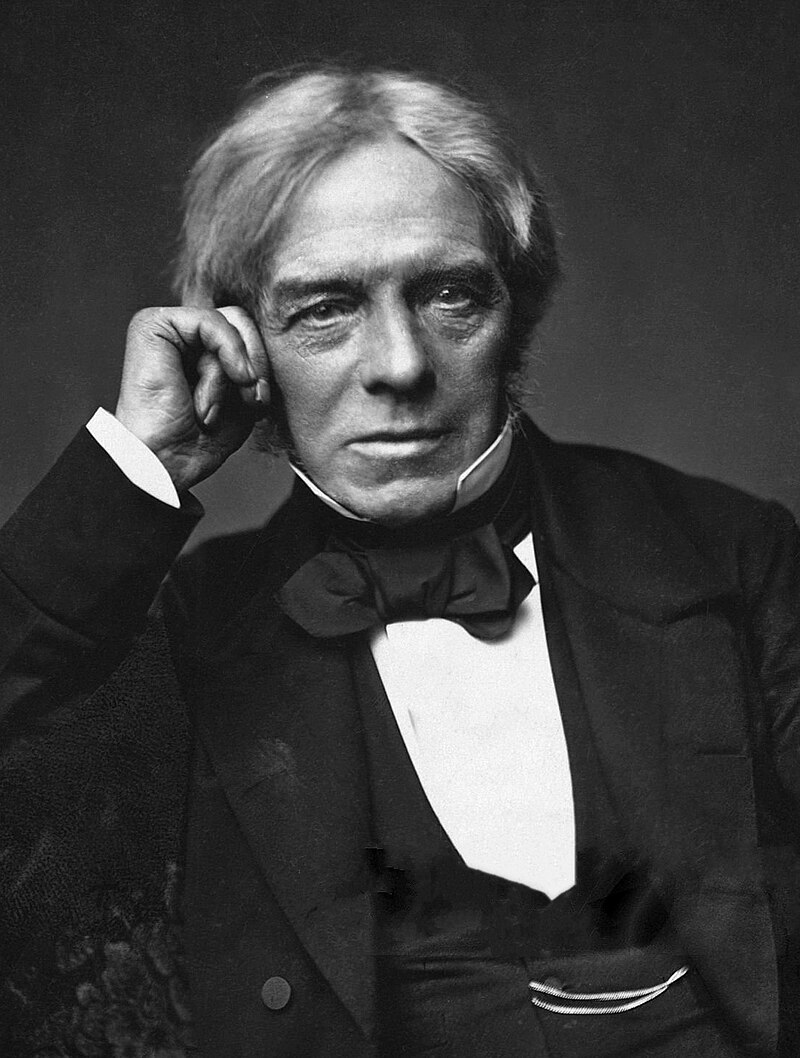
File:Michael_Faraday_sitting_crop.jpg · Wikimedia Commons · See Wikimedia Commons
Michael Faraday
Sign in to savefísico y químico británico
Michael Faraday was a British scientist who lived from 1791 to 1867 and made groundbreaking discoveries in electricity and magnetism that laid the foundation for modern electrical technology. His work revealed fundamental connections between these forces and enabled the development of electric motors, generators, and transformers that power much of our modern world.
AI-generated from the Wikipedia summary — may contain errors.
Wikidata facts
- Instance of
- human
- Given name
- Michael
- Gender
- male
- Citizenship
- Kingdom of Great Britain
- Place of birth
- London
- Place of death
- London
- Occupation
- writer
- Languages spoken
- English language
- Native language
- English language
- Religion
- Glasite
- Academic degree
- honorary degree
- Student of
- Humphry Davy
- Doctoral student
- John Tyndall
- Image
- Michael Faraday. Photograph by Henry Dixon & Son Ltd. Wellcome V0026347.jpg
- Work location
- England
Show 16 more facts
- place of burial
- Highgate Cemetery
- Commons category
- Michael Faraday
- date of birth
- 1791-00-00
- date of death
- 1867-00-00
- topic's main category
- Category:Michael Faraday
- Commons gallery
- Michael Faraday
- influenced by
- Jane Marcet
- name in native language
- Michael Faraday
- on focus list of Wikimedia project
- Wikipedia:Vital articles/Level/4
- student
- Charles Joseph Hullmandel
- writing language
- English language
- Commons Creator page
- Michael Faraday
- topic has template
- Template:Michael Faraday
- P8168
- Bobby Bare
Sources (6)
via Wikidata · CC0
Works in European collections
21 objects attributed to Michael Faraday, held across European museums, libraries & archives · via Europeana
![Chemische Manipulation oder das eigentlich Practische der sichern Ausführung chemischer Arbeiten und Experimente, [1]. [Grundwerk]](https://api.europeana.eu/thumbnail/v2/url.json?uri=https%3A%2F%2Fapi.digitale-sammlungen.de%2Fiiif%2Fimage%2Fv2%2Fbsb11020524_00005%2Ffull%2Ffull%2F0%2Fdefault.jpg&type=IMAGE)
Chemische Manipulation oder das eigentlich Practische der sichern Ausführung chemischer Arbeiten und Experimente, [1]. [Grundwerk]

Experimental researches in electricity, 1851,1

Experimental researches in electricity, Vol. 3

Naturgeschichte einer Kerze : sechs Vorlesungen für die Jugend

The life and letters of Faraday : in two volumes, 1

Experimental Relations of Gold (and other Metals) to Light : (Separatabdruck aus?

Die verschiedenen Kräfte der Materie und ihre Beziehungen zu einander : 6 Vorlesungen für die Jugend

Experimental Researches in chemistry and physics
![Chemische Manipulation oder das eigentlich Practische der sichern Ausführung chemischer Arbeiten und Experimente, [2]. Nachträge zur ersten Ausgabe von Faraday's chemischer Manipulation](https://api.europeana.eu/thumbnail/v2/url.json?uri=https%3A%2F%2Fapi.digitale-sammlungen.de%2Fiiif%2Fimage%2Fv2%2Fbsb10072543_00003%2Ffull%2Ffull%2F0%2Fdefault.jpg&type=IMAGE)
Chemische Manipulation oder das eigentlich Practische der sichern Ausführung chemischer Arbeiten und Experimente, [2]. Nachträge zur ersten Ausgabe von Faraday's chemischer Manipulation

On the Physical Character of the Lines of Magnetic Force : with a plate

Experimental researches in electricity, 1852,1

Chemical manipulation : Being instructions to students in chemistry, on the methods of performing experiments of demonstration or of research, with accuracy and success
![Chemische Manipulation oder das eigentlich Practische der sichern Ausführung chemischer Arbeiten und Experimente, [2]. Nachträge zur ersten Ausgabe von Faraday's chemischer Manipulation](https://api.europeana.eu/thumbnail/v2/url.json?uri=https%3A%2F%2Fapi.digitale-sammlungen.de%2Fiiif%2Fimage%2Fv2%2Fbsb10707830_00005%2Ffull%2Ffull%2F0%2Fdefault.jpg&type=IMAGE)
Chemische Manipulation oder das eigentlich Practische der sichern Ausführung chemischer Arbeiten und Experimente, [2]. Nachträge zur ersten Ausgabe von Faraday's chemischer Manipulation

The chemical History of a Candle: A Course of Lectures delivered before a juvenile Audience at the royal Institution : a course of lectures delivered before a juvenile audience at the royal institution
![Chemische Manipulation oder das eigentlich Practische der sichern Ausführung chemischer Arbeiten und Experimente, [1]. [Grundwerk]](https://api.europeana.eu/thumbnail/v2/url.json?uri=https%3A%2F%2Fapi.digitale-sammlungen.de%2Fiiif%2Fimage%2Fv2%2Fbsb10072542_00007%2Ffull%2Ffull%2F0%2Fdefault.jpg&type=IMAGE)
Chemische Manipulation oder das eigentlich Practische der sichern Ausführung chemischer Arbeiten und Experimente, [1]. [Grundwerk]

The life and letters of Faraday : in two volumes, 2
Untitled

Untitled
Untitled
Untitled
Untitled
Article · Español
Michael Faraday (Reino Unido: /ˈmaɪkəl ˈfæɹəˌdeɪ/; Newington Butt, 22 de septiembre de 1791-Hampton Court, 25 de agosto de 1867) fue un científico británico que estudió el electromagnetismo y la electroquímica. Sus principales descubrimientos incluyen la inducción electromagnética, el diamagnetismo y la electrólisis. A pesar de la escasa educación formal recibida, Faraday es uno de los científicos más influyentes de la historia. Mediante su estudio del campo magnético alrededor de un conductor por el que circula corriente continua, fijó las bases para el desarrollo del concepto de campo electromagnético. También estableció que el magnetismo podía afectar a los rayos de luz y que había una relación subyacente entre ambos fenómenos Descubrió asimismo el principio de inducción electromagnética, el diamagnetismo, las leyes de la electrólisis e inventó algo que él llamó dispositivos de rotación electromagnética, que fueron los precursores del actual motor eléctrico. En el campo de la química, Faraday descubrió el benceno, investigó el clatrato de cloro, inventó un antecesor del mechero de Bunsen, el sistema de números de oxidación e introdujo términos como ánodo, cátodo, electrodo e ion. Finalmente, fue el primero en recibir el título de en la Royal Institution de Gran Bretaña, que ostentaría hasta su muerte. Faraday fue un excelente experimentador, que transmitió sus ideas en un lenguaje claro y simple. Sus habilidades matemáticas, sin embargo, no abarcaban más allá de la trigonometría y el álgebra básica. James Clerk Maxwell tomó el trabajo de Faraday y otros y lo resumió en un grupo de ecuaciones que representan las actuales teorías del fenómeno electromagnético. El uso de líneas de fuerza por parte de Faraday llevó a Maxwell a escribir que "demuestran que Faraday ha sido en realidad un gran matemático. Del cual los matemáticos del futuro derivarán valiosos y prolíficos métodos". La unidad de capacidad eléctrica en el Sistema Internacional de Unidades (SI), el faradio (F), se denomina así en su honor. Albert Einstein tenía colgado en la pared de su estudio un retrato de Faraday junto a los de Isaac Newton y James Clerk Maxwell. El físico neozelandés Ernest Rutherford declaró: "Cuando consideramos la extensión y la magnitud de sus descubrimientos y su influencia en el progreso de la ciencia y de la industria, no existen honores que puedan retribuir la memoria de Faraday, uno de los mayores descubridores científicos de todos los tiempos". Fue miembro de la Royal Society de Londres.
Abstract from DBpedia / Wikipedia · CC BY-SA
Gallery (12)
Available in 153 languages
- Español
- Français
- Deutsch
- 中文
- 日本語
- Русский
- Português
- Italiano
- العربية
- हिन्दी
- Afrikaans
- Albanian
- Albanian
- Amharic
- Aragonese
- Armenian
- Assamese
- Asturian
Show 134 more
- azb
- Azerbaijani
- Bahasa Indonesia
- Bangla
- Bashkir
- Basque
- bat_smg
- be_x_old
- Belarusian
- Bosnian
- Breton
- btm
- Bulgarian
- Buriat
- Burmese
- Catalan
- Central Kurdish
- Chechen
- Chuvash
- Cornish
- Croatian
- Czech
- Danish
- dty
- Egyptian Arabic
- Esperanto
- Estonian
- Fiji Hindi
- Filipino
- Finnish
- Galician
- gcr
- Georgian
- Goan Konkani
- Greek
- Guarani
- Haitian Creole
- Hebrew
- Hungarian
- hyw
- Icelandic
- Ido
- Iloko
- Interlingua
- Irish
- Javanese
- Kannada
- Kanuri
- Kara-Kalpak
- Kazakh
- Khmer
- Kikuyu
- Kurdish
- Kyrgyz
- Latin
- Latvian
- Ligurian
- Limburgish
- Lithuanian
- Lombard
- Low German
- Luxembourgish
- Macedonian
- Madurese
- Maithili
- Malagasy
- Malay
- Malayalam
- Marathi
- Mazanderani
- Mingrelian
- Mongolian
- Moroccan Arabic
- nah
- Nederlands
- Nepali
- Newari
- Northern Frisian
- Norwegian
- Norwegian Nynorsk
- Obolo
- Occitan
- Odia
- olo
- Oromo
- Pampanga
- Pashto
- Piedmontese
- Polski
- Punjabi
- Quechua
- rki
- Romanian
- Rusyn
- Santali
- Scottish Gaelic
- Serbian
- Serbian (Latin)
- Sicilian
- simple
- Sindhi
- Sinhala
- Slovak
- Slovenian
- Somali
- Sundanese
- Svenska
- Swahili
- szy
- Tajik
- Tamil
- Tatar
- Telugu
- Tiếng Việt
- Türkçe
- Ukrainian
- Urdu
- Uzbek
- Veps
- Volapük
- Waray
- Welsh
- Western Frisian
- Western Panjabi
- Wu Chinese
- Yakut
- Yiddish
- Yoruba
- Zeelandic
- zh_min_nan
- zh_yue
- فارسی
- ไทย
- 한국어
via Wikidata sitelinks · CC0