File:Animal_cell_cycle-en.svg · Wikimedia Commons · See Wikimedia Commons
mitotic cell cycle
Sign in to saveAlso known as GO:0000278, mitotic nuclear division, mitosis
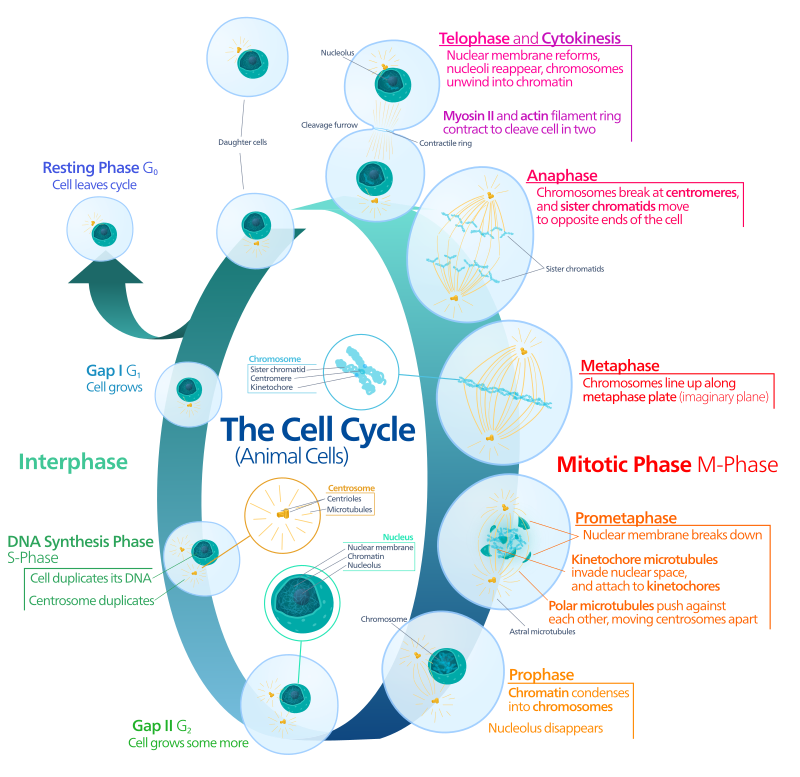
thumb|upright=1.5|Mitosis in the animal cell cycle (phases ordered counter-clockwise).
The mitotic cell cycle is the process by which a cell duplicates its contents and divides into two identical daughter cells, with the phases of this cycle shown in the counter-clockwise diagram for animal cells. This process matters because it allows organisms to grow, repair damaged tissues, and reproduce.
AI-generated from the Wikipedia summary — may contain errors.
Research
41,732 papersvia PubMed
Wikidata facts
- Instance of
- biological process
- Subclass of
- cell cycle
Show 6 more facts
- exact match
- purl.obolibrary.org/obo/GO_0000278
- Commons category
- Mitosis
- topic's main category
- Category:Mitosis
- Commons gallery
- Mitosis
- different from
- meiosis
- described by source
- Granat Encyclopedic Dictionary
Sources (6)
via Wikidata · CC0
~29 min read
Encyclopedic overview
26 sectionsContents
- Discovery
- Phases
- Overview
- Interphase
- Mitosis
- Preprophase (plant cells)
- Prophase
- Prometaphase
- Metaphase
- Anaphase
- Telophase
- Cytokinesis
- Function
- Variations
- Forms of mitosis
- Errors and other variations
- Diagnostic marker
- Related cell processes
- Cell rounding
- Mitotic recombination
- Evolution
- Gallery
- See also
- References
- Further reading
- External links
thumb|upright=1.5|Mitosis in the animal cell cycle (phases ordered counter-clockwise).
Mitosis () is a part of the cell cycle in eukaryotic cells in which replicated chromosomes are separated into two new nuclei. Cell division by mitosis is an equational division which gives rise to genetically identical cells in which the total number of chromosomes is maintained. Mitosis is preceded by the S phase of interphase (during which DNA replication occurs) and is followed by telophase and cytokinesis, which divide the cytoplasm, organelles, and cell membrane of one cell into two new cells containing roughly equal shares of these cellular components. This process ensures that each daughter cell receives an identical set of chromosomes, maintaining genetic stability across cell generations. The different stages of mitosis altogether define the mitotic phase (M phase) of a cell cycle—the division of the mother cell into two daughter cells genetically identical to each other.
Excerpted from Wikipedia’s “mitotic cell cycle” article, available under the CC BY-SA 4.0 licence.
Gallery (44)
Available in 81 languages
- Español
- Français
- Deutsch
- 中文
- 日本語
- Русский
- Português
- Italiano
- العربية
- हिन्दी
- Afrikaans
- Albanian
- Albanian
- Armenian
- Asturian
- Azerbaijani
- Bahasa Indonesia
- Bangla
Show 62 more
- Bashkir
- Basque
- be_x_old
- Belarusian
- Bosnian
- Bulgarian
- Catalan
- Croatian
- Czech
- Danish
- Esperanto
- Estonian
- Finnish
- Galician
- Georgian
- Greek
- Haitian Creole
- Hebrew
- Hungarian
- Ido
- Irish
- Kannada
- Kazakh
- Kurdish
- Kyrgyz
- Latin
- Latvian
- Lingua Franca Nova
- Lithuanian
- Lombard
- Macedonian
- Malay
- Malayalam
- Mongolian
- Nederlands
- Norwegian
- Norwegian Nynorsk
- Occitan
- Oromo
- Polski
- Punjabi
- Romanian
- Serbian
- Serbian (Latin)
- simple
- Sinhala
- Slovak
- Slovenian
- Svenska
- Tamil
- Tiếng Việt
- Türkçe
- Ukrainian
- Urdu
- Uzbek
- Welsh
- Wu Chinese
- zh_min_nan
- zh_yue
- فارسی
- ไทย
- 한국어
via Wikidata sitelinks · CC0