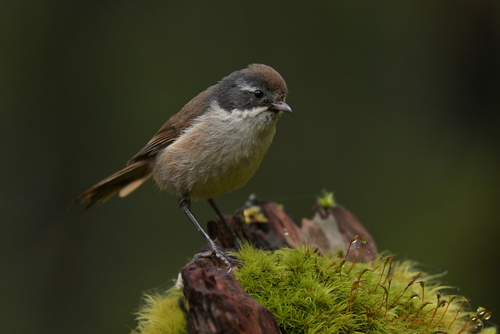
Mohoua novaeseelandiae
Also known as New Zealand creeper, Pipipi
The pīpipi (Mohoua novaeseelandiae), also known as brown creeper or New Zealand creeper, is a small passerine bird endemic to the South Island, Stewart Island and their surrounding islands, in New Zealand. It was called the New Zealand titmouse in the 1780s. It is a specialist insectivore, gleaning insects from branches and leaves. They have strong legs and toes for hanging upside down while feeding.
Species
Pipipi
SPECIES
- KingdomAnimalia
- PhylumChordata
- ClassAves
- OrderPasseriformes
- FamilyAcanthizidae
Observations812
via GBIF
Bird sounds
- call· New Zealand· quality A
- call· New Zealand· quality A
- song· New Zealand· quality A
- song· New Zealand· quality B
Article
16 sectionsContents
- Taxonomy and naming
- Description
- Distribution and habitat
- Behaviour and ecology
- Breeding
- Food and feeding
- Predators, parasites, and diseases
- Parasites – long-tailed cuckoo
- European settlement
- Other information
- Use of UV light vision to recognize foreign eggs
- Song dialect
- Pīpipi and humans
- Notes
- References
- Works cited
The pīpipi (Mohoua novaeseelandiae), also known as brown creeper or New Zealand creeper, is a small passerine bird endemic to the South Island, Stewart Island and their surrounding islands, in New Zealand. It was called the New Zealand titmouse in the 1780s. It is a specialist insectivore, gleaning insects from branches and leaves. They have strong legs and toes for hanging upside down while feeding.
==Taxonomy and naming== The pīpipi was formally described in 1789 by the German naturalist Johann Friedrich Gmelin in his revised and expanded edition of Carl Linnaeus's Systema Naturae. He placed it with the tits in the genus Parus and coined the binomial name Parus novaeseelandiae. Gmelin based his description on the "New-Zealand titmouse" that had been described in 1783 by the English ornithologist John Latham in his book A General Synopsis of Birds. The naturalist Joseph Banks had provided Latham with a watercolour painting of the bird by Georg Forster who had accompanied James Cook on his second voyage to the Pacific Ocean. The specimen had been collected in 1773 at Dusky Sound on the southwest coast of New Zealand. This picture is now the holotype for the species and is in the collection of the Natural History Museum in London.