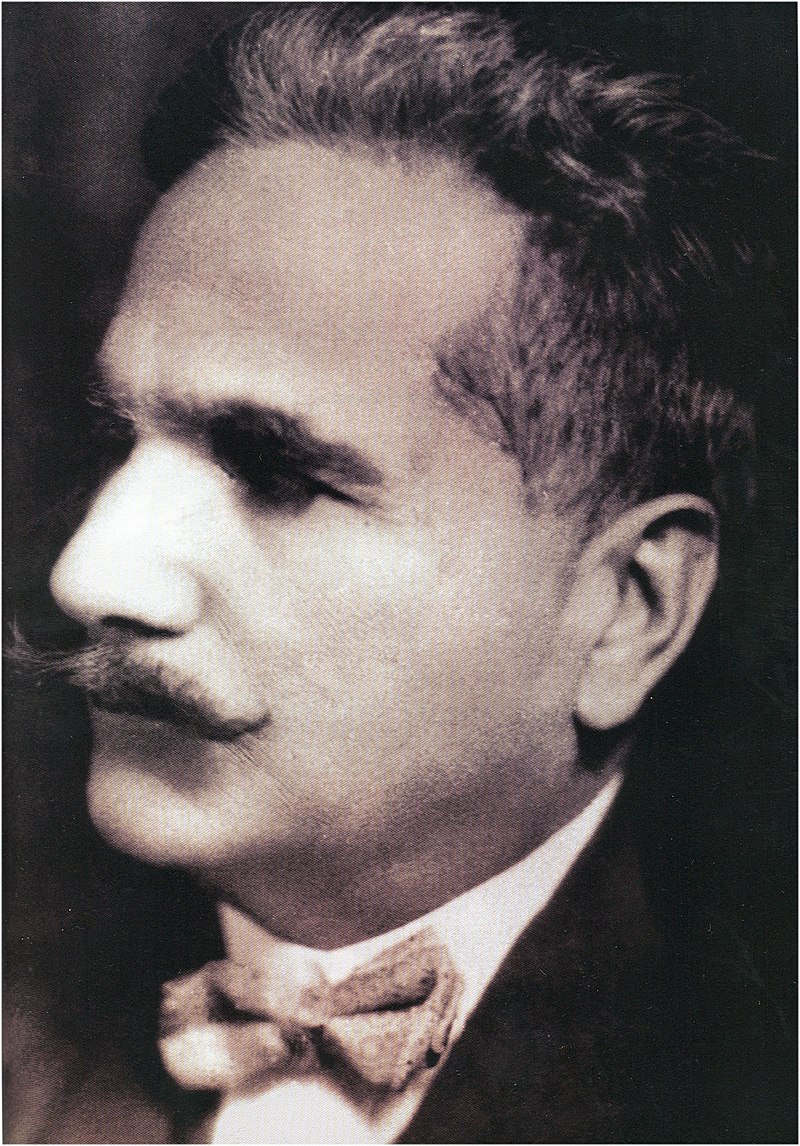
File:Allama_Iqbal.jpg · Wikimedia Commons · See Wikimedia Commons
Muhammad Iqbal
Sign in to saveAlso known as Allama Muhammad Iqbal, Sir Muhammad Iqbal, Allama Iqbal, Muhammed İkbal, Sir Allama Muhammad Iqbal
South Asian Islamic philosopher, poet and politician
Muhammad Iqbal was a South Asian Islamic philosopher, poet, and politician whose writings and ideas shaped intellectual and political thought in the region. His work matters because he blended Islamic philosophy with modern ideas, influencing how Muslims in South Asia understood their faith and identity during a period of significant social and political change.
AI-generated from the Wikipedia summary — may contain errors.
Official website
Allama Muhammad Iqbal
allamaiqbal.com →Link to the official site · 13,629 chars · not written by Vinony
Described at
Muhammad Iqbal
El Poder de la Palabra. The Power of the Word., epdlp, El Poder de la Palabra. The Power of the Word., Muhammad
epdlp.com →Link to a page describing this subject · 3,119 chars · not written by Vinony
Wikidata facts
- Instance of
- human
- Given name
- Muhammad
- Gender
- male
- Citizenship
- British Raj
- Place of birth
- Sialkot
- Place of death
- Lahore
- Child
- Javid Iqbal
- Occupation
- lawyer
- Languages spoken
- English language
- Religion
- Islam
- Award
- Knight Bachelor
- Notable work
- Gift from Hijaz
- Field of work
- politics
- Official website
- www.allamaiqbal.com
- Image
- Iqbal 2.jpg
- Residence
- Sialkot
Show 11 more facts
- influenced by
- Syed Abul Ala Maududi
- Commons category
- Muhammad Iqbal
- date of birth
- 1873-01-01
- date of death
- 1938-00-00
- topic's main category
- Category:Muhammad Iqbal
- Commons gallery
- Muhammad Iqbal
- writing language
- Urdu
- name in native language
- علامه محمد اقبال
- described at URL
- www.epdlp.com/escritor.php?id=3063
- on focus list of Wikimedia project
- Wikipedia:Vital articles/Level/4
- place of burial
- Lahore Fort
Sources (8)
via Wikidata · CC0
~40 min read
Encyclopedic overview
Sir Muhammad Iqbal (9 November 1877 – 21 April 1938) was an Islamic philosopher and poet. His poetry in Urdu is considered to be among the greatest of the 20th century, and his vision of a cultural and political ideal for the Muslims of British India is widely regarded as having animated the impulse for the Pakistan Movement. He is commonly referred to by the honorific Allamah (Persian: علامه, transl. "learned") and widely considered one of the most important and influential Muslim thinkers and Islamic religious philosophers of the 20th century.
Iqbal was born and raised in Sialkot, Punjab, British India and studied at Scotch Mission College in Sialkot and Government College in Lahore. He taught Arabic at the Oriental College, Lahore, from 1899 until 1903, during which time he wrote prolifically. Notable among his Urdu poems from this period are "Parinde Ki Faryad" ("A Bird's Prayer"), an early contemplation on animal rights, and "Tarana-e-Hindi" ("Anthem of the Indians"), a patriotic poem—both composed for children. In 1905, he departed from India to pursue further education in Europe, first in England and later in Germany. In England, he earned a second BA at Trinity College, Cambridge, and subsequently qualified as a barrister at Lincoln's Inn. In Germany, he obtained a PhD in philosophy at the Ludwig-Maximilians-Universität München (LMU), with his thesis focusing on "The Development of Metaphysics in Persia" in 1908. Upon his return to Lahore in 1908, Iqbal established a law practice but primarily focused on producing scholarly works on politics, economics, history, philosophy, and religion. He is most renowned for his poetic compositions, including "Asrar-e-Khudi", "Rumuz-e-Bekhudi", and "Bang-e-Dara." His literary works in the Persian language garnered him recognition in Iran.
Excerpted from Wikipedia’s “Muhammad Iqbal” article, available under the CC BY-SA 4.0 licence.
Gallery (12)
Available in 85 languages
- Español
- Français
- Deutsch
- 中文
- 日本語
- Русский
- Português
- Italiano
- العربية
- हिन्दी
- Albanian
- Amharic
- Armenian
- Asturian
- azb
- Azerbaijani
- Bahasa Indonesia
- Bangla
Show 66 more
- Bashkir
- Basque
- Belarusian
- Bishnupriya
- Bulgarian
- Catalan
- Central Kurdish
- Croatian
- Czech
- Danish
- Egyptian Arabic
- Esperanto
- Estonian
- Finnish
- Galician
- Goan Konkani
- Greek
- Hausa
- Hebrew
- Hungarian
- Javanese
- Kannada
- Kashmiri
- Kurdish
- Latin
- Latvian
- Lingua Franca Nova
- Lithuanian
- Malagasy
- Malay
- Malayalam
- Marathi
- Minangkabau
- Mirandese
- Nederlands
- Norwegian
- Odia
- Pashto
- Polski
- Punjabi
- Romanian
- Sanskrit
- Scots
- Serbian
- simple
- Sindhi
- Slovenian
- Sundanese
- Svenska
- Tajik
- Tamil
- Telugu
- Tiếng Việt
- Türkçe
- Ukrainian
- Urdu
- Uyghur
- Uzbek
- Waray
- Western Panjabi
- Wu Chinese
- Yoruba
- zh_yue
- فارسی
- ไทย
- 한국어
via Wikidata sitelinks · CC0