Encyclopedia of Life · EOL (see source)
Negativicutes
Sign in to saveThe Negativicutes are a class of bacteria in the phylum Bacillota, whose members have a peculiar cell wall with a lipopolysaccharide outer membrane which stains gram-negative, unlike most other members of the Bacillota. Although several neighbouring Clostridia species (firmicute bacteria) also stain gram-negative, the proteins responsible for the unusual diderm structure of the Negativicutes may have actually been laterally acquired from Pseudomonadota (formerly Proteobacteria). Additional research is required to confirm the origin of the diderm cell envelope in the Negativicutes.
In the Vinony graph
Vinony's link graph records 782 inbound references to Negativicutes, and connects out to Spirochaetae, Pseudomonadota and Deinococcota.
It is catalogued under topics including Bacteria classes and Negativicutes.
Vinony links it to 10 Wikipedia language editions.
Species
CLASS
- KingdomBacteria
- PhylumFirmicutes_C
- ClassNegativicutes
Negativicutes es un classe de Firmicutes.
via GBIF
Wikidata facts
Show 7 more facts
- taxon name
- Negativicutes
- taxon rank
- class
- topic's main category
- Category:Negativicutes
- Gram staining
- gram-negative bacteria
- LPSN URL
- lpsn.dsmz.de/class/negativicutes
- taxonomic type
- Selenomonad
- Commons category
- Negativicutes
Sources (1)
via Wikidata · CC0
~4 min read
Encyclopedic overview
5 sectionsContents
- Taxonomy
- Molecular signatures
- Phylogeny
- See also
- References
The Negativicutes are a class of bacteria in the phylum Bacillota, whose members have a peculiar cell wall with a lipopolysaccharide outer membrane which stains gram-negative, unlike most other members of the Bacillota. Although several neighbouring Clostridia species (firmicute bacteria) also stain gram-negative, the proteins responsible for the unusual diderm structure of the Negativicutes may have actually been laterally acquired from Pseudomonadota (formerly Proteobacteria). Additional research is required to confirm the origin of the diderm cell envelope in the Negativicutes.
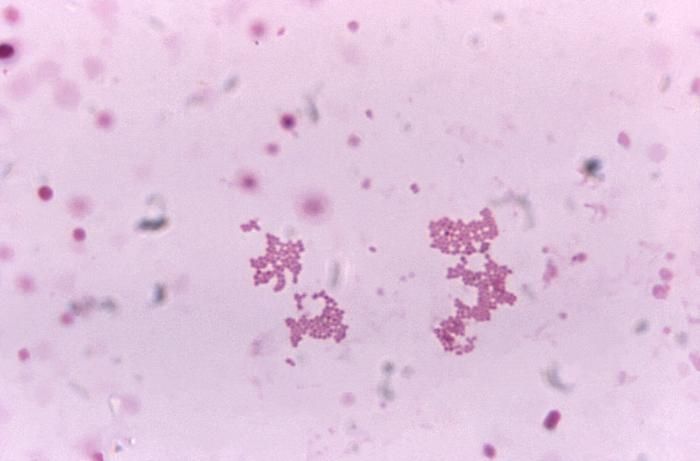
Most members of this class are obligate anaerobes, and occur in habitats such as rivers, lakes, and the intestines of vertebrates. They range from spherical forms, such as Megasphaera and Veillonella, to curved rods, as typified by the selenomonads. Selenomonas has a characteristic crescent shape, with flagella inserted on the concave side, while Sporomusa is similar, but nonmotile. Their names refer to this distinctive morphology: selene means moon, and musa means banana.
Excerpted from Wikipedia’s “Negativicutes” article, available under the CC BY-SA 4.0 licence.