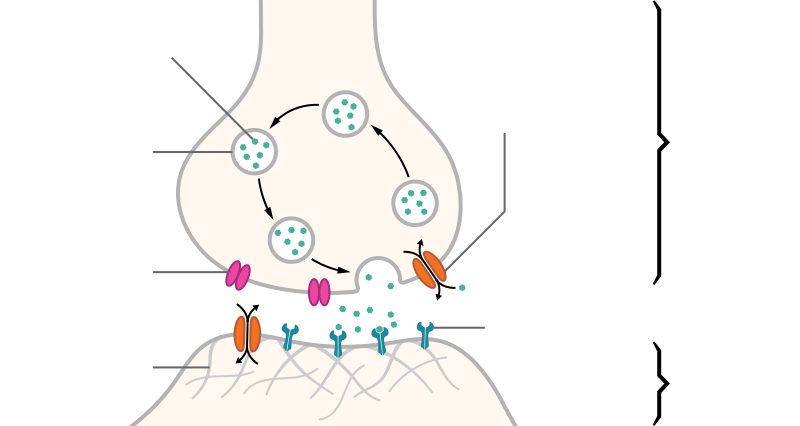
File:SynapseSchematic_lines.svg · Wikimedia Commons · See Wikimedia Commons
neurotransmitter
Sign in to saveAlso known as neurotransmitters
A neurotransmitter is a signaling molecule secreted by a neuron to affect another cell across a synapse. The cell receiving the signal, or target cell, may be another neuron, but could also be a gland or muscle cell.
A neurotransmitter is a chemical messenger that one nerve cell releases to send signals to another cell across a tiny gap called a synapse. This system allows nerve cells to communicate with other nerve cells, glands, and muscles, enabling your brain and body to coordinate everything from movement to mood.
AI-generated from the Wikipedia summary — may contain errors.
Wikidata facts
- Image
- SynapseSchematic lines.svg
Show 3 more facts
- Commons category
- Neurotransmitters
- topic's main category
- Category:Neurotransmitters
- topic has template
- Template:Neurotransmitters
via Wikidata · CC0
~49 min read
Encyclopedic overview
28 sectionsContents
- Mechanism and cycle
- Synthesis
- Storage
- Release
- Receptor interaction
- Elimination
- Discovery
- Identification
- Actions
- Modulation
- Neurotransmitter actions
- Types
- List of neurotransmitters, peptides, and gaseous signaling molecules
- Neurotransmitter systems {{anchor|table}}
- Effects
- Drug effects
- Agonists
- Antagonists
- Drug antagonists
- Diseases and disorders<!-- This section needs a lot more detail! -->
- Dopamine
- Serotonin
- Glutamate
- Neurotransmitter imbalance
- See also
- Notes
- References
- External links
A neurotransmitter is a signaling molecule secreted by a neuron to affect another cell across a synapse. The cell receiving the signal, or target cell, may be another neuron, but could also be a gland or muscle cell.
Neurotransmitters are released from synaptic vesicles into the synaptic cleft where they are able to interact with neurotransmitter receptors on the target cell. Some neurotransmitters are also stored in large dense core vesicles. The neurotransmitter's effect on the target cell is determined by the receptor it binds to. Many neurotransmitters are synthesized from simple and plentiful precursors such as amino acids, which are readily available and often require a small number of biosynthetic steps for conversion.
Excerpted from Wikipedia’s “neurotransmitter” article, available under the CC BY-SA 4.0 licence.
Gallery (11)
Available in 70 languages
- Español
- Français
- Deutsch
- 中文
- 日本語
- Русский
- Português
- Italiano
- العربية
- हिन्दी
- Afrikaans
- Armenian
- Asturian
- Azerbaijani
- Bahasa Indonesia
- Bangla
- Basque
- be_x_old
Show 51 more
- Belarusian
- Bosnian
- Bulgarian
- Catalan
- Central Kurdish
- Croatian
- Czech
- Danish
- Egyptian Arabic
- Esperanto
- Estonian
- Filipino
- Finnish
- Galician
- Georgian
- Greek
- Haitian Creole
- Hebrew
- Hungarian
- Icelandic
- Irish
- Latin
- Latvian
- Lingua Franca Nova
- Lithuanian
- Malay
- Malayalam
- Mongolian
- Nederlands
- Norwegian
- Occitan
- Pashto
- Polski
- Romanian
- Serbian
- Serbian (Latin)
- simple
- Slovak
- Slovenian
- Svenska
- Tiếng Việt
- Türkçe
- Ukrainian
- Urdu
- Uzbek
- Waray
- Wu Chinese
- zh_yue
- فارسی
- ไทย
- 한국어
via Wikidata sitelinks · CC0