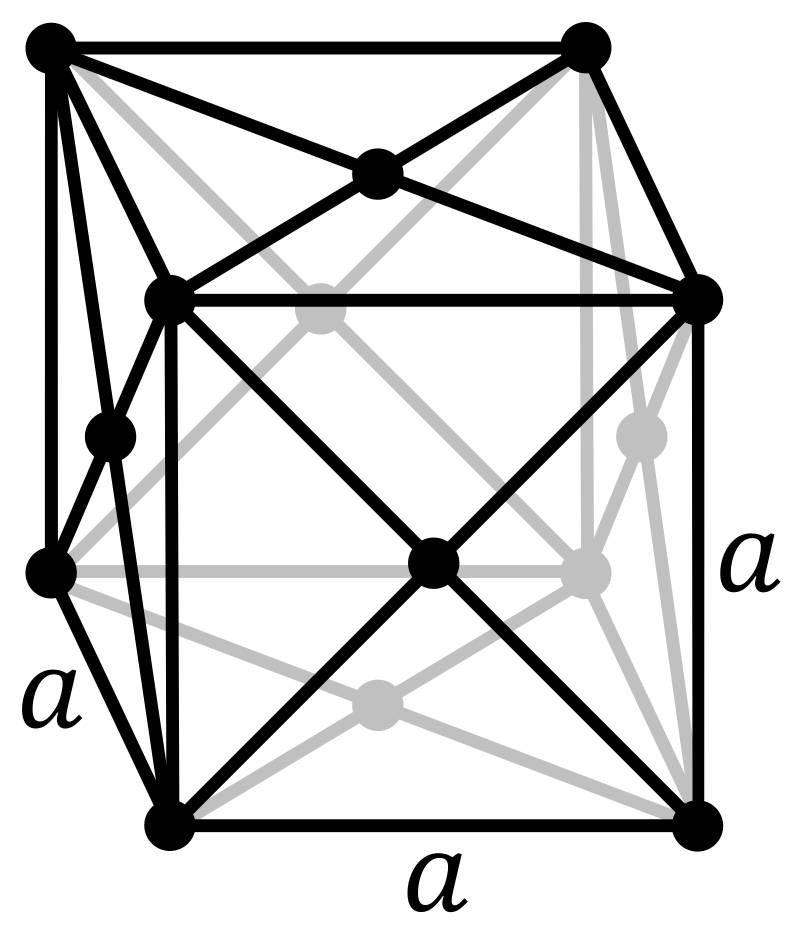
File:Cubic-face-centered.svg · Wikimedia Commons · See Wikimedia Commons
nobelium
Sign in to saveAlso known as No, element 102, Unb, unnilbium, 102No
Nobelium is a synthetic chemical element; it has symbol No and atomic number 102. It is named after Alfred Nobel, the inventor of dynamite and benefactor of science. A radioactive metal, it is the tenth transuranium element, the second transfermium, and is the fourteenth member of the actinide series. Like all elements with atomic number over 100, nobelium can only be produced in particle accelerators by bombarding lighter elements with charged particles. A total of twelve nobelium isotopes are known to exist; the most stable is 259No with a half-life of 58 minutes, but the shorter-lived 255No
OverviewAI-generated
Nobelium is a chemical element with the symbol No and the atomic number 102. It was discovered in 1958. The element has an electronegativity of 1.3. Its chemical formula is No, and its canonical SMILES representation is [No]. The Unicode character for the element is 鍩.
The standard atomic weight of nobelium is 259.10100. According to IUPAC nomenclature, the name is nobelium. The InChIKey for the substance is ORQBXQOJMQIAOY-UHFFFAOYSA-N. It has a topological polar surface area of 0 and carries a charge of 0. There are no hydrogen bond donors or acceptors associated with the element.
Nobelium is referenced by 569 other encyclopedia articles. In scientific literature, there are 36 records associated with the query "nobelium". The element is categorized under the Commons category "Nobelium".
Synthesized by Vinony from 21 facts across 4 sources: Wikidata, PubMed, PubChem, Vinony graph. Generated from structured data (not the Wikipedia text) and checked against those facts — may still contain errors.
Chemical data
- Formula
- No
- Molecular weight
- 259.101 g/mol
- IUPAC name
- nobelium
- SMILES
- [No]
- InChIKey
- ORQBXQOJMQIAOY-UHFFFAOYSA-N
- Polar surface area
- 0 Ų
- H-bond donors
- 0
- H-bond acceptors
- 0
- Formal charge
- 0
via PubChem
Research
36 papers- Nobelium non-believers.Nature chemistry · 2014
- Nobelium: tracer chemistry of the divalent and trivalent ions.Science (New York, N.Y.) · 1968
- Probing Sizes and Shapes of Nobelium Isotopes by Laser Spectroscopy.Physical review letters · 2018
- Atom-at-a-time laser resonance ionization spectroscopy of nobelium.Nature · 2016
- Laser Resonance Chromatography of Superheavy Elements.Physical review letters · 2020
via PubMed
Wikidata facts
- Instance of
- synthetic element
- Part of
- actinide
- Named after
- Alfred Nobel
- Image
- Nobelium.svg
Show 16 more facts
- described by source
- Armenian Soviet Encyclopedia
- atomic number
- 102
- element symbol
- Unb
- Commons category
- Nobelium
- time of discovery or invention
- 1958-01-01
- topic's main category
- Category:Nobelium
- Commons gallery
- Nobelium
- canonical SMILES
- [No]
- chemical formula
- No
- discoverer or inventor
- Glenn T. Seaborg
- Unicode character
- 鍩
- electronegativity
- 1.3
- different from
- Nobel
- on focus list of Wikimedia project
- Wikipedia:Vital articles/Level/4
- topic has template
- Template:Infobox nobelium
- maintained by WikiProject
- WikiProject Elements
Sources (6)
via Wikidata · CC0
~24 min read
Encyclopedic overview
12 sectionsContents
- Introduction
- Discovery
- Characteristics
- Physical
- Chemical
- Atomic
- Isotopes
- Preparation and purification
- Notes
- References
- Bibliography
- External links
Nobelium is a synthetic chemical element; it has symbol No and atomic number 102. It is named after Alfred Nobel, the inventor of dynamite and benefactor of science. A radioactive metal, it is the tenth transuranium element, the second transfermium, and is the fourteenth member of the actinide series. Like all elements with atomic number over 100, nobelium can only be produced in particle accelerators by bombarding lighter elements with charged particles. A total of twelve nobelium isotopes are known to exist; the most stable is 259No with a half-life of 58 minutes, but the shorter-lived 255No (half-life 3.1 minutes) is most commonly used in chemistry because it can be produced on a larger scale.
Chemistry experiments have confirmed that nobelium behaves as a heavier homolog to ytterbium in the periodic table. The chemical properties of nobelium are not completely known: they are mostly only known in aqueous solution. Before nobelium's discovery, it was predicted that it would show a stable +2 oxidation state as well as the +3 state characteristic of the other actinides; these predictions were later confirmed, as the +2 state is much more stable than the +3 state in aqueous solution and it is difficult to keep nobelium in the +3 state.
Excerpted from Wikipedia’s “nobelium” article, available under the CC BY-SA 4.0 licence.
Gallery (13)
Available in 133 languages
- Español
- Français
- Deutsch
- 中文
- 日本語
- Русский
- Português
- Italiano
- العربية
- हिन्दी
- Afrikaans
- Albanian
- Amharic
- Angika
- Armenian
- Asturian
- Azerbaijani
- Bahasa Indonesia
Show 114 more
- Balinese
- Bangla
- Bashkir
- Basque
- be_x_old
- Belarusian
- Bhojpuri
- Bikol
- Bosnian
- Breton
- Bulgarian
- Burmese
- Catalan
- cdo
- Cebuano
- Central Kurdish
- Chuvash
- Cornish
- Corsican
- Croatian
- Czech
- Danish
- Egyptian Arabic
- Esperanto
- Estonian
- Faroese
- Fiji Hindi
- Filipino
- Finnish
- Friulian
- Galician
- Georgian
- Greek
- Gujarati
- Haitian Creole
- Hakka Chinese
- Hebrew
- Hungarian
- Icelandic
- Ido
- Interlingua
- Irish
- Javanese
- Kannada
- Kazakh
- kbp
- Komi
- Kyrgyz
- Latin
- Latvian
- Ligurian
- Limburgish
- Lithuanian
- Lojban
- Luxembourgish
- Macedonian
- Malay
- Malayalam
- Manx
- Marathi
- Mongolian
- Moroccan Arabic
- Nederlands
- Newari
- Northern Frisian
- Norwegian
- Norwegian Nynorsk
- Novial
- Odia
- olo
- Pashto
- Piedmontese
- Polski
- Quechua
- roa_rup
- Romanian
- Sanskrit
- Sardinian
- Saterland Frisian
- Scottish Gaelic
- Serbian
- Serbian (Latin)
- Sicilian
- simple
- Slovak
- Slovenian
- Svenska
- Tajik
- Tamil
- Tatar
- Telugu
- Tiếng Việt
- Türkçe
- Ukrainian
- Urdu
- Uyghur
- Uzbek
- Veps
- Volapük
- Waray
- Welsh
- Western Mari
- Western Panjabi
- Wu Chinese
- Yakut
- Yiddish
- Yoruba
- zh_classical
- zh_min_nan
- zh_yue
- Zulu
- فارسی
- ไทย
- 한국어
via Wikidata sitelinks · CC0