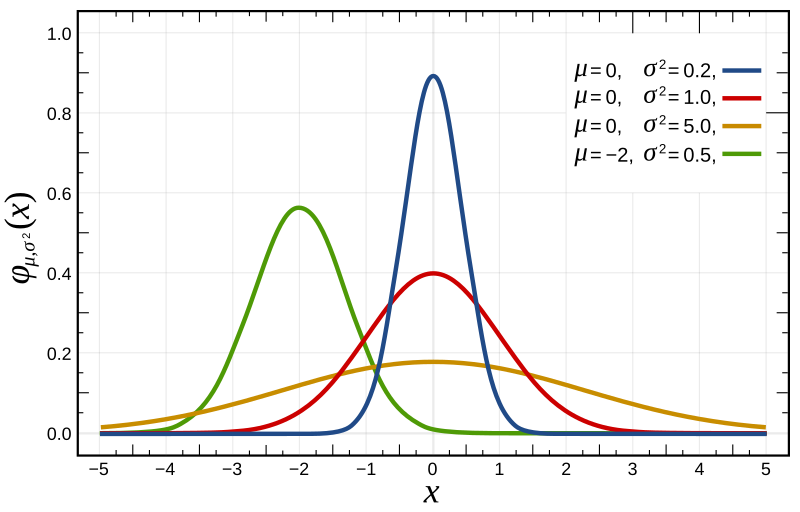
File:Normal_Distribution_PDF.svg · Wikimedia Commons · See Wikimedia Commons
A normal distribution is a bell-shaped curve that describes how many random events or measurements cluster around an average value, with fewer occurrences at the extremes. It matters because many natural phenomena—like heights, test scores, and measurement errors—tend to follow this pattern, making it a fundamental tool for understanding and predicting real-world data.
AI-generated from the Wikipedia summary — may contain errors.
Research
130,632 papers- The normal distribution of the hypoxic ventilatory response and methodological impacts: a meta-analysis and computational investigation.The Journal of physiology · 2023Oeung B, Pham K, Olfert IM et al.DOI: 10.1113/JP284767
- Distribution of data in cellular electrophysiology: Is it always normal?Progress in biophysics and molecular biology · 2020Kula R, Bébarová M, Matejovič P et al.DOI: 10.1016/j.pbiomolbio.2020.05.008
- Descriptive statistics and normality tests for statistical data.Annals of cardiac anaesthesia · 2019Mishra P, Pandey CM, Singh U et al.DOI: 10.4103/aca.ACA_157_18
- Parametric or nonparametric statistical tests: Considerations when choosing the most appropriate option for your data.ReviewCytopathology : official journal of the British Society for Clinical Cytology · 2022Vrbin CMDOI: 10.1111/cyt.13174
- Do overactive bladder symptoms and their treatment-associated changes exhibit a normal distribution? Implications for analysis and reporting.Neurourology and urodynamics · 2020Amiri M, Murgas S, Stang A et al.DOI: 10.1002/nau.24275
- Rayleigh-half normal distribution for modeling tooth movement data.Journal of biopharmaceutical statistics · 2020Abd El-Monsef MME, Abd El-Raouf MMDOI: 10.1080/10543406.2019.1684312
- Determination of Normal Distribution of Distended Colon Volumes to Guide Performance of Colonic Imaging With Fluid Distention.ReviewCurrent problems in diagnostic radiology · 2016Zheng KS, Small WC, Mittal PK et al.DOI: 10.1067/j.cpradiol.2015.11.001
- Variability in the Log Domain and Limitations to Its Approximation by the Normal Distribution.CPT: pharmacometrics & systems pharmacology · 2020Elassaiss-Schaap J, Duisters KDOI: 10.1002/psp4.12507
via PubMed
Wikidata facts
- Subclass of
- continuous probability distribution
- Named after
- Carl Friedrich Gauss
- Image
- Normal Distribution PDF.svg
Show 8 more facts
- Stack Exchange tag
- stats.stackexchange.com/tags/normal-distribution
- facet of
- statistics
- Commons category
- Normal distribution
- topic's main category
- Category:Normal distribution
- TeX string
- \mathcal{N}(\mu,\,\sigma^2)
- definition domain
- set of real numbers
- on focus list of Wikimedia project
- Wikipedia:Vital articles/Level/4
- maintained by WikiProject
- WikiProject Mathematics
via Wikidata · CC0
Article · Français
En théorie des probabilités et en statistique, les lois normales sont parmi les lois de probabilité les plus utilisées pour modéliser des phénomènes naturels issus de plusieurs événements aléatoires. Elles sont en lien avec de nombreux objets mathématiques dont le mouvement brownien, le bruit blanc gaussien ou d'autres lois de probabilité. Elles sont également appelées lois gaussiennes, lois de Gauss ou lois de Laplace-Gauss des noms de Laplace (1749-1827) et Gauss (1777-1855), deux mathématiciens, astronomes et physiciens qui l'ont étudiée. Plus formellement, une loi normale est une loi de probabilité absolument continue qui dépend de deux paramètres : son espérance, un nombre réel noté μ, et son écart type, un nombre réel positif noté σ. La densité de probabilité de la loi normale d'espérance μ, et d'écart type σ est donnée par : . La courbe de cette densité est appelée courbe de Gauss ou courbe en cloche, entre autres. C'est la représentation la plus connue de ces lois. Lorsqu'une variable aléatoire X suit une loi normale, elle est dite gaussienne ou normale et il est habituel d'utiliser la notation avec la variance σ2 : . La loi normale de moyenne nulle et d'écart type unitaire, , est appelée loi normale centrée réduite ou loi normale standard. Parmi les lois de probabilité, les lois normales prennent une place particulière grâce au théorème central limite. En effet, elles correspondent au comportement, sous certaines conditions, d'une suite d'expériences aléatoires similaires et indépendantes lorsque le nombre d'expériences est très élevé. Grâce à cette propriété, une loi normale permet d'approcher d'autres lois et ainsi de modéliser de nombreuses études scientifiques comme des mesures d'erreurs ou des tests statistiques, en utilisant par exemple les tables de la loi normale centrée réduite.
Abstract from DBpedia / Wikipedia · CC BY-SA
Gallery (12)
Available in 74 languages
- Español
- Français
- Deutsch
- 中文
- 日本語
- Русский
- Português
- Italiano
- العربية
- हिन्दी
- Albanian
- Albanian
- Armenian
- Asturian
- azb
- Azerbaijani
- Bahasa Indonesia
- Basque
Show 55 more
- Belarusian
- Bosnian
- Bulgarian
- Catalan
- Chuvash
- Croatian
- Czech
- Danish
- Esperanto
- Estonian
- Filipino
- Finnish
- Galician
- Georgian
- Greek
- Hebrew
- Hungarian
- Icelandic
- Irish
- Kazakh
- Latin
- Latvian
- Lithuanian
- Lombard
- Macedonian
- Malay
- Marathi
- Nederlands
- Northern Frisian
- Norwegian
- Norwegian Nynorsk
- Piedmontese
- Polski
- Romanian
- Serbian
- Serbian (Latin)
- simple
- Slovak
- Slovenian
- Sundanese
- Svenska
- Tamil
- Tatar
- Tiếng Việt
- Türkçe
- Ukrainian
- Urdu
- Welsh
- Wu Chinese
- Yiddish
- zh_min_nan
- zh_yue
- فارسی
- ไทย
- 한국어
via Wikidata sitelinks · CC0