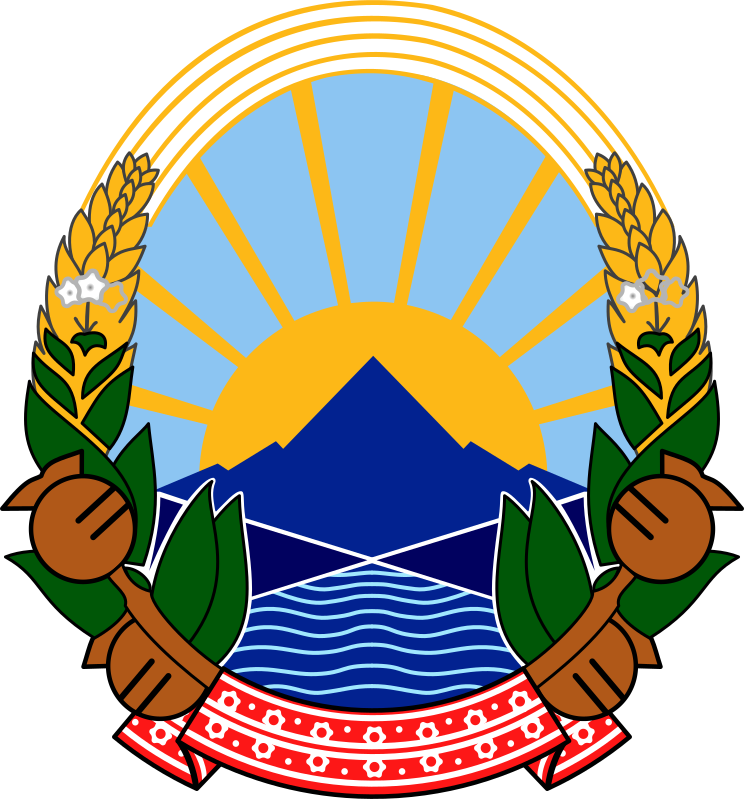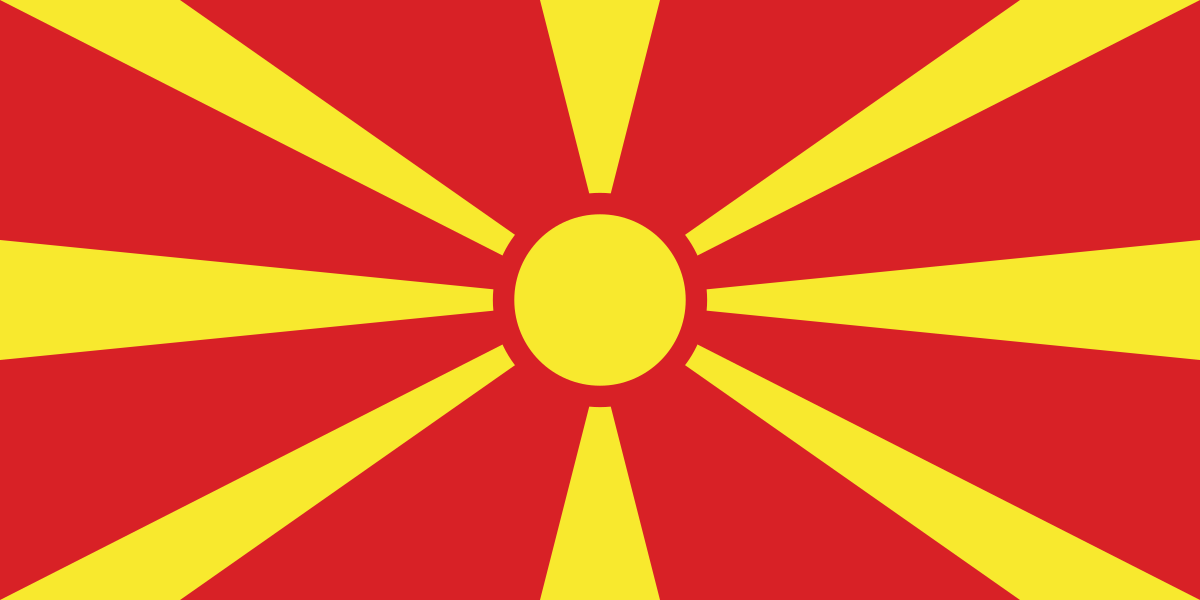
Also known as Republic of North Macedonia, FYROM, FYR Macedonia, Former Yugoslav Republic of Macedonia, Republic of Macedonia, Macedonia
สาธารณรัฐในยุโรปตะวันออกเฉียงใต้
North Macedonia is a landlocked country in Southeast Europe bordered by Greece, Albania, Bulgaria, Kosovo, and Serbia, with its capital in Skopje and a population of over 1.83 million people who are primarily ethnic Macedonians with significant Albanian and other minority populations. It occupies roughly the northern third of the broader geographical region of Macedonia and serves as an important crossroads between different Balkan nations and ethnic communities.
AI-generated from the Wikipedia summary — may contain errors.
via Open-Meteo
The country officially changed its name from the Republic of Macedonia (Macedonian: Македонија, Makedonija) to the Republic of North Macedonia in February 2019 in order to settle a dispute over its name with Greece. However, hardly any Macedonian refers to their country as "North Macedonia"; instead, they continue to use "Macedonia" and find "North" to be offensive. It was also known as "the former Yugolav Republic of Macedonia (FYROM)" prior to the official name change.
North Macedonia is a country with several ethnic minorities. The majority of the population is ethnic Macedonian and Orthodox Christian but there is also a significant Albanian Muslim minority, and Albanians form majorities in areas in the northwest.
thumb|450px|Visa policy of North Macedonia
thumb|Ohrid is known for its countless churches. thumb|The rugged landscapes of Galičica National Park.
This lovely, compact country has a surprising myriad of attractions to offer. It's a fascinating mix of the ancient Balkan, the laid-back Mediterranean and the hip and happening vibe of modern Europe.
It all starts in lively Skopje, the country's main city and the centre of its economy. It offers great shopping and party opportunities, but also grand historic monuments. The 5th century Tvrdina Kale Fortress is one of the main landsmarks, together with the beautiful Sveti Spas Church, the charming old Ottoman bazaar Čaršija and the Kameni Most. This 600 year old Stone Bridge will take you right onto the city's main square, where a gigantic statue of Alexander the Great awaits. If you're up for a hike, make your way up to the enormous Millennium Cross on top of Vodno mountain, or take the rope railway to get the same views with less effort. If summer makes the city hard to bear, follow the locals to the cool shores of Lake Matka just out of town, where you can explore the gorge and caves through hikes and kayak tours.
Smaller but a visitor's favourite is the city of Ohrid, famous for its countless Byzantine churches. Beautifully situated on Lake Ohrid, this place is listed by UNESCO as both a cultural and a natural monument. It's home to one of the most prominent collections of Byzantine icons in the world, second only to that of the famous Tretiakov Gallery in Moscow, as …
2 mapped locations
via REST Countries
via World Bank Open Data · CC BY 4.0
via Wikimedia Pageviews API
via PubMed
via Wikidata · CC0
thumb|Fish plate, Ohrid If you are on a tight budget, try one of the Skara (grill) places. There are quite a few up-market restaurants serving better quality food on the waterfront, but these cater to tourists, so don't be surprised by a rather sizeable bill at the end of your meal.
Service at the restaurants and cafés nationwide tend to be slow-ish, either because these businesses are chronically understaffed, or because of the general laid-back culture. Consider yourself lucky if your food is served within half an hour after you get seated.
Rakija is a strong grape brandy that has the best claim to being the republic's national beverage. Homemade one can be bought for about 100 dinar per ½ L (sold in water bottles) in local markets from some fruit vendors, which sometimes sell quite high quality and percentage. Keep looking for yellowish one, which was fermented in wood barrels for a while.
Macedonians boast the largest winery in the Balkan area—the Tikveš (Tikvesh) winery in Kavadarci. Red wines are usually better than white ones. Try T'ga za Jug, a Macedonian affordable red wine made from a local grape variety called Vranec. Local white wines include Traminec and Temjanika.
The local beer market is dominated by Skopsko (Скопско, "of Skopje", following the Slavic convention of naming beers after their origin), a drinkable, if not entirely distinctive, lager. There are also many breweries which brew surprisingly good-tasting beer.
Sale of any alcoholic beverages from the stores end by 21:00 all over the country, but in the restaurants and cafés, it's business as usual.
Unlike much of the rest of the Balkans, sparkling water or water with gas is instead mineral water, or kisela voda.
The most common coffee drink in cafés is the macchiato (макијато, espresso topped by a foamy cream), which can be ordered as a single shot, small, mali macchiato, or double shot, large, golem macchiato. Cold cappuccinos with flavoured creams coming in large glasses are also popular in summer.
Tea is pretty much limited to…
Being the national tourist attraction, Ohrid is more expensive than any other destination in North Macedonia. Hotel prices, primarily those of high-end hotels, are very expensive throughout the country and charge double rates to foreigners. It is therefore advisable to stay in private accommodation. If someone does not ask you at the bus station, you can always consult one of the many travel agencies in and around the centre. If you do opt for private accommodation make sure you see the room first and then decide. Payment is normally made in advance and should cost no more than €10-15 per night per person in peak season and half that during the rest of the year. Finding suitable accommodation in July and August is not easy, so try to book through a travel agent in advance.
When visiting Lake Ohrid, staying in nearby Struga as opposed to the more popular Ohrid is a wise alternative for the price and tourist-trap conscious.
North Macedonia is a safe country. Driving is not ill-advised, but it's recommended for foreigners to try to use taxis and public transport wherever possible. As in all countries, keep an eye out for pickpockets and all valuables safe. Hotels and most private accommodation will offer a safe to store valuables and cash in.
Most people are very friendly and hospitable.
Water is safe to drink and there are public drinking water fountains in most public places. It is advisable to wash all fruit and vegetables.
Use caution when eating red meat at restaurants. Although Macedonian cuisine typically revolves around grills ("skara") there are some restaurants that do not use proper or clean methods of cooking, which if practised in many Western countries would be seen as a violation of certain health regulations. Bad restaurants can be spotted easily; they will probably not look very appealing and will not have many customers. However, the vast majority of restaurants in North Macedonia serve good quality food.
thumb|Part of Kale fortress, Skopje
It is advisable to simply refer to the country as "Macedonia". The "north" part of the name, added in 2019 to resolve a naming dispute with Greece, has not made it into everyday use among Macedonians and may never do so. Many, in fact, consider it offensive. Macedonia is directly transliterated from the Cyrillic as Makedonija, and is pronounced roughly how it would appear to an English speaker: "mahk-eh-DOHN-ee-yah".
Touchy topics are Macedonian-Bulgarian, Macedonian-Albanian, and Macedonian-Greek relations. Most Macedonians can hold strong political opinions regarding their neighbours and won't shy away from expressing their views in most cases. Politics often finds its way into conversation over a cup of coffee. To keep from upsetting your hosts or new-found friends, avoid topics such as the 2001 war against the NLA, Macedonia's partition during the Balkan wars and North Macedonia's pending membership into the European Union. Don't worry about talking about the Communist period or about Josip Tito.
There is a significant Albanian minority here, but some ethnic Macedonians are supportive of Serbia's position on the Kosovo issue. Ask as many questions as you'd like (within reason), but don't make any statements. Roughly one in four people you see on the street are likely to be Albanian, with far higher percentages in the west, and tensions are at times high between the Macedonian and Albanian communities.
Travel guide from Wikivoyage (CC BY-SA 4.0)
via Wikidata sitelinks · CC0
Discovered by embedding cosine similarity (sentence-transformers MiniLM, 384-dim).