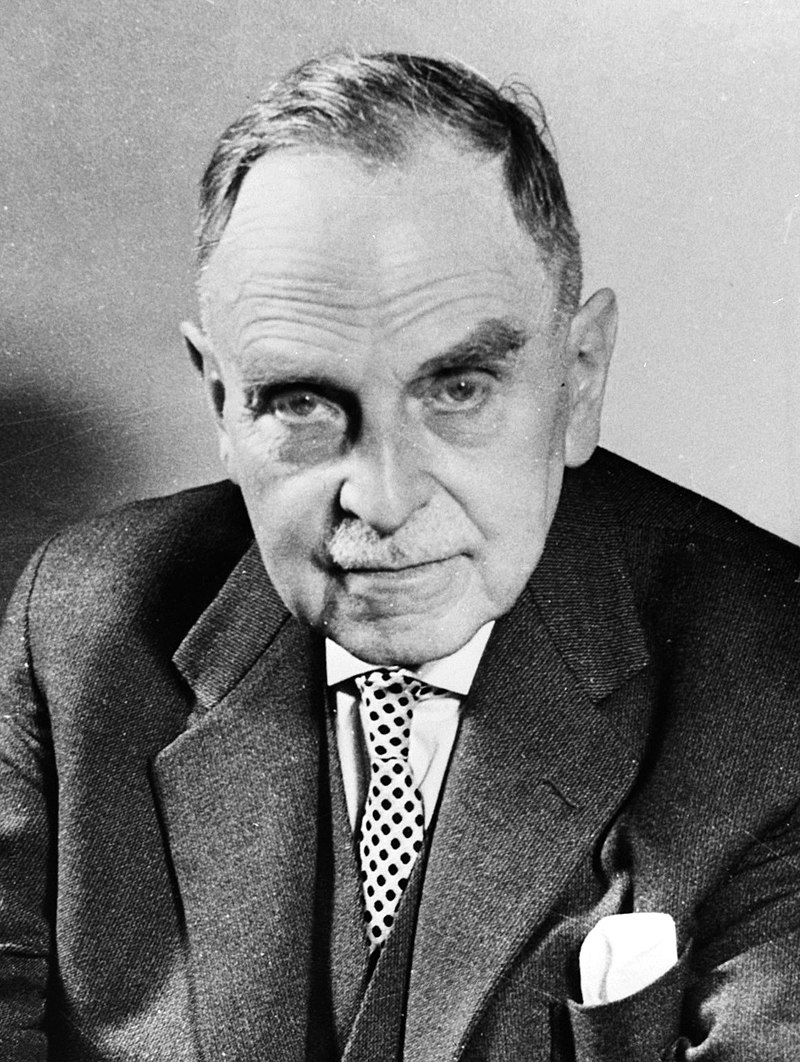
File:Otto_Hahn_1970.jpg · Wikimedia Commons · See Wikimedia Commons
Otto Hahn
Sign in to saveAlso known as O. Hahn, Otto Emil Hahn
German chemist and physicist (1879-1968)
OverviewAI-generated
Otto Hahn was a male chemist specializing in nuclear chemistry. He was a German national who worked in the German language. His professional affiliations included recognition within the Royal Society collection, the Nobel Laureates collection, the Nobel Chemistry collection, and the American Academy Arts Sciences collection.
Hahn was born in 1879 and died in 1968. He received one Nobel Prize. His Erdős number was 7.
Synthesized by Vinony from 17 facts across 4 sources: Wikidata, Nobel Prize, VIAF, Vinony collections. Generated from structured data (not the Wikipedia text) and checked against those facts — may still contain errors.
Authority record · VIAF
- Lifespan
- 1879–1968
- Nationality
- DE, DEU
- Role / Field
- Kimikis, Kodolkimija
- Language
- ger
- Gender
- Male
Recorded by 30 libraries
via VIAF · OCLC
Nobel Prize
- The Nobel Prize in Chemistry1944
“for his discovery of the fission of heavy nuclei”
Wikidata facts
- Instance of
- human
- Given name
- Emil
- Family name
- Hahn
- Gender
- male
- Citizenship
- Nazi Germany
- Place of birth
- Frankfurt
- Place of death
- Göttingen
- Occupation
- autobiographer
- Educated at
- Humboldt-Universität zu Berlin
- Employer
- Freie Universität Berlin
- Languages spoken
- German
- Religion
- Lutheranism
- Academic degree
- professor
- Doctoral advisor
- Theodor Zincke
- Doctoral student
- Nikolaus Riehl
- Field of work
- nuclear chemistry
- Conflict
- World War I
- Image
- Otto Hahn (Nobel).jpg
- Significant event
- Alsos Mission
Show 15 more facts
- place of burial
- Göttingen City Cemetery
- topic's main category
- Category:Otto Hahn
- Erdős number
- 7
- Commons category
- Otto Hahn
- nominated for
- Nobel Prize in Chemistry
- date of birth
- 1879-03-08
- date of death
- 1968-07-28
- Commons gallery
- Otto Hahn
- name in native language
- Otto Hahn
- significant person
- Lise Meitner
- on focus list of Wikimedia project
- Wikipedia:Vital articles/Level/4
- maintained by WikiProject
- WikiProject Mathematics
- interested in
- physical chemistry
via Wikidata · CC0
~40 min read
Encyclopedic overview
Otto Hahn ( German: [ˈɔtoː ˈhaːn] ; 8 March 1879 – 28 July 1968) was a German chemist who was a pioneer in the field of radiochemistry. He is referred to as the father of nuclear chemistry and discoverer of nuclear fission, the science behind nuclear reactors and nuclear weapons. Hahn and Lise Meitner discovered isotopes of the radioactive elements radium, thorium, protactinium and uranium. He also discovered the phenomena of atomic recoil and nuclear isomerism, and pioneered rubidium–strontium dating. In 1938, Hahn, Meitner and Fritz Strassmann discovered nuclear fission, for which Hahn alone was awarded the 1944 Nobel Prize in Chemistry.
A graduate of the University of Marburg, which awarded him a doctorate in 1901, Hahn studied under Sir William Ramsay at University College London and at McGill University in Montreal, Canada, under Ernest Rutherford, where he discovered several new radioactive isotopes. He returned to Germany in 1906; Emil Fischer let him use a former woodworking shop in the basement of the Chemical Institute at the University of Berlin as a laboratory. Hahn completed his habilitation in early 1907 and became a Privatdozent. In 1912, he became head of the Radioactivity Department of the newly founded Kaiser Wilhelm Institute for Chemistry (KWIC). Working with Austrian physicist Lise Meitner in the building that now bears their names, they made a series of groundbreaking discoveries, culminating with her isolation of the longest-lived isotope of protactinium in 1918.
Excerpted from Wikipedia’s “Otto Hahn” article, available under the CC BY-SA 4.0 licence.
Gallery (12)
Available in 87 languages
- Español
- Français
- Deutsch
- 中文
- 日本語
- Русский
- Português
- Italiano
- العربية
- Afrikaans
- Albanian
- Asturian
- azb
- Azerbaijani
- Bahasa Indonesia
- Bangla
- Basque
- be_x_old
Show 68 more
- Belarusian
- Bosnian
- Breton
- Bulgarian
- Catalan
- Croatian
- Czech
- Danish
- Egyptian Arabic
- Esperanto
- Estonian
- Finnish
- Galician
- Georgian
- Greek
- Gujarati
- Haitian Creole
- Hakka Chinese
- Hebrew
- Hungarian
- Icelandic
- Ido
- Interlingue
- Irish
- Javanese
- Kannada
- Latin
- Latvian
- Lithuanian
- Low German
- Macedonian
- Malagasy
- Malay
- Malayalam
- Marathi
- Mazanderani
- Mingrelian
- Nederlands
- Norwegian
- Occitan
- Pashto
- Polski
- Romanian
- Scots
- Scottish Gaelic
- Serbian
- Serbian (Latin)
- simple
- Slovak
- Slovenian
- Svenska
- Swahili
- Tamil
- Tatar
- Telugu
- Tiếng Việt
- Türkçe
- Ukrainian
- Urdu
- Uzbek
- Western Panjabi
- Wu Chinese
- Yoruba
- zh_min_nan
- zh_yue
- فارسی
- ไทย
- 한국어
via Wikidata sitelinks · CC0