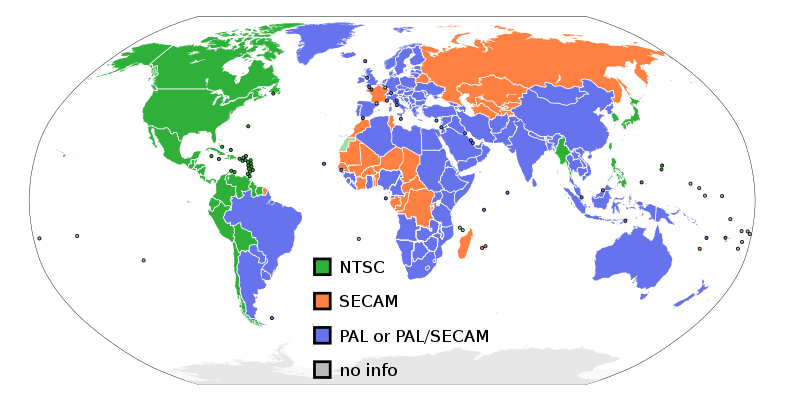
File:PAL-NTSC-SECAM.svg · Wikimedia Commons · See Wikimedia Commons
PAL
Also known as Phase Alternating Line, Phased Alteration by Line
Phase Alternating Line (PAL) is a colour encoding system for analogue television. It was one of three major analogue colour television standards, the others being NTSC and SECAM. In most countries it was broadcast at 625 lines, 50 fields (25 frames) per second, and associated with CCIR analogue broadcast television systems B, D, G, H, I and K. The articles on analogue broadcast television systems further describe frame rates, image resolution, and audio modulation.
AI overview
PAL (Phase Alternating Line) is a color encoding system that was used for analog television broadcasts in most countries around the world. It mattered because it was one of the three major standards that defined how color television signals were transmitted and received, alongside competing systems called NTSC and SECAM.
AI-generated from the Wikipedia summary — may contain errors.
Wikidata facts
Show 2 more facts
- Commons category
- PAL
- inception
- 1967-00-00
Sources (3)
via Wikidata · CC0