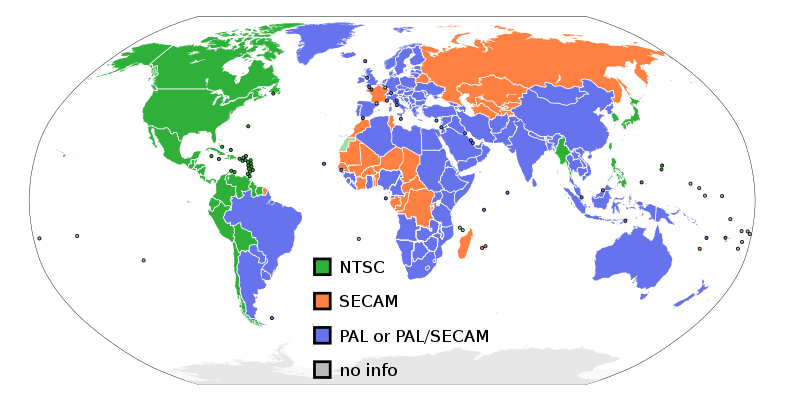
File:PAL-NTSC-SECAM.svg · Wikimedia Commons · See Wikimedia Commons
PAL
Also known as Phase Alternating Line, Phased Alteration by Line
Phase Alternating Line (PAL) is a colour encoding system for analogue television. It was one of three major analogue colour television standards, the others being NTSC and SECAM. In most countries it was broadcast at 625 lines, 50 fields (25 frames) per second, and associated with CCIR analogue broadcast television systems B, D, G, H, I and K. The articles on analogue broadcast television systems further describe frame rates, image resolution, and audio modulation.
AI overview
PAL (Phase Alternating Line) is a color encoding system that was used for analog television broadcasts in most countries around the world. It mattered because it was one of the three major standards that defined how color television signals were transmitted and received, alongside competing systems called NTSC and SECAM.
AI-generated from the Wikipedia summary — may contain errors.
Wikidata facts
Show 2 more facts
- Commons category
- PAL
- inception
- 1967-00-00
Sources (3)
via Wikidata · CC0
Article · Português
PAL (sigla em inglês: Phase Alternating Line, Linha de Fase Alternada em português) é uma forma de codificação da cor usada nos sistemas de transmissão televisiva analógica, desenvolvido na Alemanha em 1962 por Walter Bruch (da empresa Telefunken). Era usado por boa parte dos países, excepto na maior parte das Américas, alguns países asiáticos (que usam o NTSC), partes do Médio oriente, Europa de Leste e França (que usam o sistema SECAM) apesar de a maioria deles estarem em processo de adoção do PAL. A empresa francesa Thomson, onde Henri de France desenvolveu o SECAM, mais tarde comprou a Telefunken. Está também está por detrás da marca RCA em eletrónica de consumo (Radio Corporation of America), esta criou o padrão televisivo em cores NTSC (antes da Thomson ter-se envolvido).
Abstract from DBpedia / Wikipedia · CC BY-SA