Encyclopedia of Life · EOL (see source)
Parabuthus
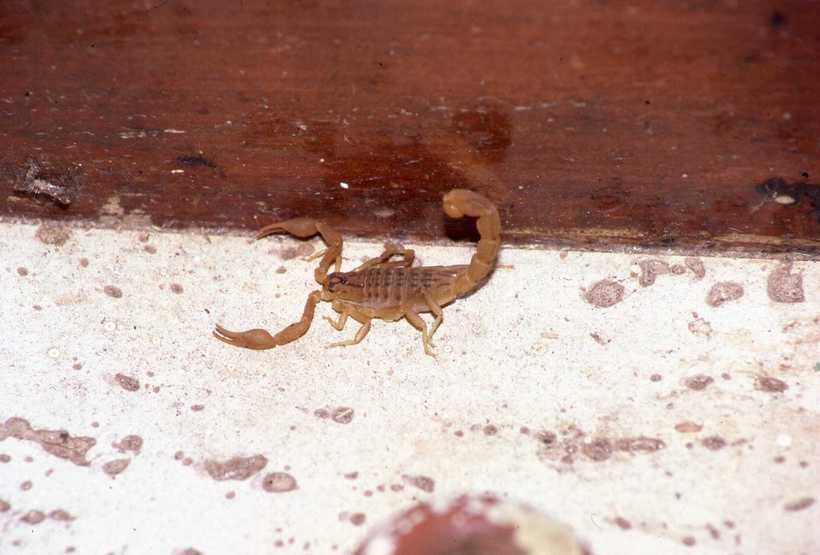
Sign in to saveParabuthus, commonly known as the thick-tailed scorpion, is a genus of large and highly venomous Afrotropical scorpions, that show a preference for areas of low rainfall. Their stings are medically important and human fatalities have been recorded.
Species
GENUS
- KingdomAnimalia
- PhylumArthropoda
- ClassArachnida
- OrderScorpiones
- FamilyButhidae
Die Gattung Parabuthus umfasst 33 Skorpionarten, die vorwiegend in Afrika beheimatet sind.[1] Die meisten Vertreter bevorzugen trockene Lebensräume, wie Wüsten und Steppen, mit starken Temperaturschwankungen zwischen Tag und Nacht. Inhaltsverzeichnis 1 Verbreitung 2 Phylogenetik 3 Arten und Unterarten 4 Weblinks 5 Einzelnachweise Verbreitung Das Verbreitungsgebiet der Tiere ist Afrika, südlich der Sahara und die südwestliche arabische Halbinsel, am Roten Meer entlang von Jeddah bis zum Jemen. Die Verbreitung in Zentral- und Westafrika ist nicht eindeutig geklärt. Phylogenetik Das folgende Kladogramm stellt die Beziehungen zwischen 27 verschiedenen Parabuthus-Arten anhand der Analysen von Prendini & Esposito (2010) dar.[2] Neuere Arten wurde nicht in die Untersuchungen mit einbezogen, so dass ihre Stellung in diesem System unklar ist (bezieht sich auf Parabuthus cimrmani, Parabuthus eritreaensis, Parabuthus truculentus und Parabuthus zavattarii). Grosphus madagascariensis Uroplectes triangulifer P. brevimanus P. distridor P. kuanyamarum P. glabrimanus P. gracilis P. nanus P. setiventer P. granulatus P. kalaharicus P. namibensis P. laevifrons P. stridulus P. liosoma P. heterurus
via GBIF
Museum specimens
- Specimen records
- 455
- Family
- Buthidae
- Collections
- SAM
- Recorded in
- South Africa, Zambia
Wikidata facts
Show 3 more facts
- taxon rank
- genus
- taxon name
- Parabuthus
- Commons category
- Parabuthus
Sources (1)
via Wikidata · CC0
~3 min read
Encyclopedic overview
7 sectionsContents
- Characteristics
- Diversity
- Selected species
- Phylogenetics
- See also
- Notes
- References
Parabuthus, commonly known as the thick-tailed scorpion, is a genus of large and highly venomous Afrotropical scorpions, that show a preference for areas of low rainfall. Their stings are medically important and human fatalities have been recorded.
==Characteristics== They have thick and strong tails, with typically a rough surface to the first (proximal) and sometimes second segment, that is used to produce a warning sound when rubbed against the sting (save P. distridor). Their thick tails are also employed in excavating their shallow burrows, as several are adapted to sandy environments. Some flatter-bodied species, however, take refuge in rock crevasses.
Excerpted from Wikipedia’s “Parabuthus” article, available under the CC BY-SA 4.0 licence.
Available in 11 languages
via Wikidata sitelinks · CC0