File:Church_Fathers.JPG · Wikimedia Commons · See Wikimedia Commons
patristics
Sign in to saveAlso known as patrology
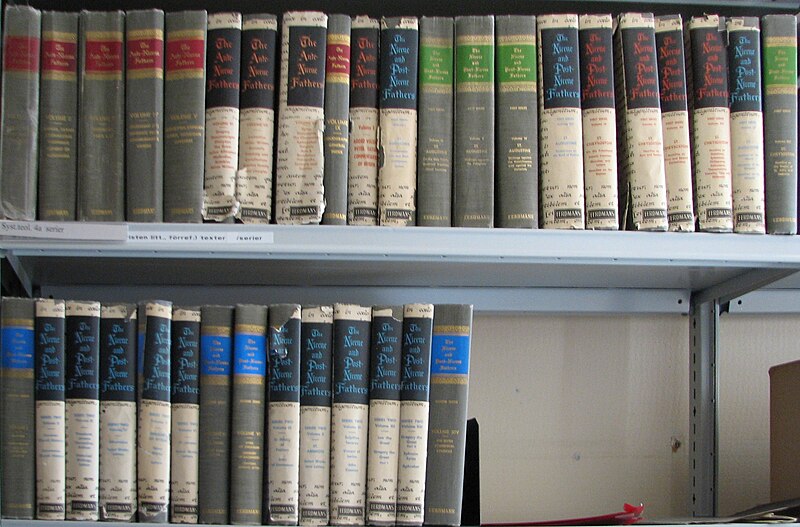
thumb|Philip Schaff's The Nicene and Post-Nicene FathersPatristics, also known as patrology, is a branch of theological studies focused on the writings and teachings of the Church Fathers, between the first and the eighth centuries AD. Scholars analyze texts from both orthodox and heretical authors. Patristics emerged as a distinct discipline in the 19th century, supported by critical editions like Patrologia Latina and Patrologia Graeca. The field employs textual analysis, archaeology, and historical criticism to analyze early Christianity's doctrinal, cultural, and intellectual development,
Wikidata facts
- Instance of
- academic discipline
- Said to be same as
- patrology
Show 4 more facts
- described by source
- Wikitólica
- topic's main category
- Category:Patristics
- Commons category
- Patristics
- different from
- patrology
Sources (6)
via Wikidata · CC0
~12 min read
Encyclopedic overview
20 sectionsContents
- Etymology
- Scope
- Patrology and patristics
- Historical development
- Early engagement (pre-5th century)
- Emergence as a discipline (15th–19th century)
- Modern scholarship
- Theological developments
- Notable Church Fathers
- Contemporary approaches
- Sources and collection of texts
- Original language collection
- Peer-reviewed journals
- See also
- Ancient Christian texts and collections
- Academic fields and studies
- Key theological and historical topics
- References
- Sources
- External links
thumb|Philip Schaff's The Nicene and Post-Nicene FathersPatristics, also known as patrology, is a branch of theological studies focused on the writings and teachings of the Church Fathers, between the first and the eighth centuries AD. Scholars analyze texts from both orthodox and heretical authors. Patristics emerged as a distinct discipline in the 19th century, supported by critical editions like Patrologia Latina and Patrologia Graeca. The field employs textual analysis, archaeology, and historical criticism to analyze early Christianity's doctrinal, cultural, and intellectual development, incorporating traditions beyond Greek and Latin, such as Syriac, Coptic, Armenian, and Ethiopian.
== Etymology == Patrology, derived from the Latin (father) and Greek logos (discourse), primarily refers to the study of the Church Fathers and serves as an introduction to early Christian writings. Historically, it also included large compilations of these writings, such as Patrologia Latina and Patrologia Graeca compiled by the French scholar Jacques Paul Migne.
Excerpted from Wikipedia’s “patristics” article, available under the CC BY-SA 4.0 licence.