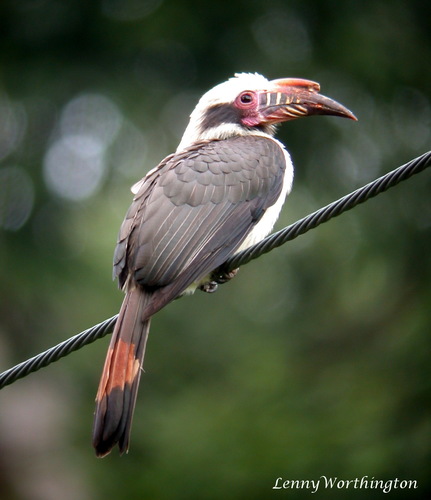
(c) Len Worthington, some rights reserved (CC BY-SA), uploaded by Len Worthington · cc-by-sa
Penelopides
Sign in to savePenelopides is a genus of relatively small, primarily frugivorous hornbills restricted to forested areas of the Philippines. Their common name, tarictic hornbills, is an onomatopoetic reference to the main call of several of them. They have a ridged plate-like structure on the base of their mandible. All are sexually dimorphic: males of all species are whitish-buff and black, while females of all species except the Mindoro hornbill are primarily black.
In the Vinony graph
Within Vinony's link graph, Penelopides is referenced by 167 other articles, and connects out to Picinae, trogon and Bucerotiformes.
Vinony files it under Bird genera, Endemic birds of the Philippines and Penelopides.
Its subject is documented across 26 Wikipedia language editions.
Species
Luzon Hornbill
GENUS
- KingdomAnimalia
- PhylumChordata
- ClassAves
- OrderBucerotiformes
- FamilyBucerotidae
種 白頰斑嘴犀鳥 P. exarhatus 棕尾斑嘴犀鳥 P. panini 呂宋犀鳥 P. manillae 棉島犀鳥 P. affinis 薩島犀鳥 P. samarensis 民島犀鳥 P. mindorensis 斑嘴犀鳥(学名:Penelopides)是斑嘴犀鳥屬下的犀鳥。牠們較為細小,主要吃果實。牠們分佈在菲律賓及印尼的蘇拉威西島。牠們的下頜基部有一個起脊的板狀結構。所有斑嘴犀鳥都是兩性異形的:除了白頰斑嘴犀鳥外,所有雄鳥都呈黑白色的;除了棉島犀鳥外,所有雌鳥都主要呈黑色。 分類 雖然就白頰斑嘴犀鳥的分類並沒有爭議,但在菲律賓群島的物種則受到極力的爭議。傳統上,只有棕尾斑嘴犀鳥被確認。後來認為牠們應該分開成為四個異地種,包括棕尾斑嘴犀鳥、呂宋犀鳥、棉島犀鳥及民島犀鳥。現今大部份學者都接受這個說法,但仍有一些卻認為應從民島犀鳥再細分多薩島犀鳥出來。 白頰斑嘴犀鳥(P. exarhatus) 棕尾斑嘴犀鳥(P. panini) 呂宋犀鳥(P. manillae) 棉島犀鳥(P. affinis) 薩島犀鳥(P. samarensis) 民島犀鳥(P. mindorensis) 參考 Kemp, A. C. (2001). Family Bucerotidae (Hornbills). Pp. 436-523 in: del Hoyo, J., Elliott, A., & Sargatal, J. eds. (2001). Handbook of the Birds of the World. Vol. 6. Mousebirds to Hornbills. Lynx Edicions, Barcelona. ISBN 84-87334-30-X 取自“https://zh.wikipedia.org/w/index.php?title=斑嘴犀鳥&oldid=42710802” 分类: 斑嘴犀鳥屬 犀鳥科 隐藏分类: 本地相关图片与维基数据不同 含有拉丁語的條目 使用ISBN魔术链接的页面
via GBIF
Museum specimens
- Specimen records
- 21
- With media
- 1
- Family
- Bucerotidae
- Collections
- YPM, CM, NHMUK, SDNHM
- Recorded in
- Philippines
Wikidata facts
Show 5 more facts
- taxon rank
- genus
- taxon name
- Penelopides
- Commons category
- Penelopides
- topic's main category
- Category:Penelopides
- Commons gallery
- Penelopides
Sources (1)
via Wikidata · CC0
~3 min read
Encyclopedic overview
3 sectionsContents
- Taxonomy
- References
- Further reading
Penelopides is a genus of relatively small, primarily frugivorous hornbills restricted to forested areas of the Philippines. Their common name, tarictic hornbills, is an onomatopoetic reference to the main call of several of them. They have a ridged plate-like structure on the base of their mandible. All are sexually dimorphic: males of all species are whitish-buff and black, while females of all species except the Mindoro hornbill are primarily black.
==Taxonomy== The genus Penelopides was introduced in 1849 by the German naturalist Ludwig Reichenbach in a plate of the hornbills. The type species was subsequently designated as the Visayan hornbill (Penelopides panini) by the English zoologist George Gray. The origin of Reichenbach's generic name is uncertain. It may be a combination of the Latin pene meaning "almost" or "nearly", the Ancient Greek lophos meaning "crest" and -oidēs "resembling".
Excerpted from Wikipedia’s “Penelopides” article, available under the CC BY-SA 4.0 licence.