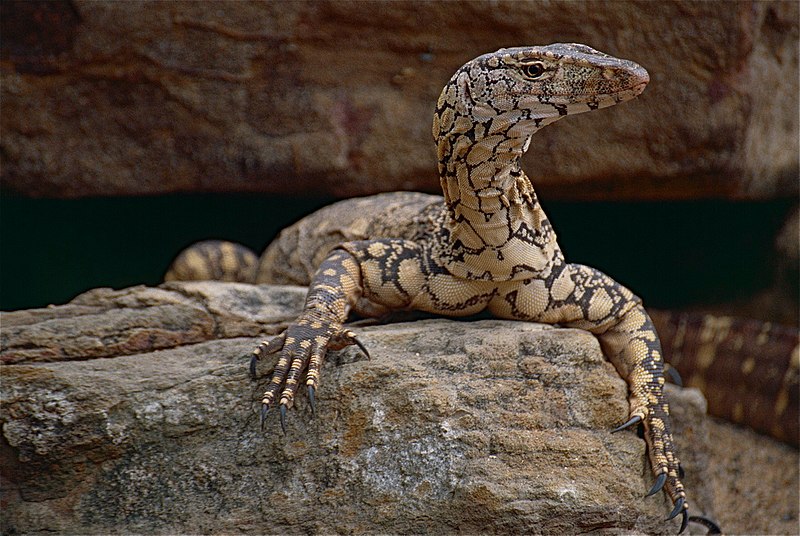
File:Perentie_(Varanus_giganteus)_(10244734736).jpg · Wikimedia Commons · See Wikimedia Commons
Perentie
Sign in to saveAlso known as Varanus giganteus
The perentie (Varanus giganteus) is a species of monitor lizard. It is one of the largest living lizards, after the Komodo dragon, Asian water monitor, and the crocodile monitor. Found west of the Great Dividing Range in the arid areas of Australia, it is rarely seen because of its shyness and the remoteness of much of its range from human habitation. The species is considered to be a least-concern species according to the International Union for Conservation of Nature.
Species
Least ConcernPerentie ist eine Weiterleitung auf diesen Artikel. Zum Automodell siehe Land Rover Perentie. Der Riesenwaran (Varanus giganteus) ist eine in Australien heimische Art der Warane (Varanus). Als größte Echse Australiens erreicht er in Ausnahmefällen Längen von über 2 m und ist durch ein schwarzes Netzmuster an Kopf, Kehle und Hals sowie eine braune Rückenfärbung mit hellen Punkten gut von anderen Waranen zu unterscheiden. Er bewohnt insbesondere Trockengebiete mit Felsenformationen. Der Riesenwaran ist wie alle Warane ein tagaktiver Einzelgänger und verbringt die Nacht in einem Versteck. Seine Nahrung setzt sich vor allem aus Echsen, anderen kleinen Wirbeltieren und Insekten sowie Aas zusammen. Während der Trockenzeit (australischer Winter) verstecken sich die Tiere über Wochen in ihren Bauen, an die Ruheperiode schließt sich im Frühling und Sommer die Fortpflanzungszeit an. Inhaltsverzeichnis 1 Merkmale 2 Verbreitung und Lebensraum 3 Lebensweise 3.1 Aktivität 3.2 Sozialverhalten und Aktionsräume 3.3 Ernährung 4 Fortpflanzung und Entwicklung 5 Natürliche Feinde, Feindvermeidung und Lebenserwartung 6 Systematik 7 Kulturelle Bezüge 8 Gefährdung 9 Weblinks 10 Literatur 11 Belege 11.1 An
via IUCN
Wikidata facts
Show 9 more facts
- Commons category
- Varanus giganteus
- taxon rank
- species
- taxon name
- Varanus giganteus
- taxon common name
- Perentie
- endemic to
- Australia
- IUCN conservation status
- Least Concern
- taxon author citation
- (Gray, 1845)
- diel cycle
- diurnality
- short name
- V. giganteus
via Wikidata · CC0
~6 min read
Encyclopedic overview
11 sectionsContents
- Taxonomy
- Distribution and habitat
- Description
- Venom
- Behaviour and ecology
- Feeding
- Breeding
- Gallery
- References
- Further reading
- External links
The perentie (Varanus giganteus) is a species of monitor lizard. It is one of the largest living lizards, after the Komodo dragon, Asian water monitor, and the crocodile monitor. Found west of the Great Dividing Range in the arid areas of Australia, it is rarely seen because of its shyness and the remoteness of much of its range from human habitation. The species is considered to be a least-concern species according to the International Union for Conservation of Nature.
Its status in many Aboriginal cultures is evident in the totemic relationships, and part of the Ngiṉṯaka dreaming, as well as bush tucker. It was a favoured food item among desert Aboriginal tribes, and the fat was used for medicinal and ceremonial purposes.
Excerpted from Wikipedia’s “Perentie” article, available under the CC BY-SA 4.0 licence.