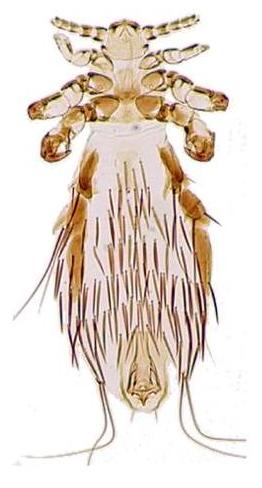
File:Fahrenholzia_pinnata.JPG · Wikimedia Commons · See Wikimedia Commons
Phthiraptera
Sign in to saveAlso known as lice, Grey Backs, Seam Squirrels, louse
Louse (: lice) is the common name for any member of the infraorder Phthiraptera, which contains nearly 5,000 species of wingless parasitic insects. Phthiraptera was previously recognized as an order, until a 2021 genetic study determined that they are a highly modified lineage of the order Psocodea, whose members are commonly known as booklice, barklice or barkflies.
OverviewAI-generated
Phthiraptera, commonly known as lice, is an accepted taxon within the order Phthiraptera. It belongs to the class Insecta and the phylum Arthropoda. The authority for this group is Haeckel, 1896. It is a child taxon of Exopterygota and Troctomorpha. The rank is listed as both order and infraorder.
The habitat includes marine, brackish, and freshwater environments. Records are held by institutions UMNH, DMNS, and MSB in the United States. There are 3176 records and 164 media items associated with the family phthiraptera. A PubMed query for Phthiraptera yields 3636 results.
The topic is described in the Gujin Tushu Jicheng and Encyclopædia Britannica 11th edition. It is referenced by 615 other encyclopedia articles. The common name Poux is also used. The subject is part of the Commons category Phthiraptera and the main category Category:Lice.
Synthesized by Vinony from 25 facts across 5 sources: Wikidata, PubMed, WoRMS, iDigBio, Vinony graph. Generated from structured data (not the Wikipedia text) and checked against those facts — may still contain errors.
Species
lice
Order
- PhylumArthropoda
- ClassInsecta
- OrderPhthiraptera
蝨毛目(學名:Phthiraptera)是原蝨目和食毛目的合稱,通稱虱或虱子(英语:louse)。全世界約有3,000種。虱寄生于人体、其他哺乳动物(除了单孔目和蝙蝠外)和鳥類的身上。以人类为宿主的虱有三种:人头虱、人体虱和阴虱(又称耻阴虱)。其中,人头虱和人体虱属于人虱科(Pediculus humanus),阴虱属于阴虱科(Pthirus pubis)。 虱体型较小,无翅,身体扁平,寄生于毛发处,有善于勾住毛发的足(攫握器)。虱为渐变态发育,终生寄生于宿主体表,以宿主血液、毛发、皮屑等为食。寄生于人体的虱主要以宿主血液为食,其若虫每日吸血1次,成虫每日吸血数次。
via
Museum specimens
- Specimen records
- 3,176
- With media
- 164
- Family
- Phthiraptera
- Collections
- UMNH, DMNS, MSB
- Recorded in
- United States
Research
3,636 papers- [Understanding mitochondrial genome fragmentation in parasitic lice (Insecta: Phthiraptera)].ReviewYi chuan = Hereditas · 2013Dong WG, Guo XG, Jin DC et al.DOI: 10.3724/sp.j.1005.2013.00847
- LOUSY ASSOCIATIONS: SUCKING LICE (PHTHIRAPTERA: ANOPLURA) PARASITIZING RODENTS AND LAGOMORPHS IN THE DESERT NATIONAL WILDLIFE REFUGE, NEVADA.The Journal of parasitology · 2024Weinstein SB, Dumbacher JP, Durden LADOI: 10.1645/24-80
- A review of the phoretic relationship between Mallophaga (Phthiraptera: Insecta) and Hippoboscidae (Diptera: Insecta).ReviewJournal of medical entomology · 1975Keirans JEDOI: 10.1093/jmedent/12.1.71
- Molecular phylogenetics of the avian feather louse Philopterus-complex (Phthiraptera: Philopteridae).Molecular phylogenetics and evolution · 2022Kolencik S, Johnson KP, Grant AR et al.DOI: 10.1016/j.ympev.2022.107556
- First record of ectoparasites (Phthiraptera and Acari) from the Andean condor (Vultur gryphus) in Colombia.Medical and veterinary entomology · 2024Llano HAB, Robayo-Sánchez LN, Ramírez-Hernández A et al.DOI: 10.1111/mve.12743
- The morphology of Colpocephalum pectinatum (Phthiraptera: Amblycera: Menoponidae) under scanning electron microscopy.Arthropod structure & development · 2021Liébanas G, Sáez Á, Luna Á et al.DOI: 10.1016/j.asd.2021.101085
- [Recommendations to researchers who will study lice (Phthiraptera) of wild birds (Aves) in Turkey].ReviewTurkiye parazitolojii dergisi · 2014Dik BDOI: 10.5152/tpd.2014.3828
- Pediculosis.ReviewDermatologic clinics · 1990Elgart ML
via PubMed
Wikidata facts
- Instance of
- taxon
- Parent taxon
- Troctomorpha
- Image
- Male human head louse.jpg
Show 6 more facts
- Commons category
- Phthiraptera
- taxon name
- Phthiraptera
- taxon rank
- infraorder
- topic's main category
- Category:Lice
- taxon common name
- Poux
- on focus list of Wikimedia project
- Wikipedia:Vital articles/Level/4
Sources (3)
via Wikidata · CC0
~20 min read
Encyclopedic overview
14 sectionsContents
- Classification
- Internal classification
- Evolutionary history
- Description
- Ecology
- Reproduction
- In human culture
- In social history
- In literature and folklore
- In science
- Woodlouse
- See also
- References
- External links
Louse (: lice) is the common name for any member of the infraorder Phthiraptera, which contains nearly 5,000 species of wingless parasitic insects. Phthiraptera was previously recognized as an order, until a 2021 genetic study determined that they are a highly modified lineage of the order Psocodea, whose members are commonly known as booklice, barklice or barkflies.
Lice are obligate parasites, living externally on warm-blooded hosts, which include most species of bird and mammal, notably excluding monotremes, pangolins, bats, sirenians, tapirs, rhinoceroses, and members of the clade and suborder Whippomorpha (Cetaceans and Hippopotamids). Chewing lice live among the hairs or feathers of their host and feed on skin and debris, whereas sucking lice pierce the host's skin and feed on blood and other secretions. They usually spend their whole life on a single host, cementing their eggs, called nits, to hairs or feathers. The eggs hatch into nymphs, which moult three times before becoming fully grown, a process that takes about four weeks.
Excerpted from Wikipedia’s “Phthiraptera” article, available under the CC BY-SA 4.0 licence.
Gallery (15)
Available in 100 languages
- Español
- Français
- Deutsch
- 中文
- 日本語
- Русский
- Português
- العربية
- हिन्दी
- Albanian
- Aragonese
- Armenian
- Asturian
- Aymara
- Azerbaijani
- Bahasa Indonesia
- Bangla
- Basque
Show 81 more
- bat_smg
- bdr
- Breton
- Bulgarian
- Burmese
- Catalan
- cdo
- Cebuano
- Cheyenne
- Chuvash
- Cornish
- Croatian
- Czech
- Danish
- Egyptian Arabic
- Esperanto
- Estonian
- Filipino
- Finnish
- Galician
- Greek
- Guarani
- Haitian Creole
- Hakka Chinese
- Hebrew
- Hungarian
- Icelandic
- Ido
- Inupiaq
- Irish
- Javanese
- Kashmiri
- Kurdish
- Latin
- Latvian
- Lithuanian
- Low German
- Malagasy
- Malay
- Malayalam
- Mazanderani
- Navajo
- Nederlands
- Northern Frisian
- Norwegian
- Occitan
- Polski
- Quechua
- Romanian
- Scots
- Scottish Gaelic
- Serbian
- Serbian (Latin)
- Shona
- Sicilian
- simple
- Sindhi
- Slovenian
- Somali
- Sundanese
- Svenska
- Swahili
- szy
- Tamil
- Telugu
- Tiếng Việt
- Türkçe
- Ukrainian
- Urdu
- Waray
- Welsh
- West Flemish
- Western Mari
- Wu Chinese
- Zaza
- zh_min_nan
- zh_yue
- Zhuang
- فارسی
- ไทย
- 한국어
via Wikidata sitelinks · CC0