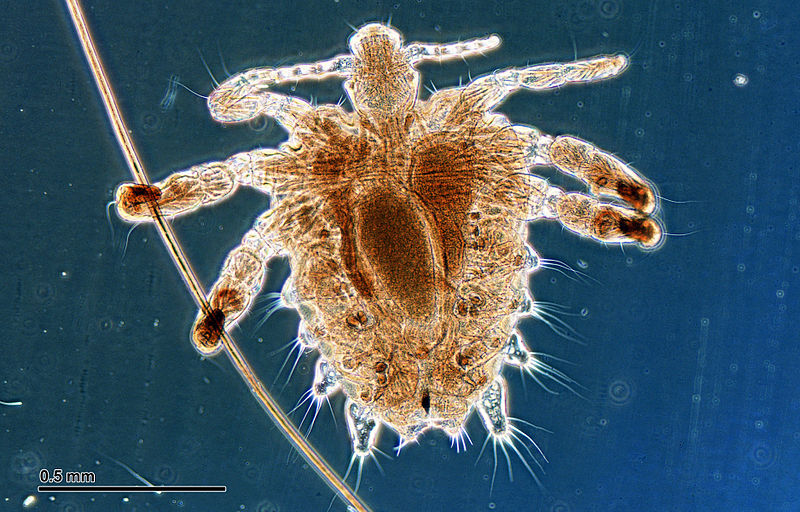
File:Crab_louse_(251_23)_Female,_from_a_human_host.jpg · Wikimedia Commons · See Wikimedia Commons
OverviewAI-generated
Pthirus pubis, commonly known as the Crab Louse, is a species of insect within the family Pthiridae. It belongs to the class Insecta and the phylum Arthropoda. The taxon was originally described by Linnaeus in 1758 and is currently accepted as a valid species. Its parent taxon is Pthirus.
Records for this organism are held by institutions including INDRE-SSA, FCB-UANL, UAM, UNHC, and TTU. Occurrence data has been documented in Mexico and the United States. The species has a host tropism characteristic.
Synthesized by Vinony from 37 facts across 7 sources: Wikidata, GBIF, iNaturalist, Gbif Occ, WoRMS, iDigBio, Vinony graph. Generated from structured data (not the Wikipedia text) and checked against those facts — may still contain errors.
Species
Crab Louse
Pthirus pubis
SPECIES
- KingdomAnimalia
- PhylumArthropoda
- ClassInsecta
- OrderPsocodea
- FamilyPthiridae
via GBIF
Museum specimens
- Specimen records
- 205
- With media
- 206
- Family
- Pthiridae
- Collections
- INDRE-SSA, FCB-UANL, UAM, UNHC, TTU, YPM
- Recorded in
- Mexico, United States
Wikidata facts
Show 7 more facts
- Commons category
- Pthirus pubis
- taxon name
- Pthirus pubis
- taxon rank
- species
- taxon common name
- pioyu púbicu
- taxon author citation
- (Linnaeus, 1758)
- has characteristic
- host tropism
- short name
- P. pubis
via Wikidata · CC0
~5 min read
Encyclopedic overview
The crab louse or pubic louse (Pthirus pubis) is an insect that is an obligate ectoparasite of humans, feeding exclusively on blood. The crab louse usually is found in the person's pubic hair. Although the louse cannot jump, it can also live in other areas of the body that are covered with coarse hair, such as the perianal area, the general body hair, and the eyelashes (in children).
Humans are the only known hosts of the crab louse, although a closely related species, Pthirus gorillae, infects gorillas. The human parasite is thought to have diverged from Pthirus gorillae approximately 3.3 million years ago. It is more distantly related to the genus Pediculus, which contains the human head and body lice and lice that affect chimpanzees and bonobos.
Excerpted from Wikipedia’s “Pthirus pubis” article, available under the CC BY-SA 4.0 licence.