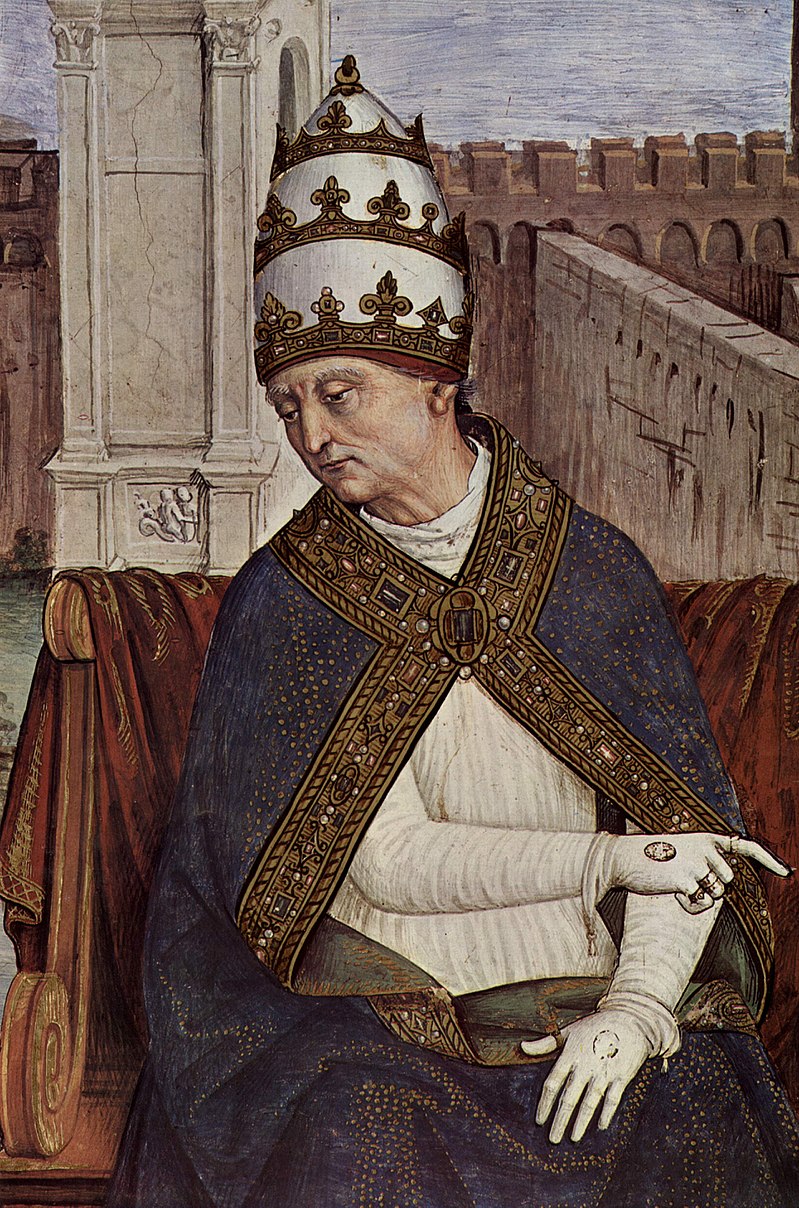
File:Pintoricchio_014.jpg · Wikimedia Commons · See Wikimedia Commons
Pius II
Sign in to saveAlso known as Enea Silvio Bartolomeo Piccolomini, Pope Pius II, pape Pie II, Aeneas Silvius Piccolomini, Enea Silvio Piccolomini, papa Pio II, Pius II. Papst, Pius PP. II
pope of the Catholic Church from 1458 to 1464 (1405–1464)
Pius II was a pope who led the Catholic Church from 1458 until his death in 1464, serving during a significant period in the Church's history during the Renaissance. He is historically noteworthy as a pope during an era of important changes in Europe and the Church's role in worldly affairs.
AI-generated from the Wikipedia summary — may contain errors.
Wikidata facts
- Instance of
- human
- Given name
- Pius
- Gender
- male
- Citizenship
- Holy Roman Empire
- Place of birth
- Pienza
- Place of death
- Ancona
- Occupation
- geographer
- Educated at
- University of Siena
- Employer
- University of Vienna
- Languages spoken
- Italian
- Religion
- Catholic Church
- Participant in
- 1458 papal conclave
- Image
- Pio II Pont Max (detail).jpg
- Work location
- Rome
Show 15 more facts
- place of burial
- Sant'Andrea della Valle
- Commons category
- Pius II
- date of birth
- 1405-10-18
- date of death
- 1464-08-14
- described by source
- Wikitólica
- manner of death
- natural causes
- birth name
- Enea Silvio Piccolomini
- topic's main category
- Category:Pope Pius II
- name in native language
- Pius PP. II
- cause of death
- plague
- consecrator
- Juan de Carvajal
- Commons Creator page
- Enea Silvio Piccolomini
- name
- pape Pie II
- has works in the collection
- J. Paul Getty Museum
- P13311
- Samara
Sources (14)
via Wikidata · CC0
Works in European collections
28 objects attributed to Pius II, held across European museums, libraries & archives · via Europeana
Speculum vitae humanae; Tractatus de clavibus sacerdotii; Liber aureus (torum)

Varia iuridica

Pii Secundi Summa Concilii Basileensis

Asiae Europaeque ... descriptio (etc.)

Storia di due amanti Di Enea Silvio Piccolomini In Seguito Papa Pio Secondo col Testo Latino e la Traduzione libera di Alessandro Braccio
Aeneae Silvii Picolominei S. Sabinae cardinalis Austrialis historiae liber primus (1700)

Untitled

Untitled
Untitled
Untitled

Untitled

Untitled

Untitled

Untitled

Untitled
Untitled

Untitled

Untitled

Untitled
Untitled

Textus varii

Textus varii, sermones, exempla, miracula

Textus varii
Epistolae Familiares
Untitled

Untitled

Untitled

Untitled
~34 min read
Encyclopedic overview
Pope Pius II (Latin: Pius PP. II, Italian: Pio II), born Enea Silvio Bartolomeo Piccolomini (Latin: Aeneas Silvius Bartholomeus; 18 October 1405 – 14 August 1464), was head of the Catholic Church and ruler of the Papal States from 19 August 1458 to his death in 1464.
Aeneas Silvius was an author, diplomat, and orator, and private secretary of Antipope Felix V and then the Emperor Frederick III, and then Pope Eugenius IV. He participated in the Council of Basel, but left it in 1443 to follow Frederick, whom he reconciled to the Roman obedience. He became Bishop of Trieste in 1447, Bishop of Siena in 1450, and a cardinal in 1456.
Excerpted from Wikipedia’s “Pius II” article, available under the CC BY-SA 4.0 licence.
Gallery (5)
Available in 77 languages
- Español
- Français
- Deutsch
- 中文
- 日本語
- Русский
- Português
- Italiano
- العربية
- Afrikaans
- Albanian
- Albanian
- Armenian
- Azerbaijani
- Bahasa Indonesia
- Basque
- be_x_old
- Belarusian
Show 58 more
- Bikol
- Breton
- Bulgarian
- Catalan
- cdo
- Croatian
- Czech
- Danish
- Egyptian Arabic
- Esperanto
- Estonian
- Filipino
- Finnish
- Friulian
- Galician
- Georgian
- Greek
- Hakka Chinese
- Hebrew
- Hungarian
- Ido
- Iloko
- Irish
- Javanese
- Latin
- Latvian
- Lithuanian
- Low German
- Macedonian
- Malay
- Marathi
- Nederlands
- Norwegian
- Norwegian Nynorsk
- Piedmontese
- Polski
- Romanian
- Serbian
- Serbian (Latin)
- Sicilian
- simple
- Slovak
- Slovenian
- Svenska
- Swahili
- Tiếng Việt
- Türkçe
- Ukrainian
- Urdu
- Waray
- Welsh
- Wu Chinese
- Yoruba
- Zaza
- zh_min_nan
- zh_yue
- فارسی
- 한국어
via Wikidata sitelinks · CC0