File:Sine_wavelength.svg · Wikimedia Commons · See Wikimedia Commons
wavelength
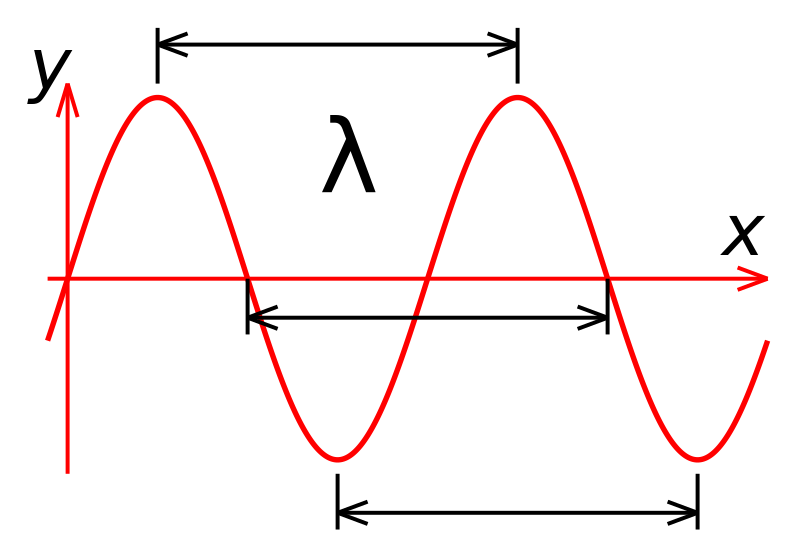
Sign in to savethumb|right|The wavelength of a sine wave, λ, can be measured between any two points with the same phase, such as between crests (on top), or troughs (on bottom), or corresponding [[zero crossings as shown.]]
Wavelength is the distance between two identical points on a repeating wave, such as from one crest to the next crest. It matters because wavelength is a fundamental way to describe and measure waves, which are everywhere in nature—from light and sound to radio signals and water ripples.
AI-generated from the Wikipedia summary — may contain errors.
Wikidata facts
- Subclass of
- distance
- Image
- Local wavelength.svg
Show 5 more facts
- Commons category
- Wavelength
- recommended unit of measurement
- metre
- notation
- Λ
- on focus list of Wikimedia project
- Wikipedia:Vital articles/Level/4
- Stack Exchange tag
- physics.stackexchange.com/tags/wavelength
Sources (3)
via Wikidata · CC0
~21 min read
Encyclopedic overview
17 sectionsContents
- Sinusoidal waves
- Standing waves
- Mathematical representation
- General media
- Nonuniform media
- Crystals
- More general waveforms
- Wave packets
- Interference and diffraction
- Double-slit interference
- Single-slit diffraction
- Diffraction-limited resolution
- Subwavelength
- Angular wavelength
- See also
- References
- External links
thumb|right|The wavelength of a sine wave, λ, can be measured between any two points with the same phase, such as between crests (on top), or troughs (on bottom), or corresponding [[zero crossings as shown.]]
In physics and mathematics, wavelength or spatial period of a wave or periodic function is the distance over which the wave's shape repeats. In other words, it is the distance between consecutive corresponding points of the same phase on the wave, such as two adjacent crests, troughs, or zero crossings. Wavelength is a characteristic of both traveling waves and standing waves, as well as other spatial wave patterns. The inverse of the wavelength is called the spatial frequency. Wavelength is commonly designated by the Greek letter lambda (λ). For a modulated wave, wavelength may refer to the carrier wavelength of the signal. The term wavelength may also apply to the repeating envelope of modulated waves or waves formed by interference of several sinusoids.
Excerpted from Wikipedia’s “wavelength” article, available under the CC BY-SA 4.0 licence.
Gallery (42)
Available in 101 languages
- Español
- Français
- Deutsch
- 中文
- 日本語
- Русский
- Português
- Italiano
- العربية
- हिन्दी
- Afrikaans
- Albanian
- Armenian
- Asturian
- azb
- Azerbaijani
- Bahasa Indonesia
- Bangla
Show 82 more
- Basque
- Bavarian
- be_x_old
- Belarusian
- Bosnian
- Breton
- Bulgarian
- Catalan
- Central Kurdish
- Croatian
- Czech
- Danish
- Esperanto
- Estonian
- Fijian
- Filipino
- Finnish
- Galician
- Georgian
- Greek
- Gujarati
- Haitian Creole
- Hebrew
- Hungarian
- Icelandic
- Ido
- Irish
- Kazakh
- Kurdish
- Kyrgyz
- Latin
- Latvian
- Lithuanian
- Low German
- Luxembourgish
- Macedonian
- Malay
- Malayalam
- Marathi
- Mongolian
- Moroccan Arabic
- Nederlands
- Northern Frisian
- Norwegian
- Norwegian Nynorsk
- Occitan
- Oromo
- Pashto
- Polski
- Punjabi
- Romanian
- Rusyn
- Scottish Gaelic
- Serbian
- Serbian (Latin)
- simple
- Sinhala
- Slovak
- Slovenian
- Somali
- Svenska
- Swahili
- Tajik
- Tamil
- Tatar
- Telugu
- Tiếng Việt
- Türkçe
- Ukrainian
- Urdu
- Uzbek
- Venetian
- Welsh
- Western Frisian
- Western Panjabi
- Wu Chinese
- zh_min_nan
- zh_yue
- Zulu
- فارسی
- ไทย
- 한국어
via Wikidata sitelinks · CC0