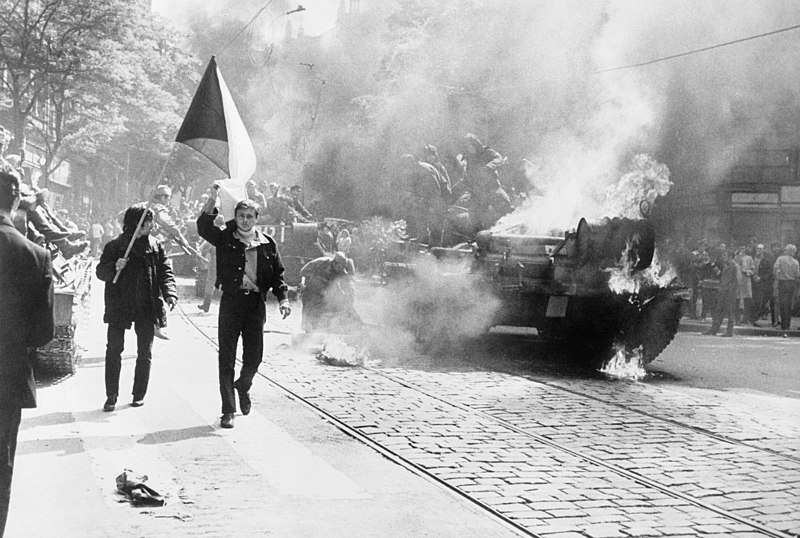
File:10_Soviet_Invasion_of_Czechoslovakia_-_Flickr_-_The_Central_Intelligence_Agency.jpg · Wikimedia Commons · See Wikimedia Commons
Prager Frühling
Sign in to saveAlso known as Prague Spring 1968
Bemühungen in der Tschechoslowakei 1968, ein Liberalisierungs- und Demokratisierungsprogramm durchzusetzen
The Prague Spring was a period of political and cultural opening in Czechoslovakia that lasted from January to August 1968, during which the government relaxed censorship and expanded freedoms. It ended when Soviet-led forces invaded the country in August, making it a pivotal moment in Cold War history that demonstrated the limits of independence within the Soviet sphere of influence.
AI-generated from the Wikipedia summary — may contain errors.
In the Vinony graph
Vinony's link graph records 2,047 inbound references to Prager Frühling, and connects out to Soviet Union, Socialist Federal Republic of Yugoslavia and Marxism–Leninism.
It is catalogued under topics including 1968 in Czechoslovakia, 1968 in international relations and 1968 protests.
Vinony links it to 79 Wikipedia language editions.
Wikidata facts
- Instance of
- social change
- Part of
- history of Czechoslovakia
- Named after
- Prague
- Location
- Czechoslovakia
- Image
- 10 Soviet Invasion of Czechoslovakia - Flickr - The Central Intelligence Agency.jpg
- Organizer
- Communist Party of Czechoslovakia
Show 4 more facts
- Commons category
- Prague Spring
- topic's main category
- Category:Prague Spring
- point in time
- 1968-00-00
- on focus list of Wikimedia project
- Wikipedia:Vital articles/Level/4
via Wikidata · CC0
Article · Deutsch
Der Prager Frühling (tschechisch Pražské jaro, slowakisch Pražská jar) ist die Bezeichnung für das Streben der tschechoslowakischen Kommunistischen Partei (KSČ) unter Alexander Dubček im Frühjahr 1968, ein Liberalisierungs- und Demokratisierungsprogramm durchzusetzen, sowie vor allem die Beeinflussung und Verstärkung dieser Reformbemühungen durch eine sich rasch entwickelnde kritische Öffentlichkeit. Mit dem Begriff „Prager Frühling“ verbinden sich zwei gegensätzliche Vorgänge: einerseits der Versuch, einen „Sozialismus mit menschlichem Antlitz“ (tschechisch: socialismus s lidskou tváří) zu schaffen, andererseits aber auch die gewaltsame Niederschlagung dieses Versuchs durch am 21. August 1968 einmarschierende Truppen des Warschauer Paktes. Die Bezeichnung „Prager Frühling“ stammt von westlichen Medien und ist eine Fortführung des Begriffs Tauwetter-Periode, der wiederum auf den Titel des Romans Tauwetter von Ilja Ehrenburg zurückgeht. In Prag selbst wird mit „Prager Frühling“ außerdem das seit 1946 regelmäßig durchgeführte Musikfestival Prager Frühling genannt.
Abstract from DBpedia / Wikipedia · CC BY-SA
Gallery (12)
Available in 79 languages
- Español
- Français
- Deutsch
- 中文
- 日本語
- Русский
- Português
- Italiano
- العربية
- हिन्दी
- Afrikaans
- Albanian
- Armenian
- Asturian
- Azerbaijani
- Bahasa Indonesia
- Bangla
- Banjar
Show 60 more
- Basque
- be_x_old
- Belarusian
- Breton
- Bulgarian
- Catalan
- Central Kurdish
- Croatian
- Czech
- Danish
- Esperanto
- Estonian
- Filipino
- Finnish
- Galician
- Georgian
- Greek
- Hebrew
- Hungarian
- Icelandic
- Ido
- Irish
- Lao
- Latin
- Latvian
- Lithuanian
- Lombard
- Luxembourgish
- Macedonian
- Malay
- Maltese
- Mongolian
- Nederlands
- Norwegian
- Norwegian Nynorsk
- Occitan
- Pashto
- Polski
- Punjabi
- pwn
- Romanian
- Rusyn
- Scottish Gaelic
- Serbian
- Serbian (Latin)
- Sicilian
- simple
- Slovak
- Slovenian
- Svenska
- Tiếng Việt
- Türkçe
- Ukrainian
- Venetian
- Welsh
- Wu Chinese
- zh_yue
- فارسی
- ไทย
- 한국어
via Wikidata sitelinks · CC0