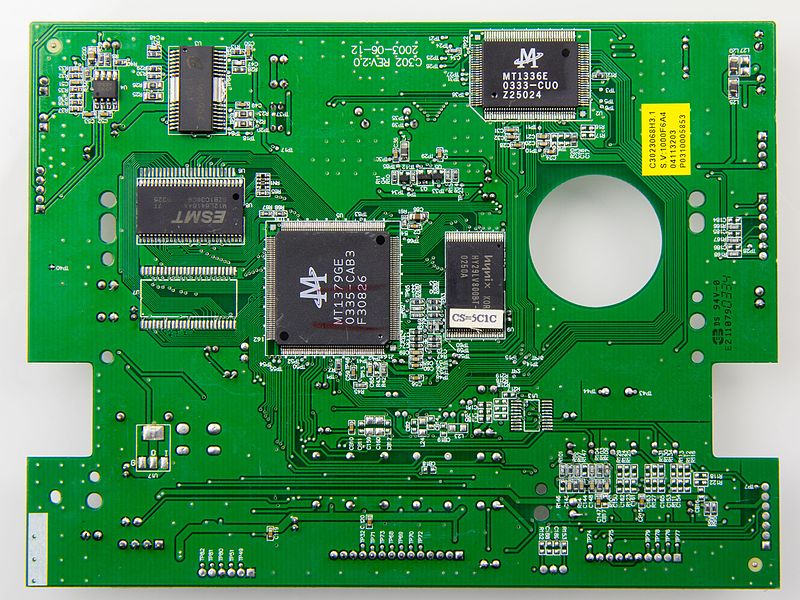
File:SEG_DVD_430_-_Printed_circuit_board-4276.jpg · Wikimedia Commons · See Wikimedia Commons
printed circuit board
Sign in to saveAlso known as PCB, bare PCB, board, circuit board, printed wiring board, PWB
board to support and connect electronic components
A printed circuit board is a flat board made of insulating material with metal pathways printed or etched onto it that holds and connects electronic components together. It's the foundation that allows all the different parts inside electronic devices—like computers, phones, and televisions—to work as a unified system.
AI-generated from the Wikipedia summary — may contain errors.
Wikidata facts
- Image
- Aurora 2ch mixer board arrived (2009-07-28 11.20.55 by c-g.).jpg
Show 6 more facts
- Stack Exchange tag
- electronics.stackexchange.com/tags/pcb
- Commons category
- Printed circuit boards
- MCN code
- 8538.90.10
- different from
- printed electronics
- short name
- PCB
- on focus list of Wikimedia project
- Wikipedia:Vital articles/Level/4
Sources (7)
via Wikidata · CC0
~36 min read
Encyclopedic overview
Printed circuit board of a DVD player Part of a 1984 Sinclair ZX Spectrum computer board, a printed circuit board, showing the conductive traces, the through-hole paths to the other surface, vias connecting traces on both sides, and some electronic components mounted using through-hole mounting
A printed circuit board (PCB), also known as a printed wiring board (PWB), is a laminated sandwich structure of conductive and insulating layers, each with a pattern of traces, planes and other features (similar to wires on a flat surface) etched from one or more sheet layers of copper laminated onto or between sheet layers of a non-conductive substrate. PCBs are used to connect or "wire" components to one another in an electronic circuit. Electrical components may be fixed to conductive pads on the outer layers, generally by soldering, which both electrically connects and mechanically fastens the components to the board. Another manufacturing process adds vias, metal-lined drilled holes that enable electrical interconnections between conductive layers, to boards with more than a single side.
Excerpted from Wikipedia’s “printed circuit board” article, available under the CC BY-SA 4.0 licence.
Gallery (12)
Available in 70 languages
- Español
- Français
- Deutsch
- 中文
- 日本語
- Русский
- Português
- Italiano
- العربية
- हिन्दी
- Afrikaans
- Armenian
- Asturian
- Azerbaijani
- Bahasa Indonesia
- Bangla
- Basque
- be_x_old
Show 51 more
- Bosnian
- Bulgarian
- Catalan
- Croatian
- Czech
- Danish
- Estonian
- Finnish
- Galician
- Georgian
- Greek
- Hebrew
- Hungarian
- Icelandic
- Ido
- Irish
- Kyrgyz
- Latin
- Latvian
- Lithuanian
- Macedonian
- Malay
- Mari
- Minangkabau
- Mongolian
- Nederlands
- Nepali
- Norwegian
- Norwegian Nynorsk
- Piedmontese
- Polski
- Romanian
- Scots
- Serbian
- Serbian (Latin)
- simple
- Slovak
- Svenska
- Swahili
- Tamil
- Tiếng Việt
- Türkçe
- Ukrainian
- Urdu
- Uzbek
- Wu Chinese
- Yiddish
- zh_yue
- فارسی
- ไทย
- 한국어
via Wikidata sitelinks · CC0