File:Quark_structure_proton.svg · Wikimedia Commons · See Wikimedia Commons
質子
Also known as p, ¹H⁺, 1H+, p⁺
A proton is a stable subatomic particle, symbol , H+, or 1H+ with a positive electric charge of +1 e (elementary charge). Its mass is slightly less than the mass of a neutron and approximately times the mass of an electron (the proton-to-electron mass ratio). Protons and neutrons, each with a mass of approximately one dalton, are jointly referred to as nucleons (particles present in atomic nuclei).
AI overview
A proton is a tiny, positively charged particle that is one of the basic building blocks of atoms, found in the nucleus alongside neutrons. Protons matter because their number determines what chemical element an atom is, and they are essential to the structure and behavior of all matter.
AI-generated from the Wikipedia summary — may contain errors.
Key facts
- Particle.classification
- Baryon
- Particle.name
- Proton
- Particle.image
- Quark structure proton.svg
- Particle.caption
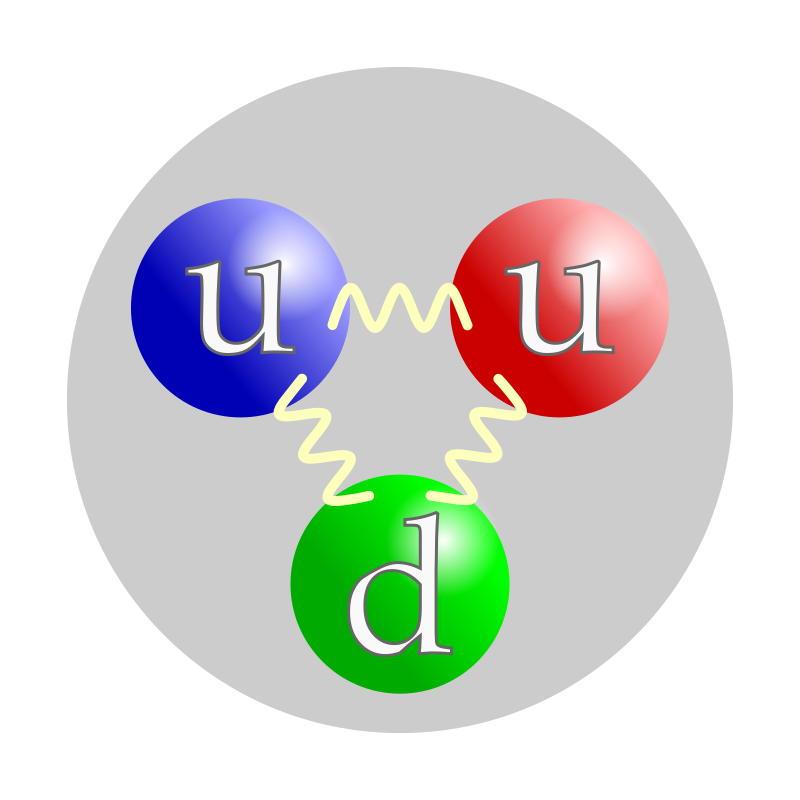
- The valence quark content of a proton. The color assignment of individual quarks is arbitrary, but all three colors must be present. Forces between quarks are mediated by gluons.
- Particle.composition
- 2 up quarks (u), 1 down quark (d)
- Particle.statistics
- Fermionic
- Particle.group
- Hadron
- Particle.interaction
- Gravity, electromagnetic, weak, strong
- Particle.antiparticle
- Antiproton
- Particle.theorized
- William Prout (1815)
- Particle.discovered
- Observed as H+ by Eugen Goldstein (1886). Identified in other nuclei (and named) by Ernest Rutherford (1917–1920).
Article · 中文
質子(英語:Proton,日韓漢字稱作陽子、陽性子),是一種帶有1个單位电荷正電的穩定強子,通常標記為p或p+。每個原子的原子核內部至少會含有一個質子,質子的數量稱為原子序數;另外,還可能含有中子,這些質子與中子都被稱為核子。由於每種元素的原子都含有獨特數量的質子,每種元素具有獨特的原子序數。 在粒子物理學的現代標準模型裏,質子是由兩個上夸克與一個下夸克組成的強子。夸克的靜質量只貢獻出大約1%質子質量,剩餘的質子質量主要源自於夸克的動能與綑綁夸克的的能量。 因為質子是由三個夸克組成,質子不是基本粒子,質子具有物理尺寸,但這尺寸並不能完美良好定義,由於質子的表面很模糊,因為這表面是由作用力的影響來定義,而這作用力不會突然終止。質子的半徑(更仔細地說,)大約為0.84–0.87飛米。 自由質子是不與其它核子或電子結合在一起的質子。自由質子很穩定,尚未被觀察到自發衰變成其它種粒子。質子與電子之間會相互親和,但當能量或溫度高到足以將質子與電子分離之時,就可以自然地找到自由質子。在等離子體裏,溫度非常高,質子無法與電子結合在一起,因此自由質子可以存在。在太空裏,傳播了星際距離的宇宙線,其成分有90%是具有高能量與高動量的自由質子。自由中子不穩定,會進行衰變,這過程的產物是質子、電子與反中微子。
Abstract from DBpedia / Wikipedia · CC BY-SA