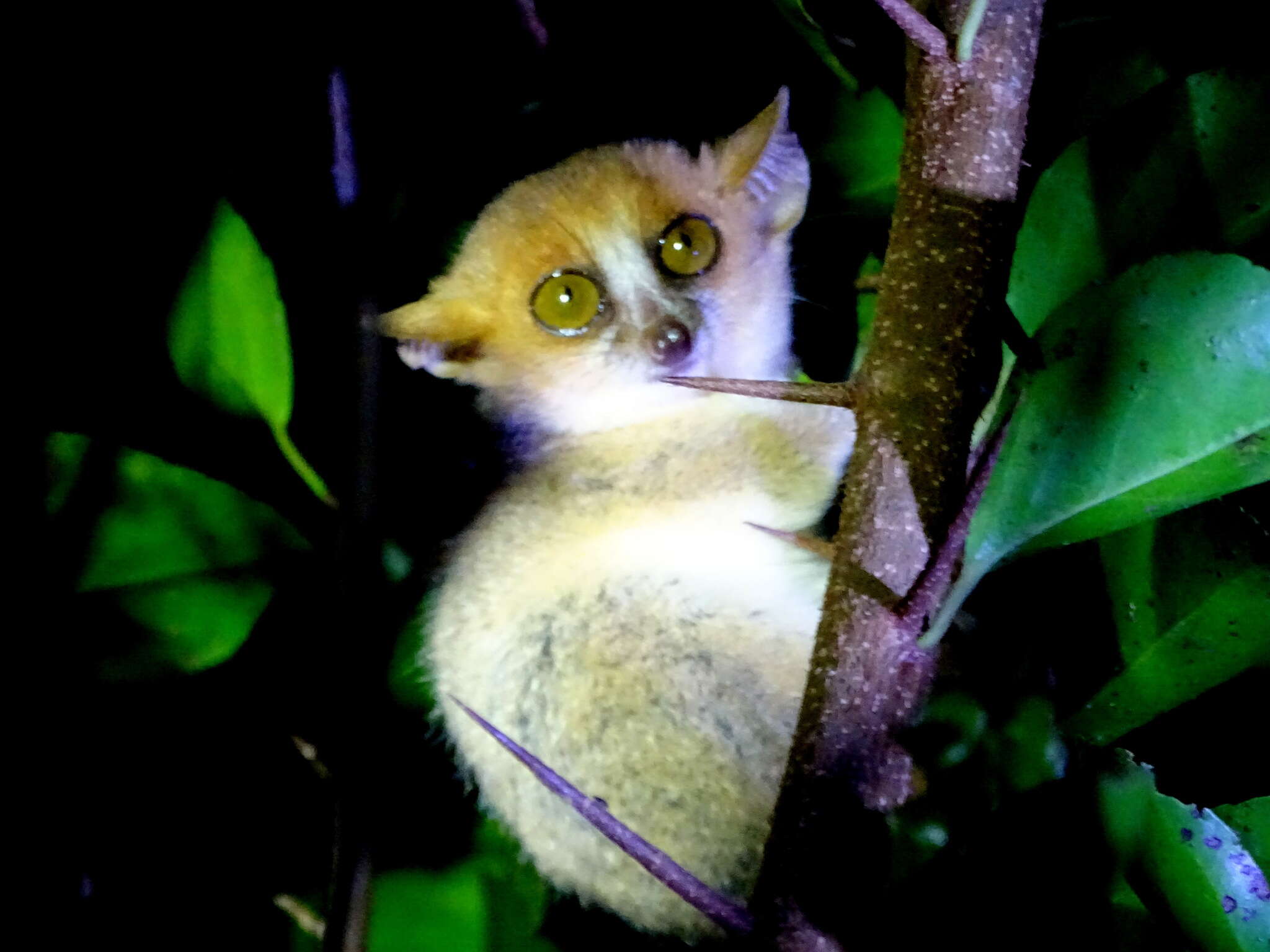
Encyclopedia of Life · EOL (see source)
Species
Vulnerableピグミーネズミキツネザル ピグミーネズミキツネザル Microcebus myoxinus 保全状況評価[a 1][a 2] VULNERABLE (IUCN Red List Ver.3.1 (2001)) ワシントン条約附属書I 分類 界 : 動物界 Animalia 門 : 脊索動物門 Chordata 亜門 : 脊椎動物亜門 Vertebrata 綱 : 哺乳綱 Mammalia 目 : サル目 Primates 科 : コビトキツネザル科 Cheirogaleidae 属 : ネズミキツネザル属 Microcebus 種 : ピグミーネズミキツネザル M. myoxinus 学名 Microcebus myoxinus Peters, 1852 和名 ピグミーネズミキツネザル 英名 Pygmy mouse lemur 生息域 ピグミーネズミキツネザル(Microcebus myoxinus)は、哺乳綱サル目(霊長目)コビトキツネザル科ネズミキツネザル属に分類されるサル。 目次 1 分布 2 形態 3 分類 4 生態 5 人間との関係 6 参考文献 7 関連項目 8 外部リンク 分布[編集] マダガスカル西部(キリンディの森およびアナラベ私設保護区)[1]固有種 形態[編集] 体長6-7センチメートル[1]。尾長11-15センチメートル[1]。体重25-40グラムとサル目最小種[1]。短い体毛で密に被われる[1]。背面の毛衣は橙がかった赤褐色、腹面の毛衣は淡黄白色[1]。 分類[編集] 同所的に分布するハイイロネズミキツネザルの幼獣と考えられていたこともあった[1]。1852年に記載されてから、1992年まで発見例がなかった[1]。 生態[編集] 乾燥した落葉樹林に生息する[1]。夜行性[1]。 人間との関係[編集] 生息数は不明でマダガスカル西部の他地域に分布する可能性もあるが、生息地の破壊により生息数が減少していると考えられている[1]。 参考文献[編集] [ヘルプ] ^ a b c d e f g h i j k 小原秀雄・浦本昌紀・太田英利・松井正文編著 『動物世界遺産 レッド・データ・アニマルズ8 太平洋、インド洋』、講談社、2001年、43、152頁。 関連項目[編集] コビトキツネザル科 ネズミキツネザル属 外部リンク[編集] ウィキメディア・コモンズには、ピグミーネズミキツネザルに関連するメディアがあります。 ウィキスピーシーズにピグミーネズミキツネザルに関する情報があります。 ^ CITES homepage Appendices I, II and III ^ The IUCN Red List of Threatened Species Andrainarivo, C., Andriaholinirina, V.N., Feis
via IUCN
Wikidata facts
- Instance of
- taxon
- Parent taxon
- Microcebus
- Image
- Microcebus myoxinus.jpg
Show 8 more facts
- taxon rank
- species
- IUCN conservation status
- Vulnerable
- taxon name
- Microcebus myoxinus
- Commons category
- Microcebus myoxinus
- Commons gallery
- Microcebus myoxinus
- taxon common name
- Zwergmausmaki
- endemic to
- Madagascar
- CITES Appendix
- Appendix I of CITES
Sources (1)
via Wikidata · CC0
~3 min read
Encyclopedic overview
The pygmy mouse lemur (Microcebus myoxinus), also known as Peters' mouse lemur or dormouse lemur, is a primate weighing only 43–55 g (1.5–1.9 oz); it is the second smallest of the mouse lemurs. Its dorsal side is a rufous-brown colour, and creamy-white ventrally. It lives in dry deciduous forests of western Madagascar. It has been captured in the Tsingy de Bemaraha Nature Reserve, the Andramasy forests north of Belo sur Tsiribihina, and the border of heavily degraded deciduous forest and savanna at Aboalimena. It has also been found in other habitats, in mangroves in two localities.
Accounts and descriptions of this species are frequently confounded with those of Microcebus berthae, the smallest primate in the world. This is because specimens of M. berthae captured in Kirindy Forest, 60 km north of Morondava, were erroneously named M. myoxinus. Apparently, the rufous color of M. berthae (not described at the time) matched the description by Peter as M. myoxinus. Most articles on the web report information on M. myoxinus that correspond to studies made in Kirindy Forest on M. berthae.
Excerpted from Wikipedia’s “Pygmy mouse lemur” article, available under the CC BY-SA 4.0 licence.