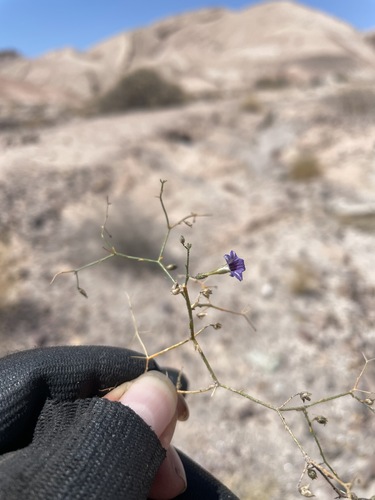
(c) Lucely L. Vilca Bustamante, some rights reserved (CC BY-NC), uploaded by Lucely L. Vilca Bustamante · cc-by-nc
Reyesia
Sign in to saveReyesia is a small genus of four species of flowering plants belonging to the subfamily Cestroideae of the nightshade family Solanaceae. It is closely related to the genus Salpiglossis, which provides the ornamental species Salpiglossis sinuata. Together, the genera Reyesia and Salpiglossis form the tribe Salpiglossideae within the Cestroideae. Historically, the species now placed in Reyesia have been held by some authors to belong to Salpiglossis, but are currently placed in a genus of their own by virtue of their tiny flowers and peculiar androecium (see description below).
Species
GENUS
- KingdomPlantae
- PhylumTracheophyta
- ClassMagnoliopsida
- OrderSolanales
- FamilySolanaceae
via GBIF · Kew POWO
Museum specimens
- Specimen records
- 5
- With media
- 1
- Family
- Solanaceae
- Collections
- F, MO
- Recorded in
- Chile, Argentina
Wikidata facts
- Instance of
- taxon
- Parent taxon
- Solanaceae
- Image
- Historia fisica y politica de Chile segun documentos adquiridos en esta republica durante doce años de residencia en ella y publicada bajo los auspicios del supremo gobierno (8280168809).jpg
Show 5 more facts
- topic's main category
- Category:Reyesia
- taxon rank
- genus
- taxon name
- Reyesia
- Commons category
- Reyesia
Sources (1)
via Wikidata · CC0
~4 min read
Encyclopedic overview
6 sectionsContents
- Description
- Taxonomy
- Species
- Distribution and habitat
- References
- Further reading
Reyesia is a small genus of four species of flowering plants belonging to the subfamily Cestroideae of the nightshade family Solanaceae. It is closely related to the genus Salpiglossis, which provides the ornamental species Salpiglossis sinuata. Together, the genera Reyesia and Salpiglossis form the tribe Salpiglossideae within the Cestroideae. Historically, the species now placed in Reyesia have been held by some authors to belong to Salpiglossis, but are currently placed in a genus of their own by virtue of their tiny flowers and peculiar androecium (see description below).
==Description== Annuals or subshrubs (possibly also biennials) clad in sticky trichomes, the plants between 0.3 and 0.8 m in height, greatly dichotomously branched or with only one branched main stem, terminal branches spine-like. One species almost leafless: the others with lower leaves with large (circa 40 mm) pinnatifid – almost pinnatisect – blades decurrent on conspicuous petioles, or forming a basal rosette of broad leaves with long petioles. Upper leaves small, almost sessile, uppermost often reduced to tiny thread-like scales. Flowers solitary, terminal, small, pedicels 10–20 mm, calyces 2–4 mm, strongly glanduliferous – like the pedicels – with five short, equal, acute teeth; corolla zygomorphic, 6–13 mm, tubulose to funnel-shaped, violet, blue or yellow, with or without violet stripes, lobes five, of which four equal (the remaining anterior lobe slightly larger), lobes much shorter than tube; stamens included and somewhat curved towards the larger anterior corolla lobe; stamens four, in two pairs of different lengths, the posterior pair fertile with larger anthers, the lateral pair with smaller anthers, fertile (in R. chilensis) or sterile (in R. parviflora). Anthers with filaments hairless or hairy, thecae usually unequal, anthers basifixed, pollen grains free or in tetrads; Nectary pelviform, bilobed; style thread-like, hollow or solid, almost as long as longest stamens, the stigma spoon-shaped. Capsules small (circa 3–4 mm) hidden in bases of persistent calyces; seeds between two and twenty-five in number, depending on species. Testa reticulate or granulate, embryo of seed curved.
Excerpted from Wikipedia’s “Reyesia” article, available under the CC BY-SA 4.0 licence.