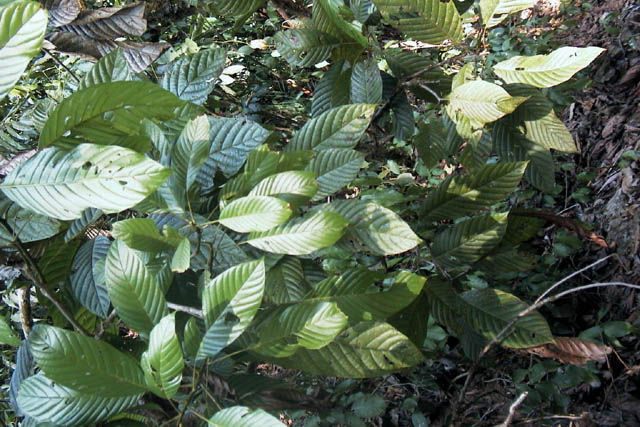
Encyclopedia of Life · EOL (see source)
Sabiaceae
Sign in to saveSabiaceae is a family of flowering plants that were placed in the order Proteales according to the APG IV system. It comprises three genera, Meliosma, Ophiocaryon and Sabia, with 66 known species, native to tropical to warm temperate regions of southern Asia and the Americas. The family has also been called Meliosmaceae Endl., 1841, nom. rej.
In the Vinony graph
Vinony's link graph records 476 inbound references to Sabiaceae, and connects out to Asterids, pollen and stamen.
Vinony files it under Eudicot families, Sabiaceae and Taxonbars with 20–24 taxon IDs.
Vinony links it to 33 Wikipedia language editions.
Species
FAMILY
- KingdomPlantae
- PhylumTracheophyta
- ClassMagnoliopsida
- OrderProteales
- FamilySabiaceae
清风藤科(学名:Sabiaceae)植物原生于南亚和美洲的热带或暖温带地区。共有三属大约160种,都是木本植物,清风藤属植物一般为藤本,泡花树属和蛇心樹屬则为乔木或灌木。 克朗奎斯特分类法将清风藤科分入毛茛目,有的分类学家将其单独分为清风藤目[1],也有的分类学家将泡花树属和蛇心树属单独分为一个泡花树科[2],2003年的APG II分类法根据基因信息,将其列为真双子叶植物分支中的一个地位未定科,未决定其目级分类,直到2016年APG IV分类法才正式将其置于山龙眼目[3]。 参考文献 ^ Sabiaceae Bl.. In. Watson, L., and Dallwitz, M.J. 1992 onwards. The families of flowering plants: descriptions, illustrations, identification, and information retrieval. Version: 16th May 2016. delta-intkey.com ^ Meliosmaceae Endl.. In. Watson, L., and Dallwitz, M.J. 1992 onwards. The families of flowering plants: descriptions, illustrations, identification, and information retrieval. Version: 16th May 2016. delta-intkey.com ^ Angiosperm Phylogeny Group. An update of the Angiosperm Phylogeny Group classification for the orders and families of flowering plants: APG IV (PDF). Botanical Journal of the Linnean Society. 2016, 181 (1): 1–20 [2016-04-10]. doi:10.1111/boj.12385. 外部链接 维基共享资源中相关的多媒体资源:清风藤科 维基物种中的分类信息:清风藤科 巴基斯坦的清风藤科植物 Hansen和 Rahn:被子植物分科 CSDL中的清风藤科 NCBI分类法中的清风藤科 多花泡花树 红枝柴 取自“https://zh.wikipedia.org/w/index.php?title=清风藤科&oldid=40612818” 分类: 山龙眼目 清风藤科 植物科名 隐藏分类: 物种微格式条目 含有拉丁語的條目
via GBIF
Museum specimens
- Specimen records
- 201
- With media
- 43
- Family
- Sabiaceae
- Collections
- CAS, BRIT, UOMNH, NY, MEL, INSTITUTO NACIONAL DE PESQUISAS DA AMAZÔNIA (INPA)
- Recorded in
- China, Peru, United States, Brazil, Vietnam, Philippines, Malaysia, Brasil
Wikidata facts
Show 7 more facts
- Commons category
- Sabiaceae
- taxon rank
- family
- taxon name
- Sabiaceae
- topic's main category
- Category:Sabiaceae
- taxonomic type
- Sabia
- taxon common name
- 清风藤科
Sources (1)
via Wikidata · CC0
~7 min read
Encyclopedic overview
10 sectionsContents
- Description
- Ecology
- Phytochemistry
- Uses
- Fossils
- Systematic position
- Taxa included
- See also
- References
- External links
Sabiaceae is a family of flowering plants that were placed in the order Proteales according to the APG IV system. It comprises three genera, Meliosma, Ophiocaryon and Sabia, with 66 known species, native to tropical to warm temperate regions of southern Asia and the Americas. The family has also been called Meliosmaceae Endl., 1841, nom. rej.
== Description == Trees, climbing shrubs or woody vines, evergreen, rarely deciduous, glabrous or pubescent, rarely spiny. Indumentum of simple multicellular hairs or with bicellular capitula. Leaves alternate, spiral to distichous, penninerved, brochidodromous, simple or imparipinnate, herbaceous or coriaceous, sometimes very large, with simple dentate edges, sometimes heteromorphic, often the base of the stalk is woody and the base of the foliole is pulvinulate, lacking stipules, vernation conduplicate, often dotted with red glands. Stomata anomocytic or paracytic, usually hypostomatic. Stems with large radii, complex unilacunar nodes, without secretory cavities, perulate buds or not. Hermaphrodite plants, rarely polygamodioecious. Inflorescences in pauci- to multi-floral panicle, terminal or axillary, often reduced to solitary axillary flower, rarely on cymes or in racemes, peduncles often very short (sub-sessile flowers), bearing zero to numerous small bracts. Small perfect flowers, actinomorphic or obliquely zygomorphic, usually pentamerous, sepals, petals and stamens arranged in opposed whorls. Hypogynous disc present, thin, annular, nectariferous, with lobes (sometimes with hardened discoid glands) alternating with the stamens, sometimes with bifid-shaped teeth. Sepals (4-)5, in a whorl, free or basally fused, equal or with the 2 internal sepals much smaller, imbricate. Petals (4-)5, in a whorl, free, equal or the 2 internal petals often much smaller (sometimes bifid), imbricate, oppositisepalous, more or less fleshy. Androecium of (4-)5(−6) elements, 5 stamens or even 2 (opposed to the internal petals) and 3 staminodes, oppositipetalous, free from each other but fused at the base of the petals, filiform filaments, expanded below the anther or forming a collar, unilocular anthers, dithecal, introrse and bent down, enclosed in external cavities belonging to the adjacent staminode, more or less adherent between themselves, leaving a central pore through which the style passes, or even extrorse, connective strongly expanded, dehiscence through transversal slits or valves. Superior gynoecium, of 2(−3) carpels, hemicarpic with apically free styles (stylodious) or sincarpic with one short cylindrical or conic style, capitate stigmas, punctate and moist, or not papillose and dry, ovules (1-)2 per carpel, hemianatropous to campylotropous, apotropous, unitegmic and crasinucelated, horizontal or pendulous, axial placentation. Fruit unilocular or dilocular, asymmetric, dry or drupaceous, indehiscent, monospermatic, sometimes in schizocarp, with persistent styles, endocarp stoney or crustaceous, sculpted or foveolate. Seeds one, with endosperm scarce or absent, with condyle, embryo with curved, elongate hypocotyl, with 2 flat cotyledons, plicate or coiled (in Ophyocaryon paradoxum). Pollen tricolpate, prolate, relatively small, semitectate exine, more or less reticulate. Chromosomal number: 2n = 24 in Sabia japonica and = 32 in Meliosma sp.
Excerpted from Wikipedia’s “Sabiaceae” article, available under the CC BY-SA 4.0 licence.