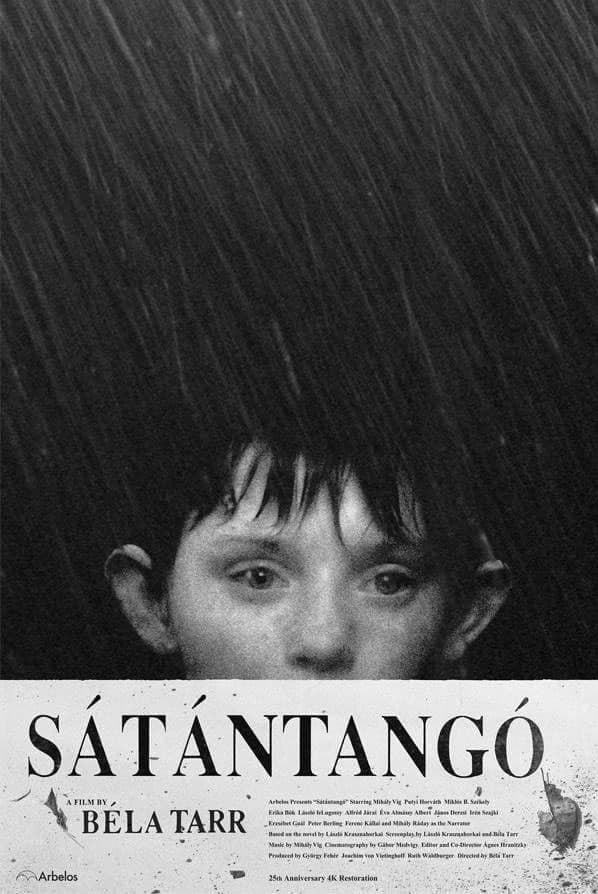
Poster from TMDB
Sátántangó
Sign in to saveAlso known as Satantango, Satan's Tango
Sátántangó (, also known in English as '''''Satan's Tango''') is a 1994 epic drama film directed and co-written by Hungarian filmmaker Béla Tarr. Shot in black-and-white and running for more than seven hours, it is based on the 1985 novel by László Krasznahorkai, whose works Tarr frequently adapted after his 1988 film Damnation''. Tarr had hoped to make the film since 1985 but was unable to proceed with production due to the strict political environment in Hungary.
OverviewAI-generated
Sátántangó is a Hungarian-language drama film directed by Béla Tarr. The screenplay was written by Tarr, László Krasznahorkai, Mihály Víg, and Péter Dobai. The cast includes Mihály Víg, János Derzsi, Peter Berling, and Péter Dobai. The film is based on the novel Satantango by László Krasznahorkai. It was produced by György Fehér and edited by Ágnes Hranitzky.
The movie is a black-and-white art film originating from Hungary, Germany, and Switzerland. Its runtime is listed as 432 minutes and 439 minutes. It was released in 1994. The production companies include Von Vietinghoff Filmproduktion, Vega Film, Mozgókép Innovációs Társulás és Alapítvány, Magyar Televízió, and TSR. The budget was 1,500,000.
Critical assessments include a review score of 8.2 out of 10 and a 100% rating. The film has received three wins and one nomination. It is part of the Museum of Modern Art collection. Keywords associated with the work include farm, countryside, based on novel or book, cat, and rain.
Synthesized by Vinony from 39 facts across 4 sources: Wikidata, TMDb, IMDb, OMDb. Generated from structured data (not the Wikipedia text) and checked against those facts — may still contain errors.
Film · TMDB
8.0Inhabitants of a small village in Hungary deal with the effects of the fall of Communism. The town's source of revenue, a factory, has closed, and the locals, who include a doctor and three couples, await a cash payment offered in the wake of the shuttering. Irimias, a villager thought to be dead, returns and, unbeknownst to the locals, is a police informant. In a scheme, he persuades the villagers to form a commune with him.
Cast
- Mihály Víg as Irimiás
- Putyi Horváth as Petrina
- Székely B. Miklós as Futaki
- Erika Bók as Estike
- László feLugossy as Schmidt
- Alfréd Járai as Halics
Themes
- farm
- countryside
- based on novel or book
- cat
- rain
- hungary
- loneliness
- art house
- poverty
- black and white
This product uses the TMDB API but is not endorsed or certified by TMDB.
Ratings
IMDb
8.2/10
13,284 votes
Rotten Tomatoes
100%
- Year
- 1994
- Runtime
- 439 min
- Genres
- Drama
- Rated
- Not Rated
- Awards
- 3 wins & 1 nomination total
via OMDb · IMDb
Key facts
- Film.name
- Sátántangó
- Film.image
- Sátántangó (2019 Rerelease Poster).jpeg
- Film.caption
- 2019 re-release poster
- Film.director
- Béla Tarr
- Film.music
- Mihály Víg
- Film.cinematography
- Gábor Medvigy
- Film.editing
- Ágnes Hranitzky
- Film.distributor
- (Hungary)
- Film.runtime
- 439 minutes
- Film.language
- Hungarian
via Wikipedia infobox
Wikidata facts
- Instance of
- film
- Genre
- art film
- Country of origin
- Switzerland
- Original language
- Hungarian
- Based on
- Satantango
- Collection
- Museum of Modern Art
- Director
- Béla Tarr
- Screenwriter
- Péter Dobai
- Composer
- Mihály Víg
- Duration
- 450
- FilmAffinity ID
- 530324
- Image
- Nagytőke nyári pusztaBlack and white.JPG
Show 8 more facts
- title
- Sátántangó
- publication date
- 2008-07-22
- film editor
- Ágnes Hranitzky
- costume designer
- Gyula Pauer
- after a work by
- László Krasznahorkai
- color
- black-and-white
- review score
- 100%
- assessment
- Bechdel test
Sources (8)
via Wikidata · CC0
~19 min read
Encyclopedic overview
17 sectionsContents
- Plot
- Cast
- Themes
- Production
- Structure
- Long takes
- The book and the film
- Music
- Release
- Home media
- Restoration
- Reception
- Critical response
- Controversy
- See also
- References
- External links
Sátántangó (, also known in English as '''''Satan's Tango''') is a 1994 epic drama film directed and co-written by Hungarian filmmaker Béla Tarr. Shot in black-and-white and running for more than seven hours, it is based on the 1985 novel by László Krasznahorkai, whose works Tarr frequently adapted after his 1988 film Damnation. Tarr had hoped to make the film since 1985 but was unable to proceed with production due to the strict political environment in Hungary.
The film was an international co-production between Hungarian, German, and Swiss companies. Sátántangó'' has received widespread critical acclaim from film critics. In 2012, it appeared in the British Film Institute's Sight & Sound critics' top 50 films.
Excerpted from Wikipedia’s “Sátántangó” article, available under the CC BY-SA 4.0 licence.