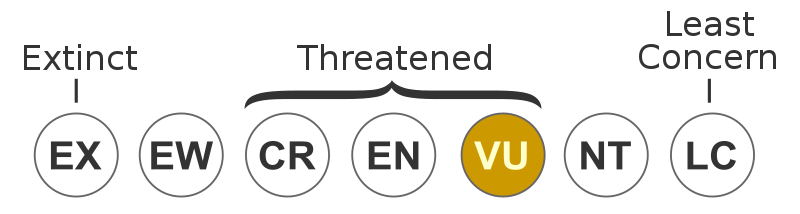
File:Status_iucn3.1_VU.svg · Wikimedia Commons · See Wikimedia Commons
Shoebill
Sign in to saveAlso known as whalehead, Balaeniceps rex, shoe-billed stork, shoebilled stork
The shoebill (Balaeniceps rex), also known as the whale-headed stork, whalebill, and shoe-billed stork, is a large long-legged wading bird. It is named for its enormous, shoe-shaped bill. It has a somewhat stork-like overall form and was previously classified as a stork in the order Ciconiiformes, but genetic evidence places it with pelicans and herons in the Pelecaniformes. Adults are mainly grey, while juveniles are browner. It lives in tropical East Africa in large swamps from South Sudan to Zambia.
The shoebill is a large wading bird from East African swamps that gets its name from its distinctive, enormous shoe-shaped bill. Though it was long thought to be a stork, genetic research has revealed it's actually more closely related to pelicans and herons.
AI-generated from the Wikipedia summary — may contain errors.
Species
鲸头鹳(学名:Balaeniceps rex)是一种大型鳥類,它是鲸头鹳科和鲸头鹳属唯一的一个物种。它的種名「rex」在拉丁文中意為「帝王」,来自它强大的喙。
via
Wikidata facts
- Instance of
- taxon
- Image
- Entebbe Shoe Bill Stork.jpg
Show 12 more facts
- taxon rank
- species
- IUCN conservation status
- Vulnerable
- taxon name
- Balaeniceps rex
- Commons category
- Balaeniceps rex
- Commons gallery
- Balaeniceps rex
- taxon common name
- picuzapatu
- litter size
- 1.7
- on focus list of Wikimedia project
- Wikipedia:Vital articles/Level/4
- diel cycle
- diurnality
- described by source
- Encyclopædia Britannica 11th edition
- taxon range
- Africa
- main food source
- Testudines
via Wikidata · CC0
~15 min read
Encyclopedic overview
14 sectionsContents
- Taxonomy
- Description
- Voice
- Flight pattern
- Distribution and habitat
- Behaviour and ecology
- Breeding
- Diet
- Relationship to humans
- Appearances in popular culture
- Status and conservation
- References
- Further reading
- External links
The shoebill (Balaeniceps rex), also known as the whale-headed stork, whalebill, and shoe-billed stork, is a large long-legged wading bird. It is named for its enormous, shoe-shaped bill. It has a somewhat stork-like overall form and was previously classified as a stork in the order Ciconiiformes, but genetic evidence places it with pelicans and herons in the Pelecaniformes. Adults are mainly grey, while juveniles are browner. It lives in tropical East Africa in large swamps from South Sudan to Zambia.
==Taxonomy== thumb|left|alt=hamerkop|Molecular studies have found the hamerkop to be the closest relative of the shoebill. The shoebill may have been known to Ancient Egyptians but was not classified by Europeans until the 19th century, after skins and eventually live specimens were brought to Europe. John Gould very briefly described it in 1850 from the skin of a specimen collected on the upper White Nile by English traveler Mansfield Parkyns. Gould provided a more detailed description in the following year. He placed the species in its own genus Balaeniceps and coined the binomial name Balaeniceps rex, from Latin 'whale' and / 'head'. Other common names are whalebill, shoe-billed stork, and whale-headed stork.
Excerpted from Wikipedia’s “Shoebill” article, available under the CC BY-SA 4.0 licence.
Gallery (18)
Available in 79 languages
- Español
- Français
- Deutsch
- 中文
- 日本語
- Русский
- Português
- Italiano
- العربية
- हिन्दी
- Afrikaans
- Albanian
- Asturian
- azb
- Azerbaijani
- Bahasa Indonesia
- Balinese
- Basque
Show 60 more
- Breton
- Bulgarian
- Catalan
- Cebuano
- Chuvash
- Croatian
- Czech
- Danish
- Egyptian Arabic
- Esperanto
- Estonian
- Filipino
- Finnish
- Galician
- Ganda
- Georgian
- Greek
- Hebrew
- Hungarian
- Icelandic
- Irish
- Javanese
- Kazakh
- Kinyarwanda
- Kotava
- Latin
- Latvian
- Lithuanian
- Malagasy
- Malay
- Malayalam
- Navajo
- Nederlands
- Northern Frisian
- Norwegian
- Norwegian Nynorsk
- Polski
- Quechua
- Romanian
- Saterland Frisian
- Scots
- Serbian
- simple
- Slovenian
- Svenska
- Swahili
- Tamil
- Tiếng Việt
- Türkçe
- Ukrainian
- Urdu
- Uzbek
- Waray
- Welsh
- Wu Chinese
- Yiddish
- zh_yue
- فارسی
- ไทย
- 한국어
via Wikidata sitelinks · CC0