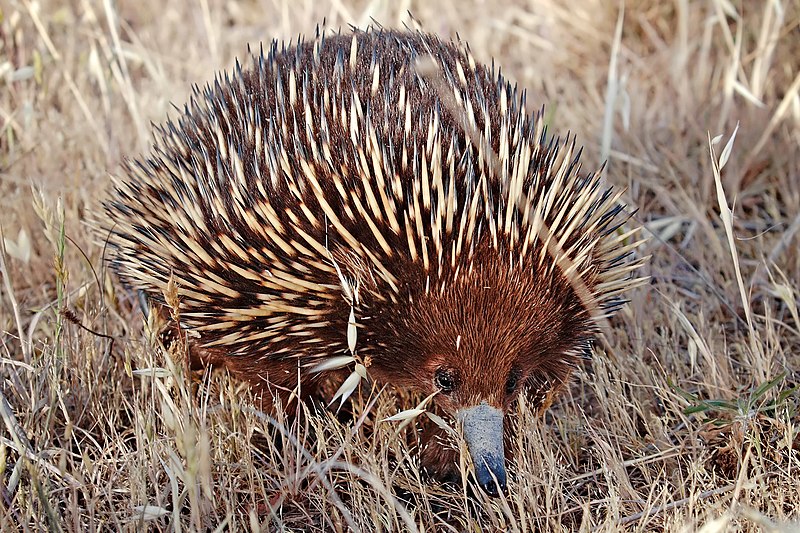
File:Wild_shortbeak_echidna.jpg · Wikimedia Commons · See Wikimedia Commons
The short-beaked echidna is a spiky mammal native to Australia and nearby regions that, like the platypus, lays eggs rather than giving birth to live young. It matters because it represents one of the few remaining egg-laying mammals on Earth, making it scientifically important for understanding early mammal evolution.
AI-generated from the Wikipedia summary — may contain errors.
Species
Least Concern二名法 Tachyglossus aculeatus(Shaw, 1792) 澳洲针鼹又称短吻针鼹,是针鼴属下的唯一一個種。生活在澳大利亚、塔斯马尼亚等地森林中,体长0.5米,体重6公斤左右,周身有刺,五指有强爪。生活地区为澳新区。澳大利亚现在流通的面值最小的5分硬币的背面即是一只针鼹。 参考 ^ Aplin, K.; Dickman, C.; Salas, L.; Helgen, K. Tachyglossus aculeatus. IUCN Red List of Threatened Species (IUCN). 2016, 2016: e.T41312A21964662 [23 April 2017]. doi:10.2305/IUCN.UK.2016-2.RLTS.T41312A21964662.en. 维基物种中的分类信息:澳洲针鼹 查 论 编 按科分類的单孔目現存物種 界 動物界 門 脊索動物門 綱 哺乳綱 (未排序)Australosphenida(英语:Australosphenida) 針鼴科(針鼴)針鼴屬 澳洲針鼴(O. anatinus) 原针鼹属(原針鼴) 阿滕伯勒長喙針鼴鼠(Z. attenboroughi) 大長吻針鼴(Z. bartoni) 長吻針鼴(Z. bruijni) 鴨嘴獸科鴨嘴獸屬 鴨嘴獸(O. anatinus) 分類 这是一篇與哺乳动物相關的小作品。你可以通过编辑或修订扩充其内容。 查 论 编 取自“https://zh.wikipedia.org/w/index.php?title=澳洲针鼹&oldid=52495243” 分类: IUCN无危物种 针鼹屬 澳大利亞哺乳類 隐藏分类: TaxoboxLatinName 本地相关图片与维基数据不同 全部小作品 哺乳類小作品
via IUCN
Wikidata facts
- Instance of
- taxon
- Parent taxon
- Tachyglossus
- Image
- Wild shortbeak echidna.jpg
Show 16 more facts
- taxon rank
- species
- IUCN conservation status
- Least Concern
- taxon name
- Tachyglossus aculeatus
- Commons category
- Tachyglossus aculeatus
- Commons gallery
- Tachyglossus aculeatus
- taxon common name
- Bristly Echidna
- longest observed lifespan
- 49.5
- taxon author citation
- (Shaw, 1792)
- gestation period
- 24.5
- litter size
- 1
- period of lactation
- 200
- time in the pouch
- 52.5
- taxon range
- Indonesia
- short name
- T. aculeatus
- has characteristic
- viviparity
- time period
- Holocene
via Wikidata · CC0
~40 min read
Encyclopedic overview
Near Scottsdale, Tasmania The short-beaked echidna (Tachyglossus aculeatus), also known as the common echidna, or short-nosed echidna, is one of four living species of echidna, and the only member of the genus Tachyglossus, from Ancient Greek ταχύς (takhús), meaning "fast", and γλῶσσα (glôssa), meaning "tongue". It is covered in fur and spines and has a distinctive snout and a specialised tongue, which it uses to catch its insect prey at a great speed. Like the other extant monotremes, the short-beaked echidna lays eggs; the monotremes are the only living group of mammals to do so.
The short-beaked echidna has extremely strong front limbs and claws, which allow it to burrow quickly with great power. As it needs to be able to survive underground, it has a significant tolerance to high levels of carbon dioxide and low levels of oxygen. It has no weapons or fighting ability but deters predators by curling into a ball and protecting itself with its spines. It cannot sweat or deal well with heat, so it tends to avoid daytime activity in hot weather. It can swim if needed. The snout has mechanoreceptors and electroreceptors that help the echidna to detect its surroundings.
Excerpted from Wikipedia’s “short-beaked echidna” article, available under the CC BY-SA 4.0 licence.