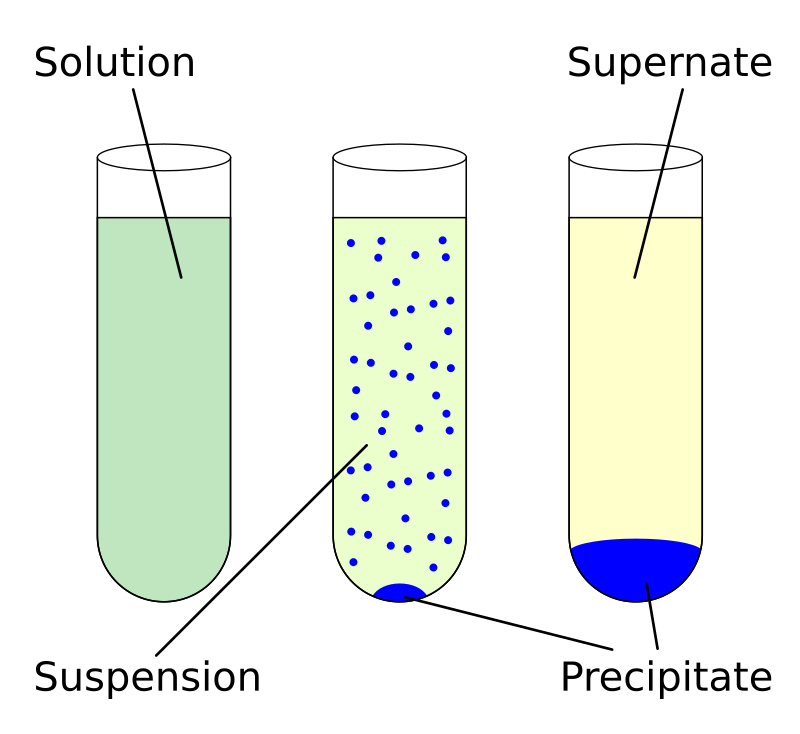
File:Chemical_precipitation_diagram_multilang.svg · Wikimedia Commons · See Wikimedia Commons
oplosbaarheid
Sign in to savethumb|Example of a dissolved solid (left) thumb|upright|Formation of crystals in a 4.2 Molar concentration|M [[ammonium sulfate solution. The solution was initially prepared at 20 °C and then stored for 2 days at 4 °C.]]
Solubility is the ability of a substance to dissolve into another substance, like salt dissolving in water, and it can change depending on conditions like temperature. It matters because understanding how much of a substance can dissolve helps predict when crystals will form or when solutions will become saturated.
AI-generated from the Wikipedia summary — may contain errors.
Research
442,967 papers- Estimating drug solubility in the gastrointestinal tract.ReviewAdvanced drug delivery reviews · 2007Dressman JB, Vertzoni M, Goumas K et al.DOI: 10.1016/j.addr.2007.05.009
- Polyphenol-solubility alters amyloid fibril formation of α-synuclein.Protein science : a publication of the Protein Society · 2021So M, Kimura Y, Yamaguchi K et al.DOI: 10.1002/pro.4130
- Solubility of Pharmaceutical Ingredients in Natural Edible Oils.Molecular pharmaceutics · 2020Brinkmann J, Rest F, Luebbert C et al.DOI: 10.1021/acs.molpharmaceut.0c00215
- Solubility and thermodynamic analysis of famotidine polymorphs in pure solvents.International journal of pharmaceutics · 2021Soto R, Svärd MDOI: 10.1016/j.ijpharm.2021.121031
- A review of drug solubility in human intestinal fluids: implications for the prediction of oral absorption.ReviewEuropean journal of pharmaceutical sciences : official journal of the European Federation for Pharmaceutical Sciences · 2014Augustijns P, Wuyts B, Hens B et al.DOI: 10.1016/j.ejps.2013.08.027
- Solubility of pharmaceutical ingredients in triglycerides.European journal of pharmaceutics and biopharmaceutics : official journal of Arbeitsgemeinschaft fur Pharmazeutische Verfahrenstechnik e.V · 2019Brinkmann J, Huxoll F, Luebbert C et al.DOI: 10.1016/j.ejpb.2019.10.012
- Solubility and Thermodynamic Investigation of Meta-Autunite Group Uranyl Arsenate Solids with Monovalent Cations Na and K.Environmental science & technology · 2023Meza I, Gonzalez-Estrella J, Burns PC et al.DOI: 10.1021/acs.est.2c06648
- Solubility measurement and thermodynamic modeling of pantoprazole sodium sesquihydrate in supercritical carbon dioxide.Scientific reports · 2022Sodeifian G, Garlapati C, Razmimanesh F et al.DOI: 10.1038/s41598-022-11887-1
via PubMed
Wikidata facts
- Subclass of
- physical quantity
- Image
- SolubilityVsTemperature.png
Show 2 more facts
- Commons category
- Solubility
- on focus list of Wikimedia project
- Wikipedia:Vital articles/Level/4
via Wikidata · CC0
Article · Nederlands
Oplosbaarheid is een fysische eigenschap van een stof, namelijk de mate waarin een stof kan oplossen in een andere stof. Deze andere stof wordt het oplosmiddel genoemd. Oplosbaarheid wordt gemeten in maximale hoeveelheid van een bepaalde stof die per volume- of per massa-eenheid kan oplossen, wanneer een oplossing in evenwicht is met nog niet opgeloste stof. Het symbool voor oplosbaarheid is S, afgeleid van de Engelse benaming solubility. * De volume-eenheid (liter) wordt het meest gebruikt bij matig tot slecht oplosbare verbindingen, de massa-eenheid (kilogram) wordt het meest gebruikt bij goed oplosbare verbindingen. Daarnaast bestaan er vanuit de geschiedenis nog een groot aantal tabellen waarin de oplosbaarheid opgegeven wordt in gram op te lossen stof per honderd gram oplosmiddel. Een oplossing waarin een maximale hoeveelheid stof is opgelost, wordt verzadigd genoemd. Wanneer er minder dan deze maximale hoeveelheid is opgelost, wordt de oplossing onverzadigd genoemd. Het tegenovergestelde is een oververzadigde oplossing, die in vele gevallen leidt tot vorming van neerslag. Bepaalde vloeistoffen, zoals ethanol in water, zijn onbeperkt oplosbaar. Dit wordt mengbaarheid genoemd. Stoffen die niet door water kunnen worden opgelost, worden watervast of waterecht genoemd. Make-up en verf voor gebruik op de buitenzijde van gebouwen zijn voorbeelden van stoffen die watervast kunnen zijn. In veel gevallen is het oplosmiddel een vloeistof. De stof die wordt opgelost kan zich in gasfase, vloeibare of vaste fase bevinden. Sommige stoffen lossen goed op, andere in mindere mate. Ook zijn er stoffen die onoplosbaar zijn. In het laatste geval is de chemicus vaak toch in staat sporen van de stof in de oplossing aan te tonen. De chemicus spreekt dan ook van slecht of zeer slecht oplosbaar. Dit komt echter nauwelijks voor, omdat er meestal wel sprake is van enige oplossing. De oplosbaarheid wordt voornamelijk bepaald door de evenwichtsconstante van een oplossingsreactie, namelijk het oplosbaarheidsproduct Ks.
Abstract from DBpedia / Wikipedia · CC BY-SA
Gallery (21)
Available in 70 languages
- Español
- Français
- Deutsch
- 中文
- 日本語
- Русский
- Português
- Italiano
- العربية
- हिन्दी
- Afrikaans
- Albanian
- Armenian
- Asturian
- Bahasa Indonesia
- Bangla
- Basque
- be_x_old
Show 51 more
- Bosnian
- Bulgarian
- Catalan
- Central Kurdish
- Chuvash
- Croatian
- Czech
- Danish
- Esperanto
- Estonian
- Filipino
- Finnish
- Galician
- Greek
- Haitian Creole
- Hebrew
- Hungarian
- Irish
- Kazakh
- Latvian
- Lithuanian
- Macedonian
- Malay
- Malayalam
- Moksha
- Mongolian
- Nederlands
- Norwegian
- Norwegian Nynorsk
- Pashto
- Polski
- Punjabi
- Romanian
- Scots
- Serbian
- Serbian (Latin)
- simple
- Slovak
- Slovenian
- Svenska
- Tamil
- Tiếng Việt
- Türkçe
- Ukrainian
- Urdu
- Welsh
- Wu Chinese
- zh_yue
- فارسی
- ไทย
- 한국어
via Wikidata sitelinks · CC0