
Spagna
Sign in to saveAlso known as Kingdom of Spain
stato dell'Europa sud-occidentale, membro dell'Unione europea
OverviewAI-generated
Spain, officially the Kingdom of Spain, is located in Southern Europe. Its capital is Madrid, and it covers an area of 505992. The country operates as a parliamentary monarchy with a median income of 21959. Its official name is also recorded as Španělské království, Reino de España, and Королівство Іспанія. The national motto is Plus ultra, and its flag is 🇪🇸.
The population is reported variously as 48592909, 49315949, and 48848840. Urbanization stands at 80.3151998212, while forest area comprises 37.1925889548355 percent. Life expectancy is 83.8878048780488 years, and the unemployment rate is 10.376 percent. Spain participates in the Ten Years' War, Little War, Second Melillan campaign, and First Melillan campaign. It is characterized as a free country.
Public holidays include New Year's Day, International Workers' Day, Assumption of Mary, and Spanish National Day. The emergency phone number is 112, and the electrical plug types are Europlug and Schuko. The license plate code is E. The highest judicial authorities are the Supreme Court of Spain and the Constitutional Court of Spain. The timezones are UTC and UTC+01:00, and the top-level domain is .es.
Synthesized by Vinony from 68 facts across 9 sources: Wikidata, Openweathermap, Open Meteo, REST Countries, World Bank, OpenStreetMap, PubMed, Vinony graph, Geo. Generated from structured data (not the Wikipedia text) and checked against those facts — may still contain errors.
In the Vinony graph
Spagna is indexed among the 215 entries in Vinony's Countries collection.
Vinony's link graph records 162,689 inbound references to Spagna, and connects out to gross domestic product, Juan Carlos I of Spain and autonomous community of Spain.
The entry is geolocated on the map in city, across 6 mapped points.
It sits within the topics Countries and territories where Spanish is an official language, Countries in Africa and Countries in Europe.
Weather now
cached 8h ago7-day forecast
via Open-Meteo
Country

- Capital
- Madrid
- Population
- 49,315,949
- Region
- Europe · Southern Europe
- Demonym
- Spanish
- Currencies
- EUR (€)
- Languages
- Catalan, Basque, Galician, Spanish
- Calling code
- +34
- Drives on
- Right
- Gini
- 34.7 (2018)
- FIFA code
- ESP
- TLD
- .es
- Timezones
- UTC · +1 more
- Borders
- AND, FRA, GIB, PRT, MAR
via REST Countries
Indicators · World Bank
- GDP
- $1.7T(2024)
- Population
- 48,848,840(2024)
- Life expectancy
- 83.9 yrs(2024)
- Unemployment
- 10.4 %(2025)
- Urban population
- 80.3 %(2024)
- Internet users
- 95.8 %(2024)
- Forest area
- 37.2 %(2023)
- Renewable energy
- 19 %(2021)
via World Bank Open Data · CC BY 4.0
Wikipedia views (30d)
321,144 totalvia Wikimedia Pageviews API
Key facts
- Country.conventional_long_name
- Kingdom of Spain
- Country.common_name
- Spain
- Country.image_flag
- Bandera de España.svg
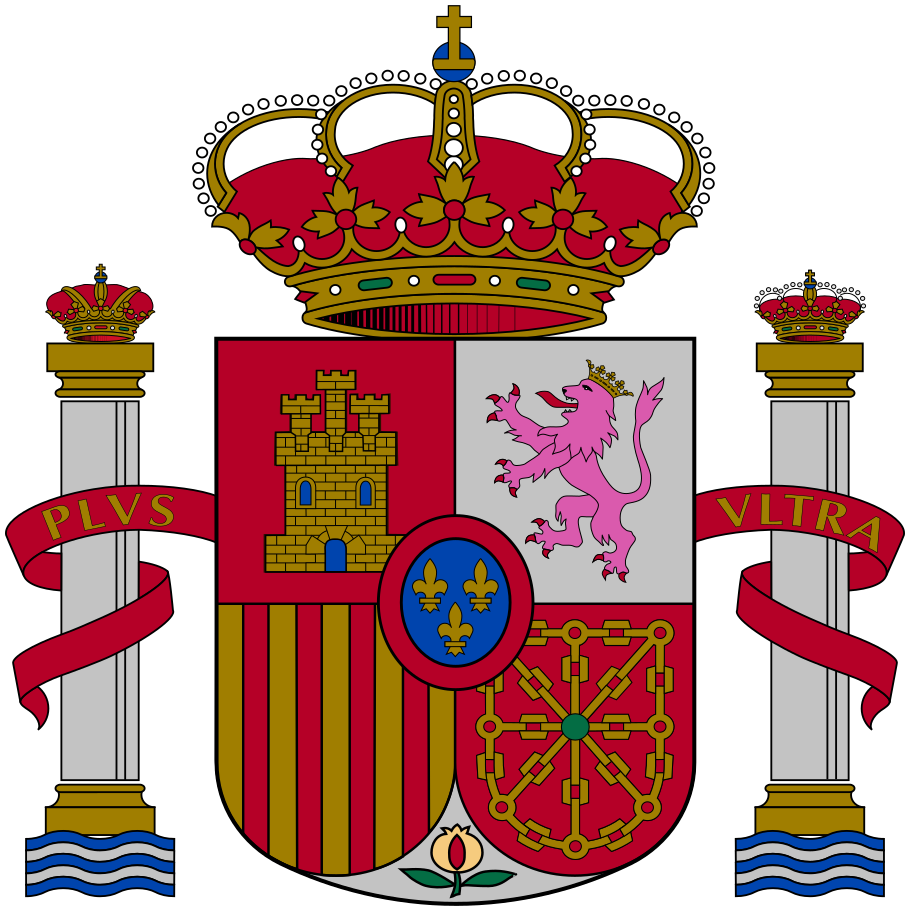
- Country.image_coat
- Escudo nacional de España, 1981 (base carpanel).svg
- Country.national_motto
- (Latin)(English: 'Further Beyond')
- Country.national_anthem
- (English: 'Royal March')
- Country.map_width
- 250px
- Country.capital
- Madrid
- Country.largest_city
- Madrid
- Country.languages_type
- Official language
- Country.languages
- Spanish
- Country.religion_year
- 2025
- Country.government_type
- Unitary parliamentary constitutional monarchy
- Country.leader_title1
- Monarch
- Country.leader_name1
- Felipe VI
- Country.leader_title2
- Prime Minister
- Country.leader_name2
- Pedro Sánchez
- Country.leader_title3
- President of the Congress of Deputies
via Wikipedia infobox
Research
1,055,310 papers- Spain's contribution to medical eponyms.Archivos de la Sociedad Espanola de Oftalmologia · 2021Yale SH, Tekiner H, Yale ESDOI: 10.1016/j.oftal.2020.05.043
- Advance Care Planning in Spain.Zeitschrift fur Evidenz, Fortbildung und Qualitat im Gesundheitswesen · 2023Lasmarías C, Carrero V, Fernández-Bueno J et al.DOI: 10.1016/j.zefq.2023.05.011
- Spain.Department of State publication. Background notes series · 1985United States. Department of State. Bureau of Public Affairs
- [Spain's primary care on the 50th anniversary of the reverse care law].Atencion primaria · 2021Zurro AM, Benedicto ASDOI: 10.1016/j.aprim.2021.102055
- Spain's suicide statistics: do we believe them?Social psychiatry and psychiatric epidemiology · 2021Snowdon JDOI: 10.1007/s00127-020-01948-z
- The threat of mosquito-borne arboviral disease in Spain: A bibliographic review.ReviewMedicina clinica · 2022Laycock T, Ureña Paniego C, Javier JDOI: 10.1016/j.medcli.2021.10.014
- [Geriatric medicine in Spain's healthcare system: Past and future].ReviewRevista espanola de geriatria y gerontologia · 2025Ribera Casado JM, Cruz Jentoft AJDOI: 10.1016/j.regg.2025.101626
- Congratulations to all Spain's emergency physicians and to the Spanish Society of Emergency Medicine (SEMES): Let the fun begin!Emergencias : revista de la Sociedad Espanola de Medicina de Emergencias · 2024Tintinalli JEDOI: 10.55633/s3me/073.2024
via PubMed
Wikidata facts
- Instance of
- nation state
- Part of
- European Economic Area
- Named after
- Hispania
- Official name
- مملكة اسپانيا
- Demonym
- Spaniard
- Participant in
- American Revolutionary War
- Country
- Spain
- Contains
- Spanish Sahara
- Continent
- Europe
- Official language
- Occitan
- Currency
- peseta
- Population
- 48592909
- Area
- 505990
- Body of water
- Alboran Sea
- Head of government
- Adolfo Suárez
- Head of state
- Francisco Franco
- Form of government
- parliamentary monarchy
- Legislature
- Cortes Generales
- Anthem
- Marcha Real
- Highest point
- Teide
- Official website
- administracion.gob.es
- Image
- Spain - Location Map (2013) - ESP - UNOCHA.svg
- Life expectancy
- 83
- Nominal GDP
- 1397509272054
Show 89 more facts
- GDP per capita
- 29993.06
- Unemployment rate
- 16
- Calling code
- +34
- Licence plate code
- E
- Electrical plug type
- Europlug
- Mains voltage
- 230
- Motto
- #spainindetail
- Flag
- flag of Spain
- Coat of arms
- coat of arms of Kingdom of Spain
- Significant event
- Spanish Constitution of 1931
- Has parts of class
- municipality of Spain
- topic's main Wikimedia portal
- Portal:Spain
- motto
- Plus ultra
- Unicode character
- 🇪🇸
- category of associated people
- Category:Spanish people
- geography of topic
- Geography of Spain
- office held by head of government
- Prime Minister of Spain
- median income
- 21959
- age of candidacy
- 18
- public holiday
- Assumption of Mary
- has characteristic
- free country
- highest judicial authority
- Constitutional Court of Spain
- number of out-of-school children
- 296768
- diplomatic relation
- North Korea
- Commons gallery
- España
- inception
- 1516-03-14
- history of topic
- history of Spain
- replaces
- First Spanish Republic
- compulsory education (maximum age)
- 16
- mobile country code
- 214
- total fertility rate
- 1.27
- maritime identification digits
- 225
- compulsory education (minimum age)
- 6
- marriageable age
- 18
- topic's main category
- Category:Spain
- category for people buried here
- Category:Burials in Spain
- age of majority
- 18
- on focus list of Wikimedia project
- Wikipedia:Vital articles/Level/4
- retirement age
- 65
- member of
- Pyrenees–Mediterranean Euroregion
- located in/on physical feature
- Southern Europe
- category for films shot at this location
- Category:Films shot in Spain
- executive body
- Government of Spain
- category for people who died here
- Category:Deaths in Spain
- office held by head of state
- monarch of Spain
- official religion
- non-denominational
- Commons category
- Spain
- top-level Internet domain
- .es
- age of consent
- 16
- category for people born here
- Category:Births in Spain
- short name
- España
- driving side
- right
- IPA transcription
- ˈspɑːnɪɑ
- maintained by WikiProject
- WikiProject Spain
- native label
- Reino de España
- language used
- Occitan
- Gregorian calendar start date
- 1582-10-15
- minimum temperature record
- -30
- GS1 country code
- 840-849
- culture
- culture of Spain
- category for maps or plans
- Category:Maps of Spain
- VAT rate
- 21
- studied by
- hispanism
- economy of topic
- economy of Spain
- demographics of topic
- demographics of Spain
- topic has template
- Template:Administrative divisions of Spain
- Democracy Index
- 8.12
- hashtag
- spain
- Human Development Index
- 0.905
- Happy Planet Index score
- 52.3
- Gini coefficient
- 34.3
- Inequality-adjusted Human Development Index
- 0.788
- coextensive with
- Spain
- NCI Thesaurus ID
- C17152
- social media followers
- 7430
- name in native language
- Reino de España
- has cabinet
- Council of Ministers of Spain
- P12749
- Billstedt
- birth rate
- 6.9
- male population
- 23416745
- death rate
- 9.7
- rural population
- 8932638
- female population
- 24361595
- urban population
- 38845702
- P8168
- Rodemack
- P13311
- Bob Dylan
- number of seats in assembly
- 50
- ethnic group
- Romani people
- significant environmental impact
- desertification
Sources (15)
via Wikidata · CC0
Travel guide
Understand
Spain shares the Iberian Peninsula with Andorra, Gibraltar, and Portugal.
A country of large geographic and cultural diversity, Spain may come as a surprise to those who only know of its reputation for great beach holidays and almost endless sunshine. There is everything from lush meadows and snowy mountains to huge marshes and deserts in the south east. While summer is the peak season, those who wish to avoid the crowds should consider visiting in the winter as not only is it normally mild and sunny, but attractions such as the Alhambra Palace in Granada and La Gran Mezquita in Cordoba will not be overcrowded. However the ski resorts of Sierra Nevada do get very crowded. The Mediterranean climate that predominates in Southern and Central Spain is noted for its dry summers and (somewhat) wet(ter) winters, so visiting in the winter or spring brings the added benefit of the vegetation looking much more healthy. Northern Spain (e.g. Asturias) on the other hand gets quite a bit of rain year round and is ripe with lush green vegetation even in August.
See
The most popular beaches are the ones along the Mediterranean coast, in the Balearic Islands and in the Canary Islands. Meanwhile, for hiking, the mountains of Sierra Nevada in the south, the Central Cordillera and the northern Pyrenees are the best places. You can also visit some of the National Parks in Spain
Eat
Spanish cuisine may not enjoy the prestige that French or Italian cuisine does in the Anglosphere, but it has skyrocketed in popularity in the 21st century, driven in no small part by the large number of Spanish celebrity chefs who have been making waves around the fine dining world.
Spaniards are very passionate about their food and wine. Spanish food can be described as quite light with a lot of vegetables and a huge variety of meat and fish. Perhaps owing to the inquisition trying to "find out" lapsed conversos pork (religiously prohibited in both Judaism and Islam) is easily the most consumed meat and features prominently in many dishes. Spanish cuisine does not use many spices; it relies only on the use of high quality ingredients to give a good taste. As such, you may find Spanish food bland at times but there are usually a variety of restaurants in most cities (Italian, Chinese, American fast food) if you would like to experience a variety of flavors. If you are familiar with Latin American cuisines, keep in mind that many Spanish dishes may have the same name as several Latin American dishes, but actually refer to completely different dishes (e.g. tortilla, horchata and mazapán refer to completely different things in Spain and Mexico).
Like much of Europe, Spain's top tourism destinations are full of tourist-trap restaurants that serve overpriced and mediocre food. If you want a good and reasonably-priced meal, it's generally best to go to restaurants with a primari…
Sleep
There are many types of tourist accommodation, ranging from hotels, pensions, rented villas and vacation homes, to camping and even monasteries.
"7% VAT is not included" is a common trick for mid-range guesthouses and hotels: always check the small print when you choose your place to stay. VAT is IVA in Spanish.
Stay safe
As per rest of the European Union, all emergencies can be reported to the toll-free number 112.
Respect
Generally speaking, Spaniards are widely regarded as welcoming and friendly.
Travel guide from Wikivoyage (CC BY-SA 4.0)
Article · Italiano
La Spagna, ufficialmente Regno di Spagna (in spagnolo Reino de España; in basco Espainiako Erresuma; in catalano Regne d'Espanya), è uno Stato sovrano, membro dell'Unione europea dal 1986. Monarchia costituzionale, la Spagna si trova all'estremità occidentale dell'Europa e occupa la quasi totalità della penisola iberica.Ha una superficie di 505941 km² e nel 2020 contava 47 431 256 abitanti.Confina a nord-est con la Francia (da cui è separata dalla catena dei Pirenei) e Andorra, a sud con il possedimento britannico di Gibilterra, a ovest con il Portogallo e, tramite le sue exclave di Ceuta e Melilla, con il Marocco.È inoltre bagnata a nord dall'oceano Atlantico e a sud dal mar Mediterraneo. In ambito internazionale la Spagna ha contenziosi territoriali con il Marocco (per Ceuta e Melilla).Alla Spagna appartiene infine l'exclave di Llívia, così come l'isola dei Fagiani nel fiume Bidasoa (in condominio con la Francia). La capitale del Paese è Madrid, che ricopre tale funzione ininterrottamente dal 1561, salvo un quinquennio tra il 1601 e il 1606.La lingua ufficiale dello Stato è lo spagnolo; altre lingue (es. catalano, basco) o dialetti (es. valenzano), sono, come recita la costituzione, «ufficiali nell'ambito delle rispettive comunità autonome conformemente ai propri statuti». In alcune fasi importanti della storia europea la Spagna ha detenuto un ruolo significativo, come nel periodo della Reconquista, nel quale i regni cristiani delle regioni interne della Penisola iberica respinsero progressivamente dal territorio gli occupanti arabi che, insediatisi in Iberia fin dall'VIII secolo, furono definitivamente allontanati nel 1492, a opera di Ferdinando d'Aragona e Isabella di Castiglia. Da inizio XVI fino a inizio XIX secolo la monarchia spagnola fu a capo di un vasto impero coloniale che si estendeva in tutti e cinque i continenti.Ridottosi drasticamente in estensione e popolazione, tale impero riuscì tuttavia a sopravvivere fino alla fine del XIX secolo (guerra ispano-americana) e oltre.Tra il 1808 e il 1812 la vittoriosa ribellione del popolo spagnolo contro Giuseppe Bonaparte, che Napoleone aveva insediato sul trono di Spagna per annettersi di fatto anche la penisola iberica, pose le basi per l'avvio della lenta rinascita e modernizzazione della Spagna, tuttavia interrotta per un quarantennio a seguito della guerra civile del 1936 contro il governo repubblicano spagnolo condotta da forze golpiste appoggiate dal Vaticano e dai governi nazifascisti di Italia e Germania; tra il 1936 e il 1975 la Spagna conobbe la dittatura di Francisco Franco e solo alla morte di quest'ultimo il Paese tornò alla democrazia con il ritorno a un sistema parlamentare e l'insediamento al trono del sovrano Juan Carlos di Borbone; il processo di democratizzazione del Paese si consolidò con l'entrata della Spagna nella comunità economica europea nel 1986 e, a seguire, nell'Unione europea. Al 2022 il sovrano del Paese è Filippo VI, della dinastia dei Borbone-Spagna, subentrato nel 2014 a suo padre Juan Carlos, che abdicò alle sue funzioni dopo 38 anni di regno.Il primo ministro è altresì il socialista Pedro Sánchez, capo del governo dal 2018.
Abstract from DBpedia / Wikipedia · CC BY-SA
Gallery (59)
On the map
6 mapped locations
Available in 310 languages
- Español
- Français
- Deutsch
- 中文
- 日本語
- Русский
- Português
- Italiano
- العربية
- हिन्दी
- Abkhazian
- abstract
- Achinese
- Adyghe
- Afrikaans
- Akan
- Albanian
- Albanian
Show 291 more
- Amharic
- ami
- Angika
- Aragonese
- Aramaic
- Armenian
- Arpitan
- Assamese
- Asturian
- Avaric
- Awadhi
- Aymara
- azb
- Azerbaijani
- Bahasa Indonesia
- Balinese
- Bambara
- Bangla
- Bashkir
- Basque
- bat_smg
- Bavarian
- be_x_old
- Belarusian
- Betawi
- Bhojpuri
- Bikol
- Bishnupriya
- Bislama
- Bosnian
- Breton
- btm
- Bulgarian
- Buriat
- Burmese
- Catalan
- cbk_zam
- cdo
- Cebuano
- Central Dusun
- Central Kurdish
- Chamorro
- Chechen
- Cherokee
- Cheyenne
- Church Slavic
- Chuvash
- Cornish
- Corsican
- Crimean Tatar
- Croatian
- Czech
- dag
- Danish
- Dinka
- Divehi
- dty
- Dzongkha
- Egyptian Arabic
- eml
- Erzya
- Esperanto
- Estonian
- Ewe
- Extremaduran
- Faroese
- Fiji Hindi
- Fijian
- Filipino
- Finnish
- fiu_vro
- Friulian
- Fula
- Gagauz
- Galician
- Gan Chinese
- Ganda
- gcr
- Georgian
- Gilaki
- Goan Konkani
- Gothic
- gpe
- Greek
- Guarani
- Gujarati
- Haitian Creole
- Hakka Chinese
- Hausa
- Hawaiian
- Hebrew
- Hungarian
- hyw
- Iban
- Icelandic
- Ido
- Igbo
- Iloko
- Inari Sami
- Ingush
- Interlingua
- Interlingue
- Inuktitut
- Inupiaq
- Irish
- Jamaican Creole English
- Javanese
- Jju
- Kabardian
- Kabyle
- Kalmyk
- Kannada
- Kanuri
- Kara-Kalpak
- Karachay-Balkar
- Kashmiri
- Kashubian
- Kazakh
- kbp
- kge
- Khmer
- Kinyarwanda
- Komi
- Komi-Permyak
- Kongo
- Kotava
- Kurdish
- Kyrgyz
- Ladino
- Lao
- Latgalian
- Latin
- Latvian
- Lezghian
- Ligurian
- Limburgish
- Lingala
- Lingua Franca Nova
- Lithuanian
- lld
- Lojban
- Lombard
- Low German
- Lower Sorbian
- Luxembourgish
- Macedonian
- Madurese
- Maithili
- Malagasy
- Malay
- Malayalam
- Maltese
- Manipuri
- Manx
- Māori
- map_bms
- Marathi
- Mari
- Mazanderani
- Minangkabau
- Mingrelian
- Mirandese
- mnw
- Moksha
- Mongolian
- Moroccan Arabic
- Navajo
- nds_nl
- Neapolitan
- Nederlands
- Nepali
- Newari
- Nigerian Pidgin
- Northern Frisian
- Northern Sami
- Northern Sotho
- Norwegian
- Norwegian Nynorsk
- Novial
- nrm
- Nyanja
- Obolo
- Occitan
- Odia
- Old English
- olo
- Oromo
- Ossetic
- Palatine German
- Pampanga
- Pangasinan
- Papiamento
- Pashto
- Pennsylvania German
- Picard
- Piedmontese
- Polski
- Pontic
- ppl
- Punjabi
- Quechua
- roa_rup
- roa_tara
- Romanian
- Romansh
- Romany
- Rundi
- Rusyn
- Samoan
- Sango
- Sanskrit
- Santali
- Sardinian
- Saterland Frisian
- Scots
- Scottish Gaelic
- Serbian
- Serbian (Latin)
- Shan
- Shona
- Sicilian
- Silesian
- simple
- Sindhi
- Sinhala
- skr
- Slovak
- Slovenian
- Somali
- Southern Sotho
- Sranan Tongo
- Standard Moroccan Tamazight
- Sundanese
- Svenska
- Swahili
- Swati
- szy
- Tachelhit
- Tahitian
- Tajik
- Talysh
- Tamil
- Taroko
- Tatar
- tay
- Telugu
- Tetum
- Tibetan
- Tiếng Việt
- Tigrinya
- Tok Pisin
- Toki Pona
- Tongan
- Tsonga
- Tumbuka
- Türkçe
- Turkmen
- Tyap
- Udmurt
- Ukrainian
- Upper Sorbian
- Urdu
- Uyghur
- Uzbek
- Venda
- Venetian
- Veps
- Volapük
- Walloon
- Waray
- Wayuu
- Welsh
- West Flemish
- Western Frisian
- Western Panjabi
- Wolof
- Wu Chinese
- Xhosa
- Yakut
- Yiddish
- Yoruba
- Zaza
- Zeelandic
- zh_classical
- zh_min_nan
- zh_yue
- Zhuang
- Zulu
- فارسی
- ไทย
- 한국어
via Wikidata sitelinks · CC0