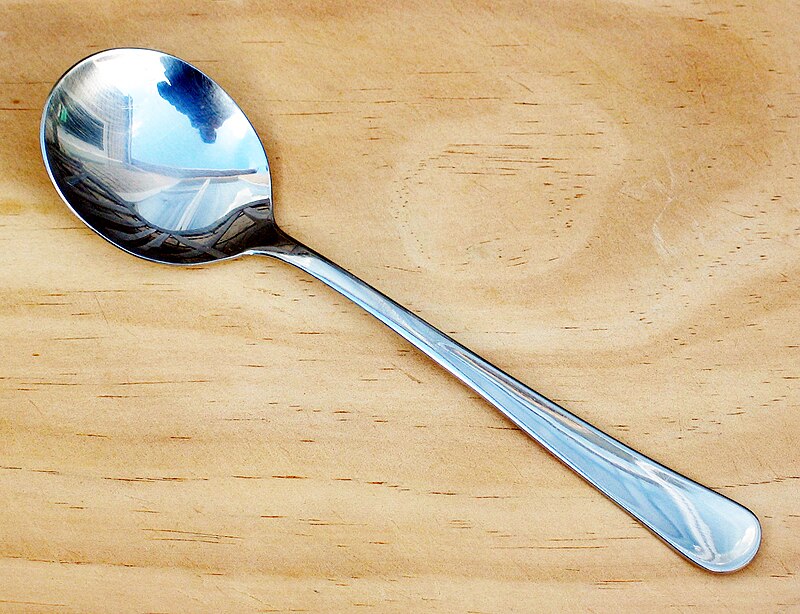
File:Soup_Spoon.jpg · Wikimedia Commons · See Wikimedia Commons
spoon
Sign in to savethumb|Stainless steel bouillon (soup) spoon thumb|Sasanian Empire|Sasanian spoon and fork (4th century) A spoon (, ) is a utensil consisting of a shallow bowl (also known as a head), oval or round, at the end of a handle. A type of cutlery (sometimes called flatware in the United States), especially as part of a place setting, it is used primarily for transferring food to the mouth (eating). Spoons are also used in food preparation to measure, mix, stir and toss ingredients and for serving food. Present day spoons are made from metal (notably stainless steel, flat silver or silverware, plated
A spoon is a utensil with a shallow bowl at the end of a handle, used primarily for eating by transferring food to the mouth, as well as for measuring, mixing, stirring, and serving food during preparation. Spoons are an important piece of cutlery found in place settings and are typically made from metal such as stainless steel or silver.
AI-generated from the Wikipedia summary — may contain errors.
Wikidata facts
- Has part
- vat
- Image
- Ngaji.jpg
Show 6 more facts
- Unicode character
- 🥄
- Commons gallery
- Spoon
- topic's main category
- Category:Spoons
- Commons category
- Spoons
- described by source
- Pauly–Wissowa
- on focus list of Wikimedia project
- Wikipedia:Vital articles/Level/4
via Wikidata · CC0
~13 min read
Encyclopedic overview
10 sectionsContents
- Terminology
- History
- Types and uses
- Language and culture
- Manufacture
- Derivatives
- See also
- Notes
- References
- External links
thumb|Stainless steel bouillon (soup) spoon thumb|Sasanian Empire|Sasanian spoon and fork (4th century) A spoon (, ) is a utensil consisting of a shallow bowl (also known as a head), oval or round, at the end of a handle. A type of cutlery (sometimes called flatware in the United States), especially as part of a place setting, it is used primarily for transferring food to the mouth (eating). Spoons are also used in food preparation to measure, mix, stir and toss ingredients and for serving food. Present day spoons are made from metal (notably stainless steel, flat silver or silverware, plated or solid), wood, porcelain or plastic. There are many different types of spoons made from different materials by different cultures for different purposes and food.
== Terminology == The spoon consists of a bowl and a handle. A handle in the shape of a slender stick is frequently called a stem. The stem can end in a sharp point or be crowned with a knop, a decorative knob. The knop-top spoons with a variety of knop shapes described by colorful terms like "acorn", "writhen-end" (spiral ornament on a ball), "maidenhead" (a bust), "diamond point," "apostle" were particularly popular in England in the 14th to 17th centuries.
Excerpted from Wikipedia’s “spoon” article, available under the CC BY-SA 4.0 licence.
Gallery (32)
Available in 138 languages
- Español
- Français
- Deutsch
- 中文
- 日本語
- Русский
- Português
- Italiano
- العربية
- हिन्दी
- Afrikaans
- Albanian
- Aragonese
- Aramaic
- Armenian
- Asturian
- Atikamekw
- Azerbaijani
Show 119 more
- Bahasa Indonesia
- Balinese
- Bangla
- Banjar
- Basque
- bat_smg
- bdr
- be_x_old
- Belarusian
- Betawi
- Bikol
- Bosnian
- Breton
- Bulgarian
- Burmese
- Catalan
- cdo
- Central Kurdish
- Chechen
- Chuvash
- Croatian
- Czech
- dag
- Danish
- Egyptian Arabic
- Erzya
- Esperanto
- Estonian
- Filipino
- Finnish
- Galician
- Gan Chinese
- Greek
- Guarani
- Haitian Creole
- Hausa
- Hebrew
- Hungarian
- Iban
- Icelandic
- Ido
- Igbo
- Irish
- Javanese
- Kabyle
- Kannada
- Kara-Kalpak
- Kazakh
- Kikuyu
- Kurdish
- Kyrgyz
- Lao
- Latin
- Latvian
- Lingua Franca Nova
- Lithuanian
- Lombard
- Luxembourgish
- Macedonian
- Malagasy
- Malay
- Malayalam
- Manx
- Marathi
- Minangkabau
- nds_nl
- Nederlands
- Nepali
- Northern Frisian
- Norwegian
- Norwegian Nynorsk
- Occitan
- Old English
- olo
- Polski
- Quechua
- roa_rup
- Romanian
- rsk
- Rundi
- Santali
- Scots
- Serbian
- Serbian (Latin)
- Sicilian
- simple
- Sindhi
- Sinhala
- Slovenian
- Somali
- Sundanese
- Svenska
- Swahili
- Tajik
- Tamil
- Telugu
- Tibetan
- Tiếng Việt
- Tulu
- Türkçe
- Tuvinian
- Tyap
- Ukrainian
- Uyghur
- Uzbek
- Venetian
- Waray
- Western Mari
- Western Panjabi
- Wolof
- Wu Chinese
- Yoruba
- Zaza
- zh_min_nan
- zh_yue
- Zhuang
- فارسی
- ไทย
- 한국어
via Wikidata sitelinks · CC0