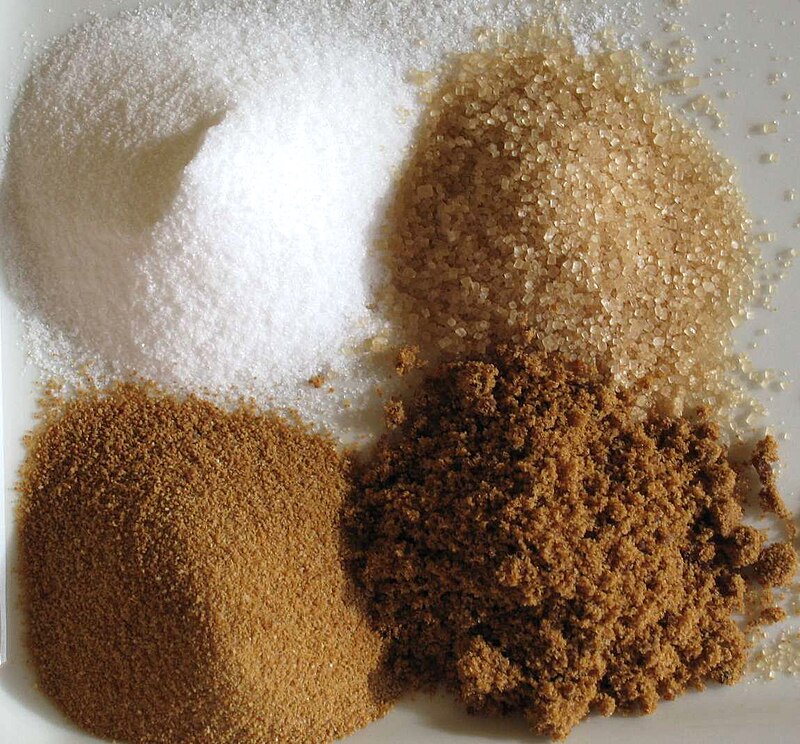
File:Sucre_blanc_cassonade_complet_rapadura.jpg · Wikimedia Commons · See Wikimedia Commons
OverviewAI-generated
Sugar is an instance of an excipient, sweetener, and commodity. It is a subclass of carbohydrate, mixture, food ingredient, and stimulant foodstuff. The term is named after the suffix -ose. Sugar is described by sources including the Brockhaus and Efron Encyclopedic Dictionary, the Explanatory Dictionary of the Living Great Russian Language, Gujin Tushu Jicheng, and the Encyclopædia Britannica 11th edition. It has the characteristic of hygroscopy.
The subject appears in the Commons category "Sugars" and the gallery "Sugar." It is on the focus list of Wikipedia:List of articles all languages should have and Wikipedia:Vital articles/Level/4. Sugar is referenced by 5,060 other encyclopedia articles. A PubMed query for sugar yields a count of 629,655. The carbon footprint of sugar is 1.8. It is different from maltose, glucose, carbohydrate, and sucrose, though it is said to be the same as carbohydrate.
Synthesized by Vinony from 16 facts across 3 sources: Wikidata, PubMed, Vinony graph. Generated from structured data (not the Wikipedia text) and checked against those facts — may still contain errors.
Research
629,655 papers- Impact of sugar on the body, brain, and behavior.ReviewFrontiers in bioscience (Landmark edition) · 2018Freeman CR, Zehra A, Ramirez V et al.DOI: 10.2741/4704
- Dietary sugar consumption and health: umbrella review.BMJ (Clinical research ed.) · 2023Huang Y, Chen Z, Chen B et al.DOI: 10.1136/bmj-2022-071609
- The Impact of Free Sugar on Human Health-A Narrative Review.ReviewNutrients · 2023Gillespie KM, Kemps E, White MJ et al.DOI: 10.3390/nu15040889
- The neural basis of sugar preference.ReviewNature reviews. Neuroscience · 2022Liu WW, Bohórquez DVDOI: 10.1038/s41583-022-00613-5
- Added Sugar and Dental Caries in Children: A Scientific Update and Future Steps.ReviewDental clinics of North America · 2019Chi DL, Scott JMDOI: 10.1016/j.cden.2018.08.003
- Sugar addiction: is it real? A narrative review.ReviewBritish journal of sports medicine · 2018DiNicolantonio JJ, O'Keefe JH, Wilson WLDOI: 10.1136/bjsports-2017-097971
- An update on sugar allocation and accumulation in fruits.ReviewPlant physiology · 2023Ren Y, Liao S, Xu YDOI: 10.1093/plphys/kiad294
- Sugar transport in thermophiles: Bridging lignocellulose deconstruction and bioconversion.ReviewJournal of industrial microbiology & biotechnology · 2024Tjo H, Conway JMDOI: 10.1093/jimb/kuae020
via PubMed
Wikidata facts
- Instance of
- commodity
- Subclass of
- colonial goods
- Named after
- -ose
- Image
- Sugar 2xmacro.jpg
- Said to be same as
- carbohydrate
Show 8 more facts
- Commons category
- Sugars
- topic's main category
- Category:Sugar
- Commons gallery
- Sugar
- has characteristic
- hygroscopy
- on focus list of Wikimedia project
- Wikipedia:Vital articles/Level/4
- different from
- sucrose
- carbon footprint
- 1.8
- exact match
- ids.clld.org/parameters/5-850
via Wikidata · CC0
Article · Deutsch
Als Zucker wird neben verschiedenen anderen Zuckerarten ein süß schmeckendes, kristallines Lebensmittel bezeichnet, das aus Pflanzen gewonnen wird und hauptsächlich aus Saccharose besteht. Hauptquellen sind Zuckerrohr (ca. 80 % der weltweiten Zuckerproduktion, Anbau in den Tropen und Subtropen) und Zuckerrübe (ca. 20 % der Zuckerproduktion weltweit, Anbau in den gemäßigten Zonen, z. B. Mitteleuropa, in den USA auch als transgene Zuckerrübe H7-1). 2018 wurden weltweit etwa 1,907 Mrd. Tonnen Zuckerrohr und 275 Mio. Tonnen Zuckerrüben produziert; die daraus jährlich gewonnene Menge an Rohzucker lag 2016 bei ca. 176 Millionen Tonnen. Hauptanbauländer für Zuckerrohr sind Brasilien, Indien, und China, für Zuckerrüben sind es Russland, Frankreich und die USA. Der durchschnittliche Zuckerkonsum lag 2021 in Deutschland bei 32,5 kg pro Kopf, was einer täglichen Menge von rund 89 Gramm entspricht. Hoher Konsum von Zucker gilt als eine der Ursachen vieler Zivilisationskrankheiten wie Fettleibigkeit, Diabetes, Karies sowie Darm-, Herz- und Gefäßkrankheiten. Sein physiologischer Brennwert beträgt 16,8 kJ oder 4,0 kcal pro Gramm (zum Vergleich: Alkohol liefert 29,8 kJ pro Gramm, Fette etwa 39 kJ pro Gramm), mit einer Dichte von 1,6 g/cm³ ist er schwerer als Wasser (1 g/cm³). (Für die Messung von Zuckermengen im Haushalt muss nicht von der Dichteangabe ausgegangen werden, sondern von der Schüttgutdichte, die geringer ausfällt. Sie liegt für Kristallzucker bzw. gekörnten Zucker zwischen 0,67 und 1,02 g/cm³.) Bei 20 °C sind 203,9 g Zucker in 100 ml Wasser löslich, bei 100 °C 487,2 g in 100 ml.
Abstract from DBpedia / Wikipedia · CC BY-SA
Gallery (26)
Available in 183 languages
- Español
- Français
- Deutsch
- 中文
- 日本語
- Русский
- Português
- Italiano
- العربية
- हिन्दी
- abstract
- Afrikaans
- Albanian
- Albanian
- Amharic
- Aragonese
- Aramaic
- Armenian
Show 164 more
- Assamese
- Asturian
- azb
- Azerbaijani
- Bahasa Indonesia
- Balinese
- Bangla
- Banjar
- Bashkir
- Basque
- bat_smg
- Bavarian
- be_x_old
- Belarusian
- Betawi
- Bhojpuri
- Bikol
- Bosnian
- Breton
- Bulgarian
- Burmese
- Catalan
- cdo
- Cebuano
- Central Kurdish
- Chechen
- Cheyenne
- Chuvash
- Cornish
- Croatian
- Czech
- Danish
- Egyptian Arabic
- Erzya
- Esperanto
- Estonian
- Extremaduran
- Faroese
- Fiji Hindi
- Fijian
- Filipino
- Finnish
- Fon
- Galician
- gcr
- Georgian
- Greek
- Guarani
- Gujarati
- Haitian Creole
- Hakka Chinese
- Hausa
- Hebrew
- Hungarian
- hyw
- Icelandic
- Ido
- Igbo
- Iloko
- Ingush
- Interlingua
- Inuktitut
- Irish
- Javanese
- Kannada
- Kashmiri
- Kazakh
- kge
- Kinyarwanda
- Kurdish
- kus
- Ladino
- Latin
- Latvian
- Limburgish
- Lingala
- Lingua Franca Nova
- Lithuanian
- Lojban
- Lombard
- Low German
- Macedonian
- Madurese
- Maithili
- Malagasy
- Malay
- Malayalam
- map_bms
- Marathi
- Minangkabau
- Mingrelian
- Moksha
- Mongolian
- nah
- Navajo
- Nederlands
- Nepali
- Newari
- Norwegian
- Norwegian Nynorsk
- nrm
- Occitan
- Odia
- Old English
- Ossetic
- Pashto
- Polski
- Punjabi
- Quechua
- rki
- roa_rup
- Romanian
- Rundi
- Rusyn
- Sanskrit
- Santali
- Scots
- Scottish Gaelic
- Serbian
- Serbian (Latin)
- Shona
- Sicilian
- simple
- Sindhi
- Sinhala
- Slovak
- Slovenian
- Somali
- Sundanese
- Svenska
- Swahili
- Tajik
- Talysh
- Tamil
- Tatar
- Telugu
- Tiếng Việt
- Toki Pona
- Türkçe
- Ukrainian
- Urdu
- Uyghur
- Uzbek
- Venetian
- Veps
- Walloon
- Waray
- Wayuu
- Welsh
- West Flemish
- Western Frisian
- Western Panjabi
- Wolof
- Wu Chinese
- Yakut
- Yiddish
- Yoruba
- zh_min_nan
- zh_yue
- Zhuang
- Zulu
- فارسی
- ไทย
- 한국어
via Wikidata sitelinks · CC0