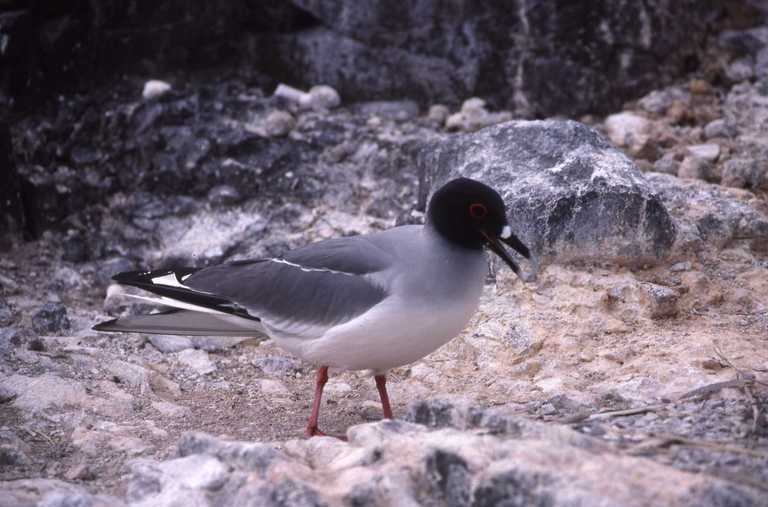
Encyclopedia of Life · EOL (see source)
OverviewAI-generated
The Swallow-tailed Gull, scientifically named *Creagrus furcatus*, is a species of bird within the family Laridae. It belongs to the order Charadriiformes, class Aves, and phylum Chordata. The species is classified under the genus *Creagrus* and was described by Néboux in 1842. Its taxonomic status is accepted, and it is also referred to by the common names gwylan y Galapagos, Gabelschwanzmöwe, and Gaviota tijereta.
This gull has a wingspan of 131.5 and inhabits marine environments. Its range is located in South America. The IUCN Red List assessed the species as Least Concern in 2018.
Synthesized by Vinony from 23 facts across 4 sources: Wikidata, WoRMS, IUCN Red List, Vinony graph. Generated from structured data (not the Wikipedia text) and checked against those facts — may still contain errors.
Species
Least Concernswallow-tailed gull
Species
- PhylumChordata
- ClassAves
- OrderCharadriiformes
- FamilyLaridae
Die Gabelschwanzmöwe (Creagrus furcatus) ist eine 55–60 Zentimeter große nachtaktive Möwenart, die in Südamerika vertreten ist. Inhaltsverzeichnis 1 Beschreibung 2 Verbreitung 3 Lebensweise 4 Fortpflanzung 5 Etymologie und Forschungsgeschichte 6 Gefährdung und Schutzmaßnahmen 7 Literatur 8 Weblinks 9 Einzelnachweise Beschreibung Die Gabelschwanzmöwe hat ein graues Gefieder. Kopf, Schnabel und Schwanz sind schwarz. Der Hals, Bauch und Schnabelspitze und -ansatz sind weiß, Beine und Schwimmfüße rot. Sie hat einen roten Ring um die Augen, wodurch diese größer erscheinen. Das Schwanzende ist geteilt wie eine Gabel. Verbreitung Die Gabelschwanzmöwe kommt auf den Galapagosinseln und in Kolumbien, Ecuador und im Süden von Peru vor. Zum Überwintern zieht sie auf die Inseln im Nordwesten Südamerikas. Es soll etwa 30.000 Tiere geben. Lebensweise Sie jagt nachts in kleineren Schwärmen auf Meer und hält sich tagsüber bei ihrem Nest an der Küste auf. Die Jagdintensität ist bei Neumond besonders hoch und damit abhängig vom Mondzyklus.[1] Als Anpassung an die nächtlichen Verhältnisse sind die großen Augen der Vögel besonders lichtempfindlich.[1] Bei ihren Jagdausflügen überwindet sie Entfernungen
via IUCN
Wikidata facts
Show 9 more facts
- taxon rank
- species
- IUCN conservation status
- Least Concern
- taxon name
- Creagrus furcatus
- Commons category
- Creagrus furcatus
- Commons gallery
- Creagrus furcatus
- taxon common name
- galapagoski galeb
- wingspan
- 131.5
- short name
- C. furcatus
- taxon range
- South America
via Wikidata · CC0
~6 min read
Encyclopedic overview
The swallow-tailed gull (Creagrus furcatus) is an equatorial seabird in the gull family, Laridae. It is the only species in the genus Creagrus, which derives from the Latin Creagra and the Greek kreourgos which means butcher, also from kreas, meat; according to Jobling it would mean "hook for meat" referring to the hooked bill of this species. It was first described by French naturalist and surgeon Adolphe-Simon Neboux in 1846. Its scientific name is originally derived from the Greek word for gull, "Glaros" and via Latin Larus, "gull" and furca "two-tined fork". It spends most of its life flying and hunting over the open ocean. The main breeding location is in the Galápagos Islands, particularly the rocky shores and cliffs of Hood, Tower and Wolf Islands, with lower numbers on most of the other islands. It is more common on the eastern islands where the water is warmer.
It is the only fully nocturnal gull and seabird in the world, preying on squid and small fish which rise to the surface at night to feed on plankton.
Excerpted from Wikipedia’s “Swallow-tailed Gull” article, available under the CC BY-SA 4.0 licence.