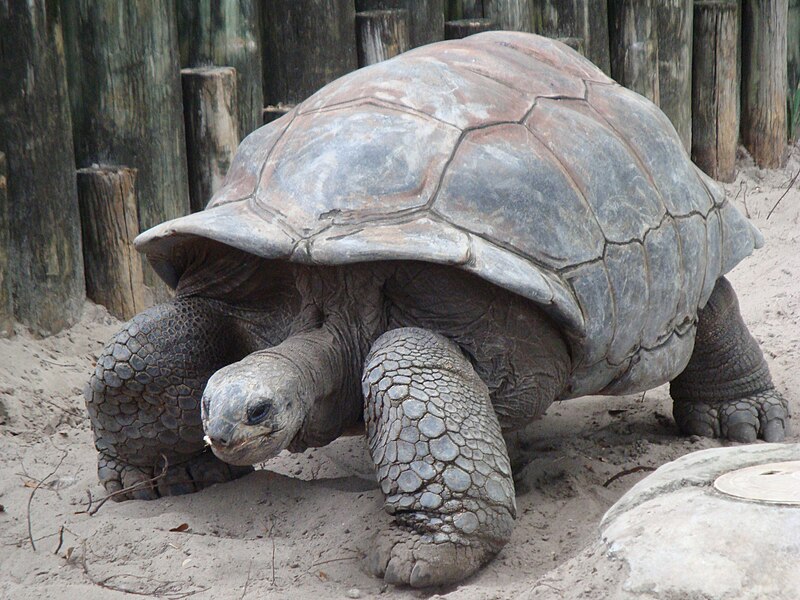
File:A._gigantea_Aldabra_Giant_Tortoise.jpg · Wikimedia Commons · See Wikimedia Commons
Testudinidae
Sign in to saveAlso known as tortoises, tortoise, testudinids, testudinid
Tortoises ( ) are reptiles of the family Testudinidae of the order Testudines (Latin for "tortoise"). Like other testudines, tortoises have a shell to protect from predation and other threats. The shell in tortoises is generally hard, and like other members of the suborder Cryptodira, they retract their necks and heads directly backward into the shell to protect them.
OverviewAI-generated
Testudinidae is a family of reptiles within the class Testudines and phylum Chordata. The taxon is classified under the order Testudines and the suborder Cryptodira. Its scientific name was established by Batsch in 1788, and the family is governed by the International Code of Zoological Nomenclature. Common names for the group include landskilpadder, kopenske želve, and tortues terrestres.
The family has an accepted status in taxonomic databases. While the habitat is listed as freshwater, the group is commonly associated with tortoises. Records of the family are held by institutions such as USNM, CM, UTEP, and SDNHM, with occurrences documented in the United States. The taxon has been described in the Encyclopædia Britannica 11th edition and is included in the Wikipedia Vital Articles list at Level 4.
Synthesized by Vinony from 33 facts across 6 sources: Wikidata, GBIF, Gbif Occ, WoRMS, iDigBio, Vinony graph. Generated from structured data (not the Wikipedia text) and checked against those facts — may still contain errors.
Species
Testudinidae
FAMILY
- KingdomAnimalia
- PhylumChordata
- ClassTestudines
- OrderTestudines
- FamilyTestudinidae
陸龜是龜鱉目(Testudinidae)的陸生爬行動物,是種獨居動物。像牠們的遠親海龜一樣,陸龜以龜殼保護自身,免受獵食者襲擊。龜殼的頂部為龜甲,底部為龜板。陸龜同時擁有內骨骼與外骨骼,其體形由數公分至兩米不等。陸龜是晝行動物,通常在黃昏時分活动。 陸龜共有11屬40種(或42種)。除大洋洲和南極洲外,其他各大洲均有分佈。
via GBIF
Museum specimens
- Specimen records
- 2,297
- With media
- 38
- Family
- Testudinidae
- Collections
- USNM, CM, UTEP, SDNHM
- Recorded in
- United States
Wikidata facts
- Instance of
- taxon
- Parent taxon
- Testudinoidea
- Image
- Testudo graeca.jpg
Show 9 more facts
- Commons category
- Testudinidae
- taxon rank
- family
- taxon name
- Testudinidae
- Code of nomenclature
- International Code of Zoological Nomenclature
- topic's main category
- Category:Tortoises
- Commons gallery
- Testudinidae
- taxon common name
- tortues terrestres
- on focus list of Wikimedia project
- Wikipedia:Vital articles/Level/4
- described by source
- Encyclopædia Britannica 11th edition
Sources (3)
via Wikidata · CC0
~22 min read
Encyclopedic overview
16 sectionsContents
- Terminology
- Biology
- Life cycle
- Dimorphism
- Brain
- Distribution
- Diet
- Behavior
- Taxonomy
- Phylogeny
- In human culture
- Gallery
- See also
- References
- Further reading
- External links
Tortoises ( ) are reptiles of the family Testudinidae of the order Testudines (Latin for "tortoise"). Like other testudines, tortoises have a shell to protect from predation and other threats. The shell in tortoises is generally hard, and like other members of the suborder Cryptodira, they retract their necks and heads directly backward into the shell to protect them.
Tortoises can vary in size with some species, such as the Galápagos giant tortoise, growing to more than in length, whereas others like the speckled Cape tortoise have shells that measure only long. Several lineages of tortoises have independently evolved very large body sizes in excess of , including the Galapagos giant tortoise and the Aldabra giant tortoise. They are usually diurnal animals with tendencies to be crepuscular depending on the ambient temperatures. They are generally reclusive animals. Tortoises are the longest-living land animals in the world, although the longest-living species of tortoise is a matter of debate. Galápagos tortoises are noted to live over 150 years, but an Aldabra giant tortoise named Adwaita may have lived an estimated 255 years. In general, most tortoise species can live 80–150 years. Tortoises are typically slow-moving.
Excerpted from Wikipedia’s “Testudinidae” article, available under the CC BY-SA 4.0 licence.
Gallery (56)
Available in 96 languages
- Español
- Français
- Deutsch
- 中文
- 日本語
- Русский
- Português
- Italiano
- العربية
- हिन्दी
- Afrikaans
- Assamese
- Asturian
- Azerbaijani
- Bahasa Indonesia
- Bangla
- Basque
- Belarusian
Show 77 more
- Bislama
- Breton
- Bulgarian
- Burmese
- Catalan
- Cebuano
- Central Kurdish
- Cornish
- Croatian
- Czech
- Egyptian Arabic
- Esperanto
- Estonian
- Faroese
- Filipino
- Finnish
- Galician
- Georgian
- Greek
- Hausa
- Hebrew
- Hungarian
- Irish
- kai
- Kannada
- Kashmiri
- Kazakh
- Kikuyu
- Kurdish
- Latin
- Latvian
- Lithuanian
- Luxembourgish
- Maithili
- Malagasy
- Malay
- Mongolian
- Navajo
- Nederlands
- Nepali
- Newari
- Norwegian
- Old English
- Polski
- Punjabi
- Romanian
- Sanskrit
- Scots
- Scottish Gaelic
- Serbian
- Serbian (Latin)
- Shona
- simple
- Sindhi
- Sinhala
- Slovak
- Slovenian
- Somali
- Svenska
- Tamil
- Telugu
- Tibetan
- Tiếng Việt
- Tulu
- Türkçe
- Tyap
- Ukrainian
- Waray
- Welsh
- Western Panjabi
- Wu Chinese
- Xhosa
- Yoruba
- zh_yue
- فارسی
- ไทย
- 한국어
via Wikidata sitelinks · CC0