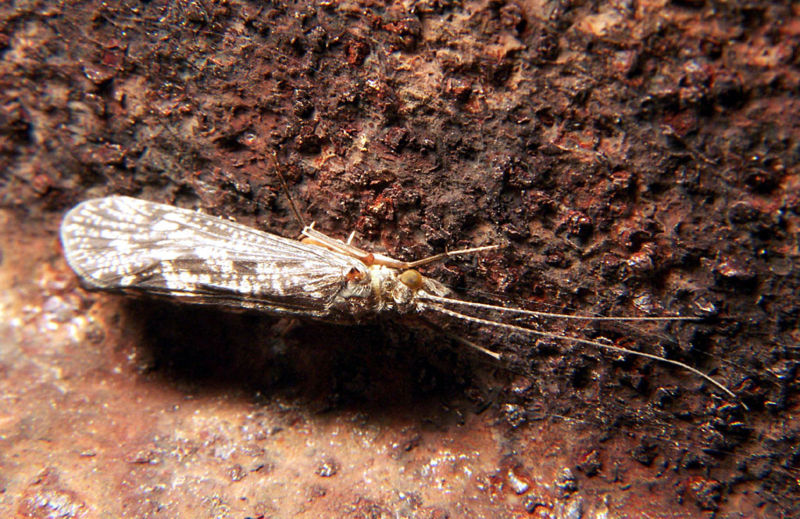
File:Trichoptera_caddisfly_1.jpg · Wikimedia Commons · See Wikimedia Commons
Trichoptera
Sign in to saveAlso known as caddisfly, sedge-flies, rail-flies
The caddisflies (order Trichoptera) are a group of insects with aquatic larvae and terrestrial adults. There are approximately 14,500 described species, most of which can be divided into the suborders Integripalpia and Annulipalpia on the basis of the adult mouthparts. Integripalpian larvae construct a portable casing to protect themselves as they move around looking for food, while annulipalpian larvae make themselves a fixed retreat in which they remain, waiting for food to come to them. The affinities of the small third suborder Spicipalpia are unclear, and molecular analysis suggests it ma
OverviewAI-generated
Trichoptera is an order of insects within the class Insecta, phylum Arthropoda, and kingdom Animalia. Commonly known as caddisflies, this taxon is accepted at the order rank. The group inhabits both marine and freshwater environments.
Records for Trichoptera are held by several institutions, including LACM, USNM, YPM, VMNH, and NHMUK. Specimens have been documented in Germany, the United States, and the United Kingdom. The family trichoceridae is associated with these records.
The taxon has a total occurrence count of 3,740,966. Additionally, there are 44,927 records and 63,158 media items available. The subject is referenced by 1,089 other encyclopedia articles.
Synthesized by Vinony from 25 facts across 6 sources: Wikidata, GBIF, Gbif Occ, WoRMS, iDigBio, Vinony graph. Generated from structured data (not the Wikipedia text) and checked against those facts — may still contain errors.
Species
caddisflies
Trichoptera
ORDER
- KingdomAnimalia
- PhylumArthropoda
- ClassInsecta
- OrderTrichoptera
via GBIF
Museum specimens
- Specimen records
- 44,927
- With media
- 63,158
- Family
- Trichoceridae
- Collections
- LACM, USNM, YPM, VMNH, NHMUK
- Recorded in
- Germany, United States, United Kingdom
Wikidata facts
- Instance of
- taxon
- Parent taxon
- Amphiesmenoptera
- Image
- Lepidostoma.hirtum.jpg
Show 9 more facts
- taxon rank
- order
- Commons category
- Trichoptera
- taxon name
- Trichoptera
- topic's main category
- Category:Trichoptera
- described by source
- Granat Encyclopedic Dictionary
- Commons gallery
- Trichoptera
- taxon common name
- Schietmotten
- different from
- Tulari
- on focus list of Wikimedia project
- Wikipedia:Vital articles/Level/4
via Wikidata · CC0
~21 min read
Encyclopedic overview
22 sectionsContents
- Etymology
- Evolution and phylogeny
- Fossil history
- Evolution
- Phylogeny
- Distribution
- Ecology
- Underwater structures
- Cases
- Fixed retreats
- Silk domes
- Nets
- Development and morphology
- Relationship with humans
- In angling
- As bioindicators
- In art
- As food
- Taxonomy
- References
- Further reading
- External links
The caddisflies (order Trichoptera) are a group of insects with aquatic larvae and terrestrial adults. There are approximately 14,500 described species, most of which can be divided into the suborders Integripalpia and Annulipalpia on the basis of the adult mouthparts. Integripalpian larvae construct a portable casing to protect themselves as they move around looking for food, while annulipalpian larvae make themselves a fixed retreat in which they remain, waiting for food to come to them. The affinities of the small third suborder Spicipalpia are unclear, and molecular analysis suggests it may not be monophyletic. Also called sedge-flies or rail-flies, the adults are small moth-like insects with two pairs of hairy membranous wings. They are closely related to the Lepidoptera (moths and butterflies) which have scales on their wings; the two orders together form the superorder Amphiesmenoptera.
The aquatic larvae are found in a wide variety of habitats such as streams, rivers, lakes, ponds, spring seeps and temporary waters (vernal pools), and even the ocean. The larvae of many species use silk to make protective cases, which are often strengthened with gravel, sand, twigs, bitten-off pieces of plants, or other debris. The larvae exhibit various feeding strategies, with different species being predators, leaf shredders, algal grazers, or collectors of particles from the water column and benthos. Most adults have short lives during which they do not feed.
Excerpted from Wikipedia’s “Trichoptera” article, available under the CC BY-SA 4.0 licence.
Gallery (47)
Available in 69 languages
- Español
- Français
- Deutsch
- 中文
- 日本語
- Русский
- Português
- Italiano
- العربية
- हिन्दी
- Afrikaans
- Asturian
- Azerbaijani
- Bahasa Indonesia
- Bashkir
- Basque
- bat_smg
- Belarusian
Show 50 more
- Bosnian
- Bulgarian
- Catalan
- Cebuano
- Croatian
- Czech
- Danish
- Egyptian Arabic
- Esperanto
- Estonian
- Finnish
- Galician
- Georgian
- Greek
- Hebrew
- Hungarian
- Kabyle
- Kazakh
- Kyrgyz
- Latin
- Latvian
- Lithuanian
- Macedonian
- Malay
- Malayalam
- Navajo
- Nederlands
- Northern Frisian
- Norwegian
- Norwegian Nynorsk
- Polski
- Romanian
- Serbian
- simple
- Slovak
- Slovenian
- Svenska
- Swahili
- Tatar
- Tiếng Việt
- Türkçe
- Ukrainian
- Urdu
- Uzbek
- Waray
- Wu Chinese
- zh_yue
- فارسی
- ไทย
- 한국어
via Wikidata sitelinks · CC0