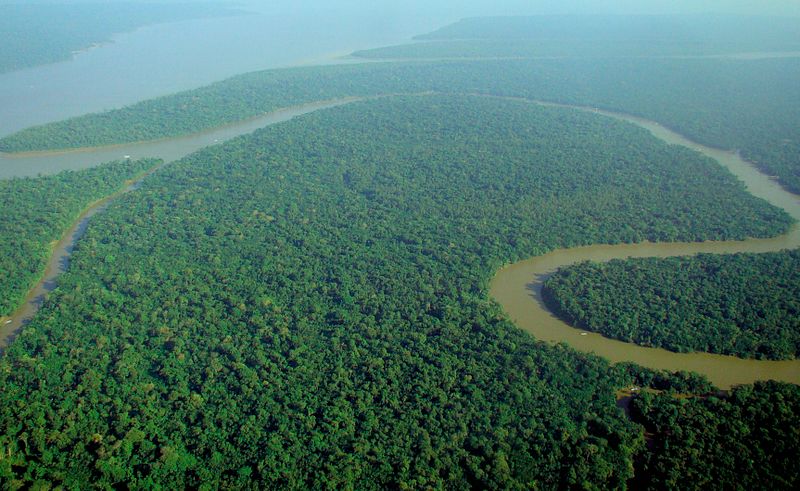
File:Aerial_view_of_the_Amazon_Rainforest.jpg · Wikimedia Commons · See Wikimedia Commons
A tropical forest is a dense ecosystem found in warm regions near the equator, characterized by high rainfall and year-round warm temperatures that support an incredible diversity of plants and animals. These forests matter because they play a crucial role in regulating Earth's climate, producing oxygen, storing carbon, and providing habitat for more species than any other terrestrial ecosystem on the planet.
AI-generated from the Wikipedia summary — may contain errors.
Wikidata facts
- Subclass of
- rainforest
- Image
- Forest on Barro Colorado.png
Show 2 more facts
- topic's main category
- Category:Tropical rainforests
- Commons category
- Tropical rainforests
Sources (2)
via Wikidata · CC0
~32 min read
Encyclopedic overview
An area of the Amazon rainforest in Brazil. The tropical rainforests of South America contain the largest diversity of species on Earth. Tropical rainforest climate zones (Af). Tropical forests: from the UN FRA2000 report
Tropical rainforests are dense and warm rainforests with high rainfall typically found between 10° north and south of the Equator. They are a subset of the tropical forest biome that occurs roughly within the 28° latitudes (in the torrid zone between the Tropic of Cancer and Tropic of Capricorn). Tropical rainforests are a type of tropical moist broadleaf forest, that includes the more extensive seasonal tropical forests. True rainforests usually occur in tropical rainforest climates where no dry season occurs; all months have an average precipitation of at least 60 mm (2.4 in). Seasonal tropical forests with tropical monsoon or savanna climates are sometimes included in the broader definition.
Excerpted from Wikipedia’s “tropical forest” article, available under the CC BY-SA 4.0 licence.
Gallery (12)
Available in 67 languages
- Español
- Deutsch
- 中文
- 日本語
- Русский
- Português
- Italiano
- العربية
- हिन्दी
- Afrikaans
- Albanian
- Aragonese
- Asturian
- Bahasa Indonesia
- Balinese
- Bangla
- Basque
- Belarusian
Show 48 more
- Bosnian
- Breton
- Bulgarian
- Catalan
- Chechen
- Croatian
- Czech
- Esperanto
- Finnish
- Friulian
- Galician
- Greek
- Haitian Creole
- Hausa
- Hebrew
- Hungarian
- Ido
- Interlingua
- Javanese
- Kannada
- Kyrgyz
- Latvian
- Lithuanian
- Macedonian
- Malay
- Nederlands
- Northern Frisian
- Norwegian
- Norwegian Nynorsk
- Oromo
- Polski
- Romanian
- Sardinian
- Serbian
- Serbian (Latin)
- Sinhala
- Slovenian
- Tamil
- Tatar
- Tiếng Việt
- Türkçe
- Ukrainian
- Western Frisian
- Wu Chinese
- zh_yue
- فارسی
- ไทย
- 한국어
via Wikidata sitelinks · CC0