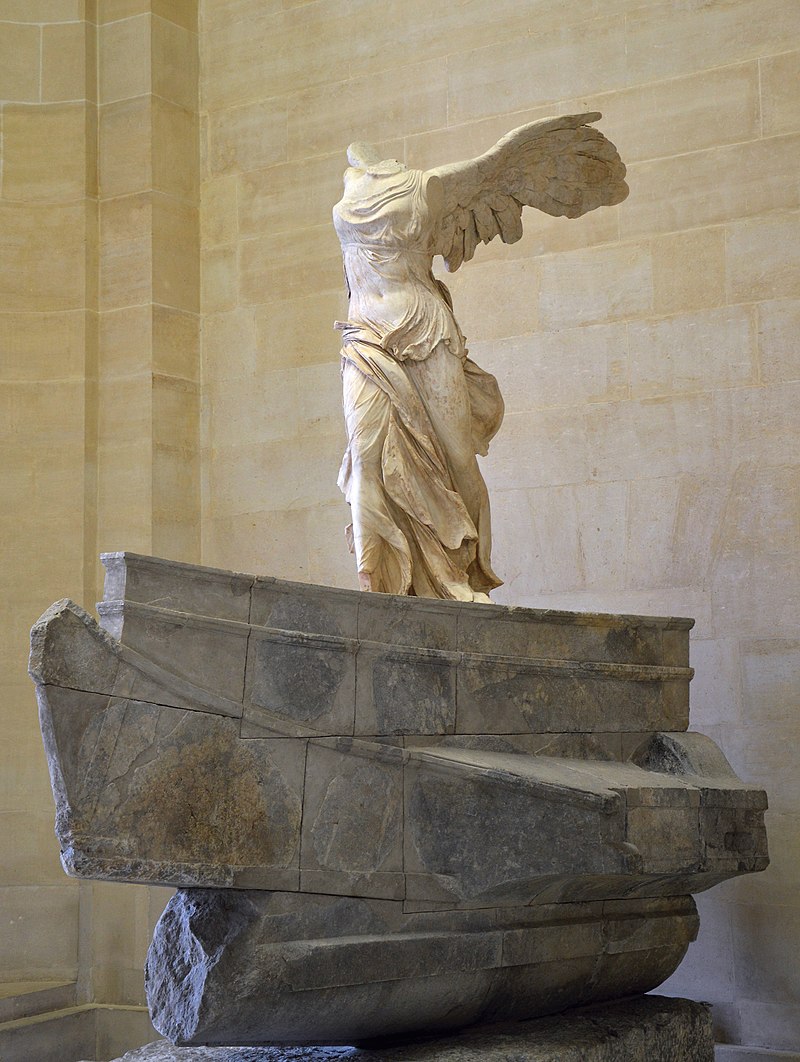
Winged Victory of Samothrace
Also known as Victory of Samothrace, Nike of Samothrace, Winged Nike of Samothrace, Winged Victory, Winged Victory of Samothrace (Nike of Samothrace), Winged Victory of Samothrace
statue from Samothrace, Greece in the Louvre, Paris, France
AI overview
The Winged Victory of Samothrace is an ancient Greek statue now displayed in the Louvre in Paris that depicts a winged female figure, likely created around 190 BCE. It is considered one of the most celebrated examples of Greek sculpture and remains famous for its dynamic composition and the skillful way the artist captured the appearance of movement.
AI-generated from the Wikipedia summary — may contain errors.
Key facts
- Year
- c. 200–190 BC
- Type
- Parian marble
- Dimensions
- 244 cm (96 in)
- Location
- Louvre , Paris
via Wikipedia infobox
Wikidata facts
- Image
- La victoire de Samothrace au Louvre.jpg
- Height
- 245
Show 5 more facts
- described at URL
- www.louvre.fr/zh/oeuvre-notices/《萨莫色雷斯岛的胜利女神》雕像
- inventory number
- Ma 2369
- Commons category
- Nike of Samothrace
- inception
~30 min read
Article
The Winged Victory of Samothrace, or the Nike of Samothrace, is a votive monument originally discovered on the island of Samothrace in the northeastern Aegean Sea. It is a masterpiece of Greek sculpture from the Hellenistic era, dating from the beginning of the 2nd century BC (190 BC). It is composed of a statue representing the goddess Nike (Victory), whose head and arms are missing, and a base in the shape of a ship's bow.
The total height of the monument is 5.57 metres (18 ft 3 in) including the socle; the statue alone measures 2.75 metres (9 ft 0 in). The sculpture is one of a small number of major Hellenistic statues surviving in the original, rather than Roman copies.
Gallery (12)
Connections
Categories
1863 archaeological discoveries2nd-century BC Greek sculpturesAncient Greek and Roman sculptures in the LouvreAncient SamothraceArchaeological discoveries in the Aegean IslandsArt and cultural repatriationGreek artifacts outside GreeceHellenistic sculptureMarble sculptures in FranceSculptures of NikeSculptures of shipsSculptures of women in Paris