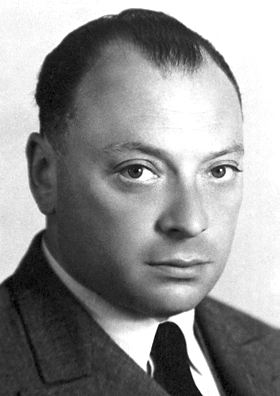
File:Pauli.jpg · Wikimedia Commons · See Wikimedia Commons
Wolfgang Pauli
Sign in to saveAlso known as Wolfgang Ernst Pauli
physicist, Nobel prize winner (1900–1958)
OverviewAI-generated
Wolfgang Pauli was a physicist born on April 25, 1900, and died on December 15, 1958. He received one Nobel Prize. His Erdős number is 3.
His work is recognized in several collections. These include the Royal Society collection, the Nobel Laureates collection, the Nobel Physics collection, and the American Academy Arts Sciences collection.
Synthesized by Vinony from 9 facts across 3 sources: Wikidata, Nobel Prize, Vinony collections. Generated from structured data (not the Wikipedia text) and checked against those facts — may still contain errors.
Nobel Prize
- The Nobel Prize in Physics1945
“for the discovery of the Exclusion Principle, also called the Pauli Principle”
Wikidata facts
- Instance of
- human
- Given name
- Ernst
- Gender
- male
- Citizenship
- Austria
- Place of birth
- Vienna
- Place of death
- Zurich
- Sibling
- Hertha Pauli
- Occupation
- physicist
- Educated at
- Bundesgymnasium Döbling
- Employer
- ETH Zurich
- Languages spoken
- English language
- Native language
- German
- Religion
- Catholicism
- Doctoral advisor
- Arnold Sommerfeld
- Student of
- Max Born
- Doctoral student
- Igal Talmi
- Field of work
- particle physics
- Image
- ETH-BIB-Pauli, Wolfgang.tif
Show 19 more facts
- member of
- Accademia Nazionale dei Lincei
- Commons category
- Wolfgang Pauli
- cause of death
- pancreatic cancer
- birth name
- Wolfgang Ernst Pauli
- date of birth
- 1900-04-25
- date of death
- 1958-12-15
- on focus list of Wikimedia project
- Wikipedia:Vital articles/Level/4
- different from
- Wolfgang Paul
- student
- Hans Frauenfelder
- Erdős number
- 3
- manner of death
- natural causes
- Commons gallery
- Wolfgang Pauli
- nominated for
- Nobel Prize in Physics
- name in native language
- Wolfgang Ernst Pauli
- lifestyle
- mysticism
- maintained by WikiProject
- WikiProject Mathematics
- interested in
- physics
- municipal affiliation of a Swiss national
- Zollikon
Sources (6)
via Wikidata · CC0
~19 min read
Encyclopedic overview
Wolfgang Ernst Pauli (25 April 1900 – 15 December 1958) was an Austrian–Swiss theoretical physicist and a pioneer of quantum mechanics. In 1945, after having been nominated by Albert Einstein, Pauli received the Nobel Prize in Physics "for the discovery of the Exclusion Principle, also called the Pauli Principle". The discovery involved spin theory, which is the basis of a theory of the structure of matter.
To preserve the conservation of energy in beta decay, Pauli proposed the existence of a small neutral particle, dubbed the "neutrino" by Enrico Fermi, in 1930. Neutrinos were first detected in 1956.
Excerpted from Wikipedia’s “Wolfgang Pauli” article, available under the CC BY-SA 4.0 licence.
Gallery (5)
Available in 93 languages
- Español
- Français
- Deutsch
- 中文
- 日本語
- Русский
- Português
- Italiano
- العربية
- हिन्दी
- Afrikaans
- Armenian
- Asturian
- azb
- Azerbaijani
- Bahasa Indonesia
- Bangla
- Basque
Show 74 more
- be_x_old
- Belarusian
- Bosnian
- Bulgarian
- Catalan
- Central Kurdish
- Croatian
- Czech
- Danish
- Egyptian Arabic
- Esperanto
- Estonian
- Filipino
- Finnish
- Galician
- Georgian
- Greek
- Gujarati
- Haitian Creole
- Hakka Chinese
- Hebrew
- Hungarian
- Ido
- Irish
- Kannada
- Kazakh
- Kurdish
- Latin
- Latvian
- Lithuanian
- Macedonian
- Malagasy
- Malay
- Malayalam
- Marathi
- Mazanderani
- Mingrelian
- Mongolian
- Nederlands
- Newari
- Norwegian
- Norwegian Nynorsk
- Occitan
- Piedmontese
- Polski
- Quechua
- Romanian
- Sanskrit
- Scots
- Serbian
- Serbian (Latin)
- Sicilian
- simple
- Slovak
- Slovenian
- Svenska
- Swahili
- szy
- Tamil
- Tatar
- Tiếng Việt
- Türkçe
- Ukrainian
- Urdu
- Uzbek
- Waray
- Western Panjabi
- Wu Chinese
- Yoruba
- zh_min_nan
- zh_yue
- فارسی
- ไทย
- 한국어
via Wikidata sitelinks · CC0